
How to Choose a Tokyo Head-Spa Experience Without the Guesswork
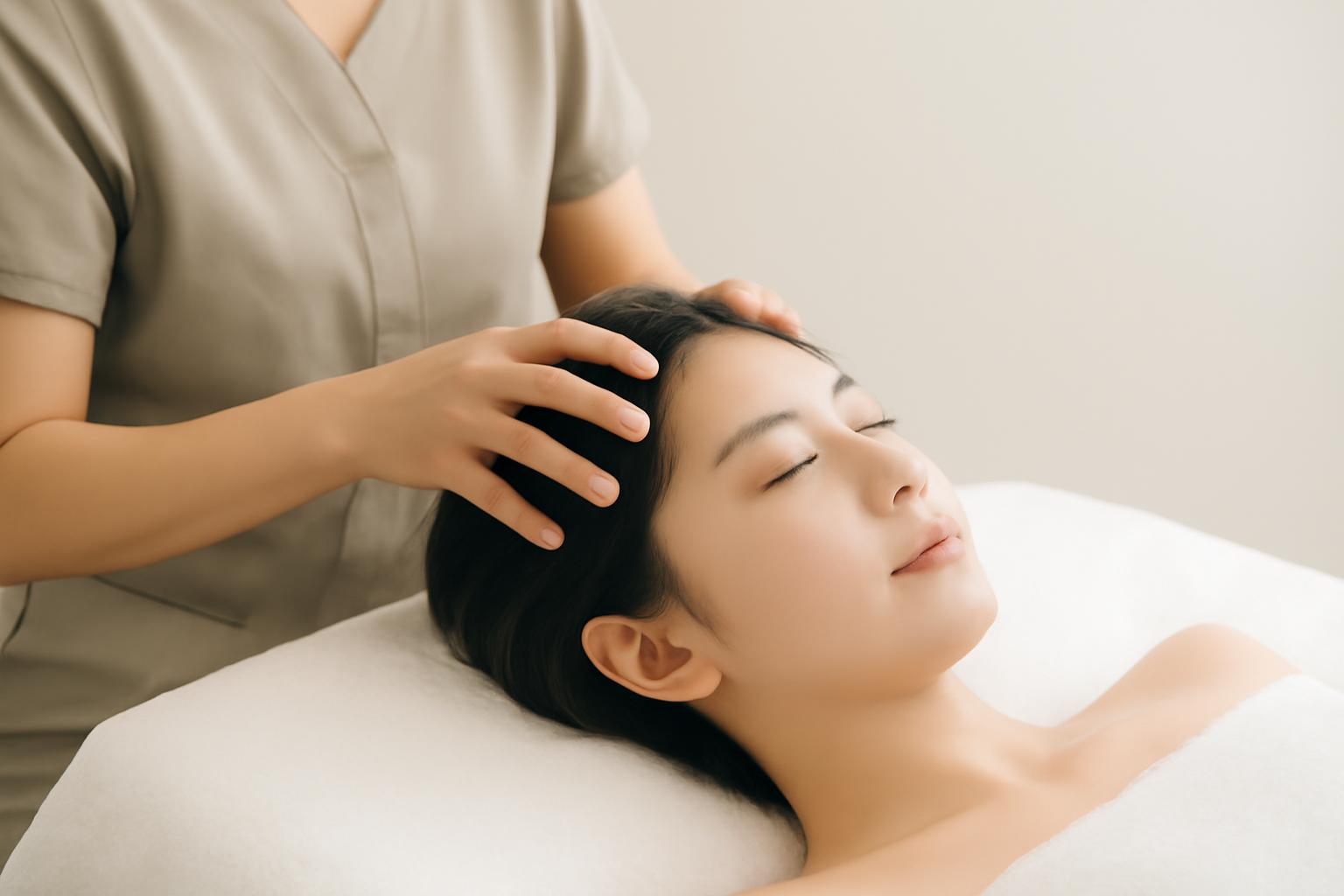
A "massage" can mean either a short dry appointment or just one element within a broader wet salon treatment with several other steps.
A Japanese head massage generally emphasizes manual pressure on the scalp and may extend to the temples, neck, or shoulders. A Japanese head spa is usually broader: it may combine massage with consultation, shampooing, scalp cleansing, exfoliation, steam, conditioning, rinsing, and hair drying or styling.
The important word is may. The available evidence does not establish one standardized Japanese protocol. One Tokyo salon may use “head spa” for a focused shampoo and scalp massage, while another may offer a long ritual involving aromatherapy, facial care, imaging, devices, and a blowout.
For travelers, the clearest way to compare services is to look past evocative package names and answer five practical questions:
- Is the treatment dry or wet?
- What steps are actually included?
- How much time involves hands-on scalp massage?
- What will happen to your hair afterward?
- What is the total payable price?
Provider details, prices, locations, language support, and booking methods cited below were reviewed on July 30, 2026. A page-access date confirms what the source published at that time; it is not a guarantee that the information will remain current.
Japanese head massage, head spa, and shampoo massage: what the terms mean
A Japanese head massage is usually the simplest concept: pressure, kneading, circular movements, or rhythmic touch focused on the scalp. Depending on the provider, the practitioner may also work around the hairline, temples, neck, shoulders, or upper back.
A Japanese head spa generally refers to a more elaborate scalp-and-hair service. It may begin with a consultation or visual scalp inspection, continue through shampooing and massage, and finish with conditioning, rinsing, drying, or styling. Exfoliation, steam, warm towels, aromatherapy, masks, and customized products are possible additions rather than defining requirements.
A shampoo massage can be narrower than either. It may simply combine shampooing with pressure or massage at the basin. Hayato Salons, for example, describes its proprietary service as a combination of shampooing and acupressure. That illustrates one salon group’s approach, not a universal Japanese method. Its site also says the group has English- and Japanese-speaking stylists; the claim was checked on the official site on July 30, 2026, but availability still needs to be confirmed for the specific Tokyo appointment. See Hayato Salons’ shampoo-massage description.
The terminology is therefore only a starting point. A “massage” could be a short dry appointment or one element of a wet salon treatment. A “head spa” could mean a practical wash-and-massage service or an extended sensory ritual. Japanese-inspired branding alone does not establish the practitioner’s training, the service’s historical lineage, or its quality.
| Service label | Water used? | Common components | Likely hair condition afterward |
|---|---|---|---|
| Dry head massage | No | Scalp pressure, kneading, sensory tools, possible neck or shoulder massage | Dry, but potentially flattened, tousled, or oily if products are used |
| Basic wet head spa | Yes | Consultation, shampoo or pre-cleanse, scalp massage, rinse, conditioner or scalp treatment | Wet, towel-dried, or lightly blow-dried, depending on the salon |
| Extended wet ritual | Yes | Cleansing, massage, exfoliation, steam or mist, masks, conditioning, optional facial or upper-body care, drying or styling | Anything from towel-dried to professionally styled |
| Shampoo massage | Yes | Shampooing combined with acupressure or manual scalp massage | Rinsed; drying and styling depend on the wider appointment |
Steam, scalp cameras, water halos, head baths, aromatherapy, gua sha, clay, micro-bubbles, red light, ultrasound, and facial treatments are all optional. None is required for a service to be marketed as a Japanese head massage or head spa.
That variation matters. If you want a shampoo and professional blowout, a dry massage will not meet the brief. If you mainly want quiet scalp pressure after a long flight, paying for imaging, facial care, devices, and several masks may add time without improving the part you value.
Dry or wet? Choose the service that matches your goal
A dry head massage uses no shampoo or water-based scalp treatment. The appointment focuses on touch applied through dry hair.
This format may suit you when you:
- prioritize massage and relaxation over cleansing;
- have limited time;
- want to avoid leaving with wet hair;
- prefer not to use multiple shampoos or treatment products;
- want to reduce disruption to your hairstyle.
Avoiding water does not guarantee that an existing style will remain intact.
A wet head spa normally involves cleansing and rinsing. A basic version may include consultation, shampooing, scalp massage, conditioner, and a simple dry. That may be enough for a traveler who wants a thorough wash and relaxing massage without paying for facial care or device-based additions.
Longer wet packages are generally more experience-led. They may add exfoliation, steam, aromatherapy, masks, warm towels, neck-and-shoulder massage, facial cleansing, hand massage, or styling. These additions may make the appointment more immersive, but they are not evidence of greater medical effectiveness.
Use this decision tree before opening a booking page:
-
Do you want your hair washed? - No: Start with dry head-massage listings. - Yes: Look for a wet head spa, shampoo massage, or scalp treatment.
-
Do you want styling afterward? - No: Towel drying, self-service drying, or a basic rough-dry may be acceptable. - Yes: Confirm whether “blow-dry” means moisture removal, a mini style, or a full professional blowout.
-
How much time do you have? - Under an hour: Compare dry massages, shampoo massages, and basic wet treatments. - About one to two hours: Compare standard wet rituals. - More than two hours: Check whether the extra time is spent on scalp massage, facial care, devices, or styling.
-
Are premium additions important to you? - No: Choose the simplest package containing the wash, massage, treatment, and finish you want. - Yes: Compare the precise additions and ask whether any can be omitted.
Do not infer depth from names such as Zen, Royal, Diamond, or Elite. These are provider-specific marketing categories, not shared service levels. Compare the listed sequence and ask how many minutes involve hands-on scalp massage. A 90-minute appointment that includes intake, facial care, steam, imaging, devices, and drying may contain less scalp massage than a simpler 60-minute service.
Also distinguish treatment time from total appointment time. Consultation, changing, scalp photography, product selection, drying, and payment may be included in the advertised duration—or may extend beyond it. If massage is your priority, ask for its approximate duration rather than assuming the entire booking is massage.
What happens during a typical wet head-spa appointment
There is no universal order, but wet services commonly draw from the stages below. Each is labeled common, optional, or provider-specific so that you can compare the outline with a salon’s actual menu.
- Arrival and intake — common
You may complete a form covering hair concerns, product preferences, desired pressure, and the result you want. This is the point to explain anything that could affect product choice, massage pressure, heat, drying, or hair handling.
- Consultation and visual scalp inspection — common
The practitioner may part the hair, look at the scalp, and discuss visible oil, flakes, dryness, or product residue. Treat this as consultation for a cosmetic service rather than as an independent medical assessment.
- Magnified scalp imaging — optional
Some salons use a camera or digital microscope before and after treatment. The images may help the salon show surface appearance or visible residue. Good Housekeeping’s cited expert cautions that salon scalp analysis is not equivalent to evaluation by a dermatologist or trichologist. Read the consumer review and expert caution.
- Aromatherapy or sensory selection — optional
You may be invited to choose an aroma, oil, warm compress, or background sound. If you do not want fragrance or essential oils, ask whether they can be omitted before the treatment begins.
- Pre-cleanse, shampoo, or scalp cleansing — common
The practitioner wets the hair and applies shampoo or a dedicated scalp cleanser. Some services use two shampoos or a clarifying stage. Others begin with oil, cream, carbonated products, clay, or an exfoliating product.
- Exfoliation — optional
A scrub, brush, applicator, or exfoliating formula may be used to loosen visible residue. Ask what will be applied and whether the step is optional if you do not want it.
- Scalp massage — common
This is the central hands-on portion. Techniques may include fingertip pressure, circular movements, kneading, and work around the hairline, temples, or base of the skull. Confirm that pressure can be adjusted during the service.
- Neck and shoulder massage — common but not universal
Many packages extend beyond the scalp. Face, back, arm, hand, or foot massage should be treated as package-specific rather than assumed.
- Steam, mist, warm towels, or a head bath — optional
Sensory elements can include warm towels, steam, fine mist, waterfall rinses, a ring-shaped water halo, or alternating-temperature water. These features may be visually prominent in promotional videos even when they occupy only a small part of the appointment.
-
Conditioner, mask, serum, or customized treatment — common in wet services
A conditioner or mask may be applied to the hair while a separate product is used on the scalp. Premium menus may add herbal products, clay, gua sha, micro-bubbles, red light, ultrasound, or customized serums. Their presence changes the experience and price but does not, by itself, establish a therapeutic outcome.
-
Final rinse — common
Products are rinsed out, sometimes with another short massage. Travelers with dense, curly, coily, or extension hair should ask how the salon handles detangling and thorough rinsing.
-
Post-treatment imaging — optional
A second camera view may be used to show a change in visible residue or surface appearance. Treat the images as part of the salon presentation, not as proof of lasting biological change.
-
Drying and styling — provider-specific
The finish may be towel drying, a self-service dryer, a quick rough-dry, a mini style, or a full blowout. Never assume that “finish” or “blow-dry” means professional styling.
A first-person Tokyo example: A travel reviewer described an approximately 75-minute appointment at Tokyo Head Spa Ebisu involving intake, manual and camera-assisted scalp inspection, aromatherapy selection, foot massage, shampoo and scalp massage, customized products, steam, waterfall-style rinsing, conditioner, neck-and-shoulder massage, a final scalp check, and a blowout. The review listed ¥24,000 for one person and ¥39,000 for a couple. The page was accessed July 30, 2026; these are dated figures from one personal review, not current prices confirmed directly with the provider or a universal treatment sequence. Read the Tokyo Head Spa Ebisu review.
The example shows why short-form videos can be misleading. A dramatic water ring or steam cloud may be only one stage. The appointment’s value may depend more on massage time, product suitability, communication, and whether the practitioner can finish your hair appropriately.
Realistic benefits—and the claims to treat cautiously
The most defensible expectations are modest and immediate: temporary relaxation, a cleaner-feeling scalp, less visible surface buildup, softer or easier-to-detangle hair, and an enjoyable grooming experience. If drying or styling is included, the finished appearance may also form part of the value.
These subjective and cosmetic outcomes do not establish lasting scalp changes or improved follicle function. Repetition across salon websites is not independent verification when the sources share a commercial interest in selling the treatment.
| Evidence category | Examples | How to interpret them |
|---|---|---|
| Reasonable short-term expectations | Relaxation, shampooing, removal of visible residue, softness, easier detangling, blow-dry or other finishing service | Immediate subjective, cosmetic, or grooming outcomes that vary with products, technique, hair type, and styling skill |
| Uncertain claims | Improved circulation, prolonged tension relief, lasting improvement in scalp condition | Claims repeated by providers but not independently established by the supplied evidence |
| Unsupported medical or biological promises | Hair regrowth, prevention of hair loss, detoxification, lymphatic drainage, anti-aging, healing, oxygenation, improved follicle function, treatment of scalp disease | Do not book on the assumption that the supplied evidence demonstrates these outcomes |
Circulation language deserves particular care. Massage may feel warming or stimulating, but the available sources do not independently establish clinically meaningful circulation changes, improved follicle function, or altered hair-loss outcomes in this context.
Treat the following as marketing unless a provider supplies credible, relevant evidence:
- “detoxes” the scalp or body;
- stimulates new hair growth;
- prevents thinning or shedding;
- drains lymph;
- heals the scalp;
- oxygenates follicles;
- reverses aging;
- treats a scalp disease;
- produces a measurable “full-body reset.”
Testimonials and ratings may help you assess atmosphere, courtesy, punctuality, or whether customers enjoyed the massage. They cannot establish a typical biological result.
The most sensible framing is customizable relaxation plus grooming. Book because you want a scalp massage, wash, sensory ritual, softer hair, or salon finish—not because a package promises unsupported medical or biological effects.
How long it takes and what it may cost in Tokyo
Duration depends on whether a listing describes a short massage, a wet salon treatment, or an extended ritual. Commercial examples include shorter 30–45-minute appointments, many services in the 45–100-minute range, and plans lasting more than two hours. These are observed menu ranges rather than Tokyo-wide averages. Japan Travel describes typical sessions as lasting one to two hours while noting that some plans extend to three or 3.5 hours. See Japan Travel’s duration guidance.
Allow additional time around the treatment. Arrival, consultation, changing, drying, styling, and payment may make a nominal 60-minute service occupy considerably more of your day. If you have a train, restaurant reservation, or timed attraction afterward, ask whether the advertised duration is treatment-only or door-to-door.
Tokyo price estimates vary because sources are measuring different parts of the market. Japan Travel published an estimate of ¥15,000–¥20,000 for 60–110-minute plans and ¥20,000–¥50,000 for 120–210-minute plans. Its article says the figures are based largely on Tokyo salons serving foreign tourists, so they should be treated as tourist-facing planning estimates rather than citywide averages. The page was accessed July 30, 2026.
At the lower end, a BONDZSALON promotional guide estimated approximately ¥2,500–¥4,000 for some 30-minute chain or walk-in sessions and ¥10,000–¥15,000 or more for some longer luxury or hotel treatments. The page was accessed July 30, 2026. These figures illustrate the breadth of the label: a short massage is not directly comparable with a private, extended wet ritual. Review BONDZSALON’s broad Tokyo estimates.
The Tokyo Head Spa Ebisu review cited earlier listed ¥24,000 for one person and ¥39,000 for a couples treatment lasting about 75 minutes. Those are dated figures reported by a reviewer, not a current Tokyo benchmark.
Price alone cannot establish value. Two packages with the same advertised duration may differ in:
- estimated hands-on scalp-massage time;
- facial, hand, foot, or upper-body care;
- private-room use;
- cameras or other devices;
- number and type of products;
- English-language assistance;
- towel drying versus professional styling;
- taxes, required fees, or add-ons.
Use this template when comparing providers:
| Comparison field | Provider A | Provider B | Provider C |
|---|---|---|---|
| Total appointment duration | |||
| Estimated hands-on massage time | |||
| Wet or dry | |||
| Consultation or imaging | |||
| Shampoo, exfoliation, steam, or masks | |||
| Neck, shoulder, facial, or other massage | |||
| Drying arrangement | |||
| Professional styling included? | |||
| Communication language | |||
| Base price | |||
| Taxes and required fees | |||
| Optional add-ons | |||
| Cancellation charge | |||
| Total payable price |
Before paying, reconfirm the price in yen, tax treatment, mandatory fees, add-ons, cancellation policy, and refund conditions directly with the provider. If you are budgeting in another currency, use the current exchange rate rather than an old conversion from a review. Save the package description and cancellation terms in case the online menu changes.
Hair type, color, extensions, and the overlooked question of styling
Hair finishing should be a central booking criterion, not an afterthought. A relaxing treatment can still create a difficult afternoon if you leave with wet hair, a finish that does not suit your texture, or an unexpected need to restyle everything yourself.
Provider policies range across:
- towel drying only;
- a supplied head wrap;
- self-service dryer access;
- hood drying;
- a light or rough blow-dry;
- a mini style;
- a full professional blowout.
As an overseas example of how policies can vary, Cincinnati-based Omega Beauty says its wet services leave the hair wet and do not include a professional blowout, although clients may use a self-service drying station. It also excludes clients with locs, braids, or extensions. These are one US provider’s rules, not evidence of standard Tokyo practice. See Omega Beauty’s published drying and eligibility policies.
The term blow-dry is not precise enough. It may mean removing most moisture rather than smoothing, defining curls, stretching textured hair, or producing a finished salon style. Ask what tools, brushes, heat settings, products, and techniques will be used.
Travelers with curly, coily, or highly textured hair should confirm:
- whether the assigned practitioner has relevant detangling and drying experience;
- whether the hair will be brushed while wet;
- what combs, brushes, conditioner, and leave-in products are used;
- whether heat can be limited;
- whether diffuse drying or curl definition is available;
- how much appointment time is allocated to drying;
- whether personal styling products may be brought.
A Good Housekeeping reviewer found the massage, cleansing, detangling, and softness worthwhile but disliked the blow-dry result on her curly hair. That is one person’s experience at one Brooklyn spa and should not be generalized to Tokyo. It does, however, show that a satisfying treatment and a satisfying finish are separate questions.
Policies for extensions, protective styles, and color also vary. One Colorado-based provider warns that water flow and massage may tangle extensions or weaken bonds, requires consultation for certain weft extensions, and advises caution with direct dyes or fashion colors because fading may occur. It suggests scheduling color a few days after the head spa. These are the provider’s own overseas policies, not universal instructions. See the provider’s extension and color guidance.
If you have extensions, braids, locs, direct dye, bleached hair, fragile ends, or recently colored hair, obtain written confirmation that the exact package is accepted. A generic claim that a service suits “all hair types” is not enough.
Ask before booking:
- Are the shampoo, exfoliant, mask, and finishing products color-safe?
- Could the service affect direct dye or recently colored or bleached hair?
- Do my extensions require consultation, and which methods do you accept?
- Must braids, locs, or another protective style be removed?
- How do you reduce tangling around extension bonds?
- What drying is included in the quoted price?
- Is the finish towel-dried, self-service, rough-dried, mini-styled, or a full blowout?
- Does the assigned practitioner have experience with my texture?
- Can I decline brushing, high heat, or a particular product?
Preparation and aftercare are also provider-specific. One salon may ask clients not to wash beforehand because the service includes a pre-wash; another may simply request minimal styling product. Follow the chosen provider’s current written instructions rather than borrowing advice from an unrelated spa.
Scalp concerns, product sensitivities, and the limits of salon analysis
The supplied provider pages offer incomplete and inconsistent safety information. They do not support a universal list of contraindications or a general declaration that every head-spa package is appropriate for every person, health circumstance, scalp condition, or hair type.
Keep the pre-service discussion practical and specific. Tell the provider about anything relevant to product selection, hair handling, pressure, heat, fragrance, devices, or positioning. Examples include:
- a scalp or skin concern already known to you;
- current tenderness, irritation, or broken skin;
- previous reactions to hair products;
- fragrance or essential-oil sensitivity;
- recent bleaching, coloring, straightening, perming, or extension work;
- discomfort with firm pressure;
- sensitivity to heat, steam, or cold water;
- difficulty holding your neck at a shampoo basin.
Japan Travel advises clients with conditions such as psoriasis to disclose them during consultation. That is guidance from a travel article, not comprehensive medical safety advice.
The supplied evidence does not establish them as diagnostic tools. If you are seeking assessment of a health concern rather than a grooming service, do not treat a salon camera or product consultation as equivalent to evaluation by an appropriately qualified medical professional.
The evidence pack also does not establish general rules for pregnancy, migraines, neck conditions, recent surgery, children, or active skin disease. A responsible article should therefore not declare the service universally safe—or provide unsupported universal prohibitions. Ask the provider for the exact treatment steps and seek individualized professional guidance when your circumstances require it.
Useful provider questions include:
- Can you provide ingredient lists for the shampoo, exfoliant, mask, serum, and finishing products?
- Are fragrance or essential oils used, and can they be omitted?
- Can pressure be reduced or the massage stopped immediately?
- Can exfoliation, steam, or a device be declined?
- How are cameras, combs, applicators, linens, and reusable equipment handled between clients?
- What is the provider’s process if a client reports discomfort during treatment?
During the appointment, communicate early. Intense fragrance, firm pressure, stinging products, or uncomfortable heat are not required features of an “authentic” experience. A transparent provider should be able to explain each stage and respond to a request to reduce pressure, cool the water, omit an optional product, or stop.
How to find and book an English-accessible head spa in Tokyo
English accessibility varies by salon. “English-friendly” might mean a bilingual practitioner, an English booking form, translated intake materials, or enough basic communication to complete a predefined service. Support may apply only to selected branches, staff members, days, or reservation channels.
Rakuten Travel Experiences is one advertised option for searching, reserving, and paying for selected Tokyo salon and head-spa appointments in English. Its guide also says English ability varies among participating salons, so verify the language available for the exact reservation. The page was checked July 30, 2026. See Rakuten Travel’s English salon-booking guide.
The Head Spa Tokyo is a provider example, not a recommendation or ranking. On July 30, 2026, its official site listed Tokyo branches including Shibuya, Daikanyama, Ebisu, Nakameguro, Gakugeidaigaku, and Harajuku, provided branch-specific booking links, and stated that its caregivers are licensed beauticians. Branches, availability, credentials, and reservation links should still be reconfirmed for the intended date. Check The Head Spa Tokyo’s current information.
Hayato Salons is another example. As noted earlier, its official site says the group has English- and Japanese-speaking stylists. That does not guarantee that every employee, service, branch, or appointment time is bilingual. Request an English-speaking stylist in the reservation notes and obtain confirmation.
Third-party booking instructions can become outdated or even conflict within the same page. The Tokyo Head Spa Ebisu review cited above says in one section that Instagram direct message was the only route, while a later section says online booking replaced the DM-only process. The inconsistency was still visible when the page was accessed July 30, 2026. Use the provider’s current official instructions rather than copying a method from an older review.
Where possible, choose a salon near the neighborhood already planned for that day. A clearly defined treatment in Ebisu, Shibuya, Harajuku, or another convenient area is usually more useful than crossing Tokyo for a loosely described package promoted as more “authentic.”
Use this pre-booking checklist:
- Branch: What is the exact branch and street address?
- Access: Which station and exit are recommended?
- Arrival: How early should I arrive, and what happens if I am late?
- Duration: Is the advertised time treatment-only or the full appointment?
- Format: Is the service dry or wet?
- Steps: Which products, devices, treatments, and body areas are included?
- Massage: Approximately how much hands-on scalp-massage time is included?
- Credentials: What qualification or license does the assigned practitioner hold, and what work does it cover?
- Language: Will the practitioner serving me communicate in English?
- Products: Are ingredient information and fragrance-free alternatives available?
- Pressure and heat: Can both be adjusted?
- Sanitation: How are tools, camera heads, applicators, linens, and reusable water equipment handled?
- Hair eligibility: Are my texture, color, extensions, braids, or locs accepted?
- Drying: Will I leave wet, towel-dried, self-dried, or blow-dried?
- Styling: Is a professional style included?
- Price: What is the final price, including tax and required fees?
- Cancellation: What are the cancellation, rescheduling, no-show, and lateness terms?
- Booking channel: Which official reservation method should I use?
Save the written reply, especially when it concerns hair eligibility, English support, price, or cancellation. Recheck time-sensitive details—including prices, addresses, opening hours, discounts, staff language, appointment limits, and booking methods—on the provider’s current official channel before paying.
Avoid “best spa” lists that do not explain how providers were compared. The most useful salon is not necessarily the one with the most elaborate branding. It is the one that clearly states what happens, communicates effectively, handles your hair appropriately, explains its hygiene practices, and gives you a price you understand before arrival.
Frequently asked questions
Is a Japanese head massage the same as a Japanese head spa?
Not necessarily. A Japanese head massage generally centers on manual scalp pressure and may be performed dry. A Japanese head spa is commonly a broader service that can add consultation, shampooing, cleansing, exfoliation, steam, conditioning, rinsing, and hair finishing.
A shampoo massage occupies the middle ground: it may combine washing with acupressure or massage without becoming a long spa ritual. Because providers use the labels differently, read the treatment steps instead of choosing by name alone.
Does a Japanese head spa help hair grow or stop hair loss?
The supplied evidence does not establish that a Japanese head spa grows hair or prevents hair loss. The most defensible expectations are temporary relaxation, cleansing, less visible surface buildup, softer hair, easier detangling, and any included styling result.
Do not treat testimonials, marketing claims, before-and-after photographs, or scalp-camera images as proof of improved follicle function. Choose the service as relaxation and grooming rather than as a demonstrated hair-loss treatment.
Will my hair be wet, dried, or professionally styled afterward?
Any of those outcomes is possible. Some salons offer only towel drying or a self-service station. Others include a light blow-dry, mini style, or full professional blowout.
Ask for the exact finish in writing. If you have curly, coily, highly textured, color-treated, or extension hair, also confirm the practitioner’s experience, detangling method, products, heat level, and time allocated to drying.
Should I wash my hair before a Japanese head-spa appointment?
Follow the chosen provider’s instructions. Some wet-service providers prefer clients not to wash beforehand because cleansing is part of the appointment.
There is no universal preparation rule in the supplied evidence. If the salon gives no guidance, ask whether it wants clean hair, product-free hair, or hair in its usual condition for consultation.
Can I book a Tokyo head spa in English?
Yes. Selected providers and booking platforms advertise English-language reservations or bilingual assistance. However, support may be limited to a particular branch, practitioner, date, or reservation channel.
Confirm the exact branch, assigned practitioner, treatment language, and booking method before paying. An English booking page alone does not guarantee that the person performing the service will speak English.
The simplest booking rule
Decide first whether you want a dry massage or a wet scalp-and-hair service. Then compare the actual treatment steps, hands-on massage time, total appointment duration, hair finish, language support, and final payable price.
Treat a Japanese head massage primarily as a relaxation and grooming experience, not a standardized protocol or medical treatment. Verify every changeable detail directly with the chosen Tokyo provider before booking.