
A Kichijoji Walk From Shopping Streets to Inokashira Park
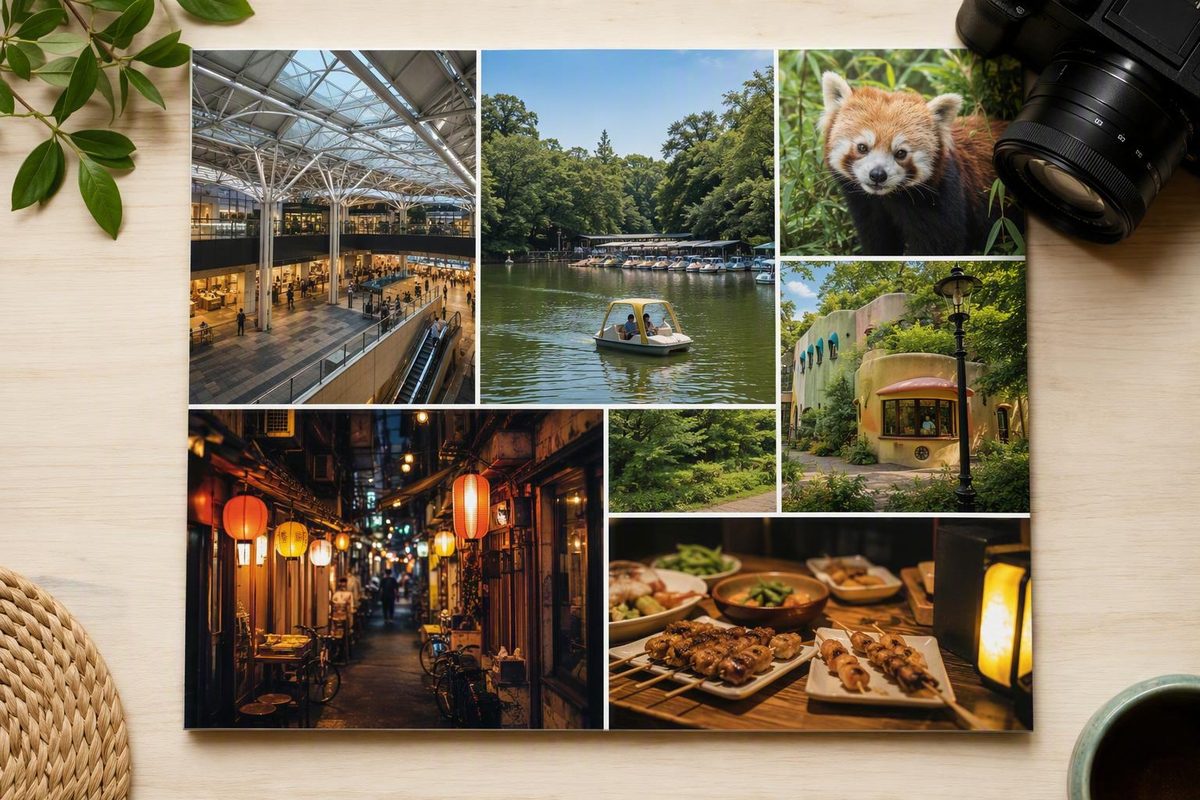
Plan a compact Kichijoji day with the right station exits, Inokashira Park, optional zoo or Ghibli Museum, and an evening in Harmonica Yokocho.
Kichijoji works best as a west-Tokyo neighborhood day rather than a rushed stop between major sights. Its useful contrast is built into the station: shopping arcades and tight drinking alleys on the north side, then Inokashira Park to the south. Tokyo’s official tourism guide places Kichijoji about 15 minutes west of Shinjuku and highlights that same pairing of Harmonica Alley and department-store shopping (GO TOKYO).
Allow half a day for the core walk. Make it a full day only if you add Inokashira Park Zoo or already hold a timed Ghibli Museum ticket.
The route at a glance
- Kichijoji Station North Exit: Sun Road, Daiyagai and an early look through Harmonica Yokocho
- Cross back through the station: use the Park Exit (South Exit)
- Inokashira Park: walk the pond and Benten Shrine area
- Choose one extension: Inokashira Park Zoo or the Ghibli Museum
- Return north of the station: eat or drink around Harmonica Yokocho
This order puts open-air walking in the middle of the day and saves Harmonica Yokocho for when its small bars and eateries become livelier. The official Kichijoji guide says Sun Road and Daiyagai are the two large shopping arcades, while the standing bars in Harmonica Yokocho open as the sun sets (GO TOKYO).
1. Start north of Kichijoji Station
Kichijoji Station is served by the JR Chuo and Sobu lines and the Keio Inokashira Line. GO TOKYO gives a journey time of 14 minutes from Shinjuku on a JR Chuo Line rapid train and 28 minutes from Tokyo Station (GO TOKYO).
Leave on the north side and use the first part of the walk to understand the compact commercial grid. Walk through part of Sun Road or Daiyagai rather than trying to cover every parallel lane. Both have everyday shops, bakeries, clothing stores and casual restaurants, so this is the practical place to buy a drink, handle lunch or retreat indoors in poor weather.
Take a brief pass through Harmonica Yokocho, immediately north of the station, but postpone a meal there if you want the more atmospheric evening version. The alleys are small enough that “seeing” them is not the time-consuming part; choosing a busy counter with space is.
2. Reset at the station and take the Park Exit
Return through or around the station and follow signs for the Park Exit (South Exit). Inokashira Park Zoo’s official access page uses that exit and estimates about a 10-minute walk from Kichijoji Station to the zoo (Inokashira Park Zoo). The pond edge arrives sooner than the zoo, so treat the zoo timing as a useful outer reference rather than a promise for every park entrance.
If you need a lift rather than stairs, consult JR East’s Kichijoji station map before travel; it marks elevators, escalators, an accessible slope, accessible facilities and coin lockers (JR East). Once outside, navigation is simpler: keep moving south toward the park instead of following the busier east–west shopping streets.
3. Give Inokashira Park the center of the day
At the park, use the pond as the organizing feature. A simple circuit can include the water, wooded paths and the red Benten Shrine without forcing a rigid turn-by-turn route. Boats operate on the lake, but availability is changeable; decide at the boathouse rather than building the whole day around a rental. GO TOKYO describes the park as a mix of grass, woodland and recreation space centered on a boating lake, with cafés around the park and Benten Shrine along its paths (GO TOKYO).
For a lower-energy day, turn back toward the station after the pond circuit. Kichijoji still works well without a ticketed attraction: the park and commercial streets provide the neighborhood contrast that makes the trip worthwhile.
4. Pick one extension, not both by default
Inokashira Park Zoo
Choose the zoo if you want a modest paid attraction without committing the day to a timed museum entry. It opens from 9:30 a.m. to 5 p.m. and normally closes on Mondays, shifting the closure to the following day when Monday is a national or substitute holiday. General admission is ¥400 (Inokashira Park Zoo).
The zoo has separate main-zoo and aquatic-park sections. They are about five minutes apart on foot, and visitors must exit onto public roads and park paths to move between them; transfer between the two is no longer possible after 4 p.m. (Inokashira Park Zoo). Start this extension early enough that the split layout does not catch you at closing time.
Ghibli Museum
Do not walk to the Ghibli Museum hoping to buy admission at the door. Entry is by advance reservation only, and tickets specify a date and entry time (Ghibli Museum). Overseas online tickets go on sale at 10 a.m. Japan time on the 10th of each month for the following month.
The museum lists hours of 10 a.m. to 6 p.m. Its official directions emphasize access from Mitaka Station, but Tokyo’s Kichijoji guide estimates a roughly 15-minute walk from Kichijoji Station (Ghibli Museum; GO TOKYO). For this neighborhood walk, approach through or alongside Inokashira Park only when you already have a reservation. Otherwise, the detour ends at a building you cannot enter.
5. Finish where Kichijoji changes character
Return to the north side of Kichijoji Station for dinner. Harmonica Yokocho is the compact, lively finish; Sun Road and Daiyagai offer more room and more conventional restaurant choices. If the alleys feel crowded, do not wait simply because they are the named sight—move into the surrounding streets and keep the clean station return.
Kichijoji is also easy to combine with a west-Tokyo itinerary because the same station provides JR connections toward Shinjuku and Tokyo and a Keio Inokashira Line connection toward Shibuya. Keep it as one coherent neighborhood block rather than adding a distant attraction; that follows the more reliable approach of planning Tokyo days by area.