How a Tiger’s Pose and Details Shape Its Symbolism
Power and courage are the usual starting points, but the more precise meaning comes from the depiction and what the wearer intends it to represent.
The short answer: the most common tiger tattoo meanings
A tiger tattoo most commonly represents strength, courage, independence, protection, resilience, or personal power. Secondary associations can include confidence, freedom, instinct, danger, passion, ferocity, and aggression held under control. These are common modern interpretations, not fixed definitions that apply to every design or wearer (Kings Avenue Tattoo’s overview of common tiger meanings).
The tiger is especially versatile because it can express different kinds of power. An exposed snarl may communicate a warning or readiness to fight. A calm, watchful tiger can suggest guardianship, discipline, or confidence that does not need to be demonstrated. A resting animal may convey maturity and restraint, while a tiger moving forward can make strength feel active and purposeful.
That distinction matters because protective strength is not the same as outright aggression. A fierce tiger might say, “I will defend what matters,” rather than, “I am violent.” Another wearer may use the same expression to represent defiance, survival, or the experience of learning to enforce personal boundaries. Pose and context help determine whether the animal reads primarily as a guardian, a warning, an embodiment of self-mastery, or an untamed force.
A tiger may represent a quality the wearer already identifies with, such as independence or confidence. It may instead stand for an aspirational quality: courage they want to develop, boundaries they intend to maintain, or composure they hope to carry through difficult circumstances. It can also mark recovery, transformation, a milestone, family protection, or the beginning of a new path.
There does not have to be a dramatic backstory. Admiration for the animal, appreciation of a tattoo tradition, or a preference for the tiger’s stripes and expressive face can be sufficient. Personal aesthetic preference is a legitimate meaning in itself.
Tiger tattoo meanings at a glance
- Power: Strength, courage, confidence, resilience, personal authority
- Protection: Guardianship, defense, loyalty, watchfulness, boundaries
- Independence: Freedom, individuality, instinct, self-reliance
- Controlled ferocity: Restraint, readiness, defiance, disciplined aggression, power held in reserve
The clearest answer to “What does a tiger tattoo mean?” is therefore twofold: it usually begins with ideas of power and courage, but its more precise meaning comes from how the tiger is depicted and what the wearer intends it to represent.
Why the same tiger can communicate different ideas
A useful interpretation begins with three layers:
- Common modern tattoo conventions: Visual associations repeated across contemporary tattoo culture, such as a roar suggesting defiance or a resting animal suggesting quiet strength.
- Culture-specific associations: Meanings connected with a named artistic, folkloric, religious, or tattoo tradition.
- The wearer’s personal story: The experience, relationship, aspiration, or aesthetic preference represented by the design.
These layers may reinforce one another, but they do not have to. Someone could choose a Japanese-inspired composition because they appreciate its flowing movement while giving the tiger a personal meaning related to recovery. Another wearer might select a naturalistic portrait simply to honor the animal. A third may deliberately invoke a traditional motif and want that cultural context to remain central.
The design works like a visual sentence. The tiger is the main subject, but its pose, facial expression, gaze, direction of movement, color, style, scale, placement, and companion motifs qualify the message. An open mouth communicates something different from a closed one. A direct gaze can feel confrontational or watchful; a lowered gaze may feel reflective. A tiger advancing toward the viewer creates a different impression from one walking peacefully through a landscape.
For example, a roaring tiger surrounded by sharp, energetic lines will normally feel more urgent, defiant, or aggressive than a resting tiger beside soft flowers. Both may represent strength, but the first activates that strength while the second tempers it with calmness or beauty.
Scale affects emphasis as well. A large full-body design has room to show movement, habitat, and relationships between several motifs. A small tiger head concentrates attention on the eyes, mouth, and expression. Neither format carries an automatic meaning; each simply gives the artist different tools.
Repeated descriptions across tattoo websites can help identify contemporary conventions, but repetition does not establish a historically universal meaning. Much of the readily available material comes from commercial studios, retailers, and general-interest symbolism pages rather than scholarly histories. It is useful for understanding how tattoos are commonly discussed today, but it cannot establish one ancient or authoritative definition.
Interpretations are therefore best phrased with care:
- “This pose may suggest readiness.”
- “A roaring tiger is commonly read as defiance.”
- “The wearer intends it to represent recovery.”
- “This contemporary guide associates the motif with protection.”
Qualified language is not evasive. It recognizes that tattoos are personal images interpreted through social conventions—and that an observer may not know the wearer’s intention.
It is equally reasonable for a tiger tattoo to have no spiritual or mythological explanation. Appreciation for the animal, the visual rhythm of its stripes, or the possibilities offered by a particular style can be the entire reason for choosing it.
Roaring, stalking, or resting: meaning by pose and expression
Pose is one of the clearest ways to refine a tiger tattoo’s message. The following matrix summarizes common interpretations rather than mandatory definitions.
| Tiger design | Commonly suggested meanings | Visual emphasis |
|---|---|---|
| Roaring or attacking | Defiance, warning, fearlessness, activated strength, confrontation | Open mouth, teeth, tension, forward energy |
| Stalking or prowling | Strategy, focus, patience, determination, restraint, readiness | Low posture, measured movement, fixed attention |
| Resting or sleeping | Calm confidence, maturity, patience, tranquility, power held in reserve | Relaxed body, closed mouth, reduced tension |
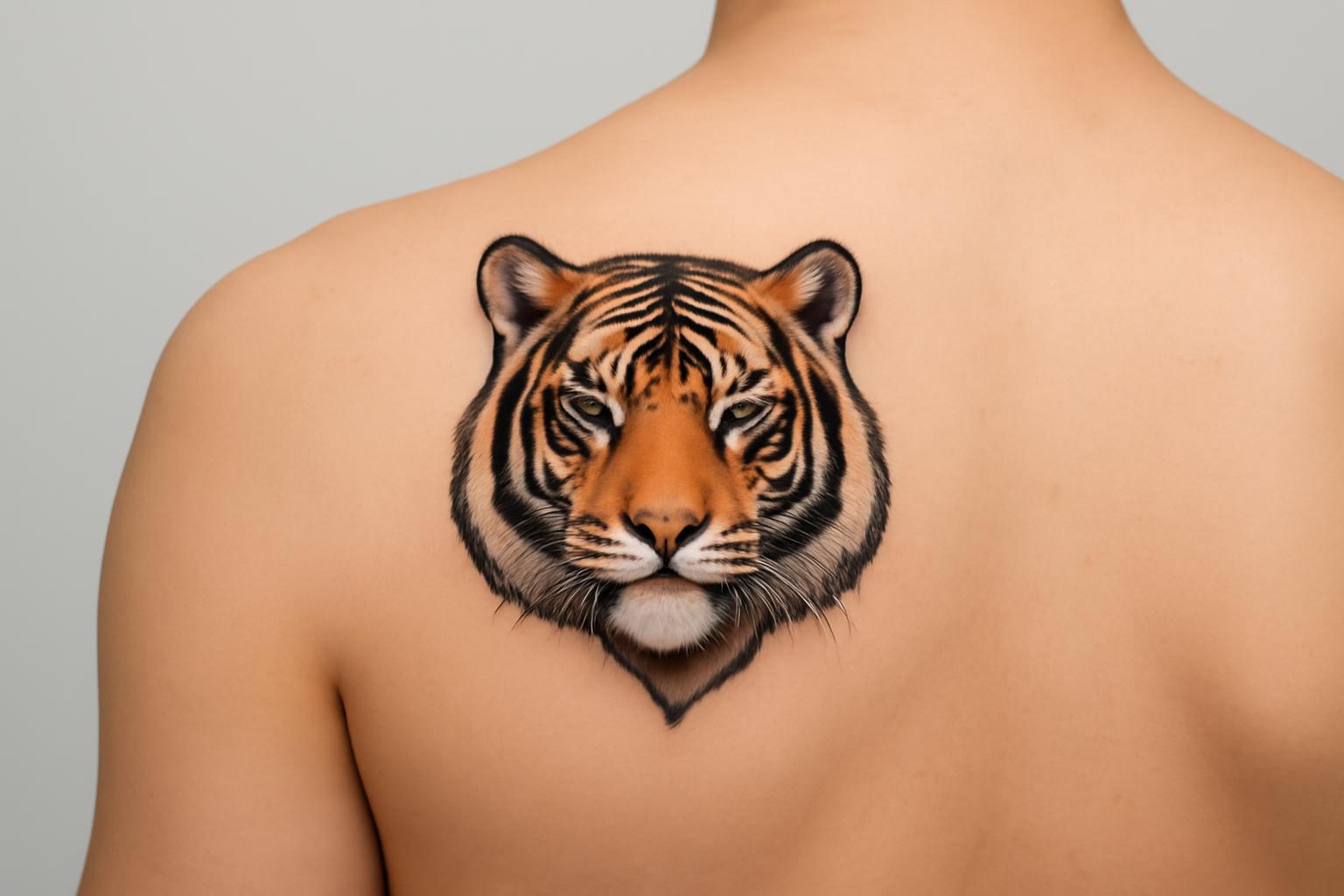
| Head only | Intensity, focus, intimidation, identity | Eyes, mouth, stripes, symmetry |
| Full body in motion | Agility, momentum, energy, purpose, power in action | Direction, anatomy, stride, surroundings |
A roaring or attacking tiger usually carries the most outwardly forceful message. Exposed teeth and a tense face may suggest fearlessness, refusal to submit, or readiness to confront a threat. Yet a roar does not have to mean uncontrolled rage. It can symbolize speaking up, facing fear, surviving adversity, or defending a hard-won boundary. Contemporary tattoo commentary commonly contrasts this activated strength with the greater restraint of stalking and relaxed poses (OCD Ink Studio’s guide to tiger poses).
A stalking or prowling tiger shifts attention from explosive force to deliberate action. The animal appears to observe, calculate, and conserve energy. This pose may represent patience during adversity, focus on a long-term goal, or confidence that does not require immediate display. Because the tiger is ready but not attacking, prowling imagery often suits themes of determination, restraint, and strategic self-control.
A resting or sleeping tiger can communicate the opposite of helplessness. Its calmness may imply that power remains present even when it is not being used. The design may therefore suggest maturity, tranquility, emotional discipline, or the ability to choose when to act. For someone who wants strength without an aggressive presentation, a closed mouth and relaxed posture may be more coherent than a snarl.
A tiger head places most of the interpretive weight on expression. A forward-facing head with an open mouth can feel immediate and intimidating. Close attention to the eyes may instead emphasize identity, alertness, ambition, or focus. A symmetrical face often feels iconic or emblematic, while an angled portrait may appear more watchful or naturalistic.
Tiger eyes alone are sometimes read as determination, ambition, instinct, or alertness. That interpretation remains flexible. Narrowed eyes can feel intensely focused; a softer gaze can communicate awareness without hostility. Brows, pupils, surrounding lines, and the direction of attention all affect the result.
A full-body tiger in motion emphasizes action. A leap may suggest commitment or decisive movement. A long stride can evoke momentum and persistence. A tiger traveling through wind, bamboo, water, or a landscape allows the surroundings to become part of the narrative. This format is particularly useful when agility and purposeful movement matter more than facial intensity.
Small changes can alter the whole tone. Open the mouth, sharpen the eyes, tense the shoulders, and angle the body forward: the tiger becomes more confrontational. Close the mouth, soften the gaze, and relax the posture: the same animal begins to express composure and self-mastery. Pose should therefore follow the intended emotional message rather than being chosen only because a reference image looks dramatic.
What dragons, flowers, bamboo, wind, and cubs add
Companion images modify the tiger’s meaning; they do not guarantee it. Their effect depends on scale, placement, interaction, and artistic context. A peony mostly hidden behind a roaring head will carry less visual weight than a prominent flower intertwined with the animal. A dragon attacking the tiger suggests a different relationship from one moving alongside it.
Tiger-and-dragon compositions are commonly interpreted as encounters between contrasting forces. Possible pairings include physical strength and wisdom, earth and sky, instinct and intellect, force and adaptability, or control and chaos.
Contemporary sources do not present one consistent explanation for the relationship. Some emphasize conflict or rivalry, while others emphasize balance or harmony. The composition should settle the intended message. Two creatures attacking each other are likely to suggest struggle; two figures arranged in a circular flow may suggest complementary powers. It is safer to describe the pairing as contrasting forces unless the wearer, artist, or named tradition supplies a more specific interpretation.
Bamboo is often used in contemporary Japanese-style tattoo commentary to reinforce perseverance, resilience, and endurance. A tiger moving steadily through bamboo can turn general strength into a more focused story about persistence through difficult conditions.
Peonies may balance the tiger’s force with beauty, grace, softness, or abundance. The flowers do not necessarily make the animal weak or gentle. Instead, the contrast can suggest that beauty and ferocity coexist, or that strength does not exclude tenderness.
Wind emphasizes movement. Sweeping wind bars or energetic lines may make the tiger appear faster and more forceful, while a softer current can suggest adaptability and movement through change. Wind can also connect the tiger’s body to the shape of an arm, back, chest, or leg, turning open space into directional energy. These bamboo, peony, wind, and dragon interpretations are recurring themes in one commercial overview of Japanese-style tiger compositions and should be treated as modern design guidance rather than comprehensive cultural history (Wabisabi Mart’s Japanese tiger overview).
Tiger cubs soften the image toward affection, innocence, family, or parental protection. A large tiger standing over cubs may communicate guardianship, while a relaxed adult interacting gently with them can foreground care rather than threat. A cub alone might represent youth, potential, or a child in the wearer’s life, but that relationship should not be assumed without context.
Landscapes and natural habitat can express admiration for tigers or a connection with nature without requiring a supernatural explanation. Forest, rock, water, grass, or mountain imagery may create a sense of place and allow the tattoo to celebrate the tiger as an animal.
Four combinations show how companion elements can clarify a design:
- Resilience: A stalking tiger moving through bamboo may suggest patience, sustained focus, and perseverance.
- Balanced strength: A tiger framed by peonies can combine power with beauty, grace, or emotional softness.
- Family protection: An alert adult tiger with cubs places strength in the service of affection and care.
- Contrasting forces: A tiger-and-dragon composition can explore tension between physical force and wisdom, earth and sky, or control and chaos.
The strongest composition usually has a clear hierarchy. Decide whether the tiger carries the central message and the other motif qualifies it, or whether both symbols are equal participants. Adding more objects does not automatically add depth; it may make the intended meaning harder to read.
Japanese, Chinese, and Western associations—with important limits
Cultural interpretation requires particular care. The available evidence here comes largely from commercial tattoo studios, retailers, and symbolism guides—not academic histories, museums, or primary religious sources. The associations below are therefore best understood as summaries of modern tattoo commentary, not definitive accounts of entire cultures or traditions.
In contemporary commercial tattoo writing, Japanese-style tiger imagery is commonly associated with courage, guardianship, resilience, discipline, emotional control, and strength during adversity. Tigers may appear with wind, bamboo, clouds, flowers, or other natural elements, placing the animal within a larger composition rather than treating it as an isolated emblem.
Some of those guides also connect Japanese tiger imagery with traditional beliefs about protection from evil, illness, bad luck, misfortune, or spiritual threats. These should be understood strictly as reported symbolic beliefs—not claims that a tattoo can provide actual protection, healing, luck, or immunity from harm.
One commercial account says that wild tigers have not inhabited Japan and attributes the stylized appearance of some Japanese tiger imagery to artists working from descriptions and imported specimens. It describes features such as rounded paws, large eyes, and small ears. That is the retailer’s historical summary, not a substitute for a scholarly history, so it should not be generalized beyond the source’s account.
Commercial tattoo commentary about Chinese-associated tiger imagery commonly uses terms such as guardianship, authority, courage, dignity, balance, luck, and protection. Depending on the design, the tiger may appear commanding, watchful, auspicious, or positioned as a counterforce to a dragon. These are broad modern summaries and should not be automatically assigned to every Chinese-style tiger image.
The White Tiger, or Bai Hu, requires particular caution. One contemporary tattoo-studio guide identifies Bai Hu as a specific Chinese figure associated with the western direction and autumn (the guide’s summary of Bai Hu). That description should not be turned into a universal meaning for every pale or white-ink tiger tattoo. Someone may choose a white tiger simply to represent individuality or because they prefer its appearance.
The Japanese term Byakko likewise should not be applied automatically to every white tiger image. Without stronger historical evidence, it is better not to make broad claims about how Bai Hu and Byakko relate or were transmitted between traditions. A tattoo deliberately designed as a named guardian is different from a naturalistic white tiger chosen for its rarity or visual effect.
Commercial guides tend to describe Western interpretations more cautiously, often emphasizing independence, individuality, freedom, rebellion, empowerment, survival, or visual boldness. An American Traditional tiger head with heavy outlines and a snarl may foreground impact and fearlessness. A realistic wildlife portrait may instead emphasize admiration for the animal’s appearance.
None of these broad categories should be collapsed into a single “Asian meaning.” Japanese, Chinese, Korean, Hindu, sak yant, and other traditions have distinct visual systems and contexts. The fact that several traditions use tiger imagery does not make their meanings interchangeable.
The same caution applies to sacred or lineage-specific imagery. If a proposed design invokes sak yant, a deity, a religious diagram, a named guardian, or another traditional system, consult someone knowledgeable about that particular practice. Ask:
- What does this motif mean within the named tradition?
- Is it decorative, devotional, protective, or ceremonial in that context?
- Are there customary methods or placements associated with it?
- Does the design combine elements that would not normally appear together?
- Is the artist describing documented tradition or a modern reinterpretation?
Cultural care does not require avoiding all traditional influence. It requires being precise about what is being referenced, avoiding unsupported claims, and recognizing the difference between visual inspiration and participation in a sacred or ceremonial practice.
White tiger meaning, color, and artistic style
A generic white tiger tattoo is commonly chosen to suggest rarity, individuality, wisdom, inner strength, or a distinctive personal path. It can retain the tiger’s broader associations with courage and power while emphasizing difference rather than aggression. Commercial tattoo guides frequently connect white tigers with uniqueness or inner strength, although their exact lists vary (Burned Hearts Tattoo’s white-tiger overview).
That generic meaning should remain separate from a deliberate reference to Bai Hu or Byakko. A white tiger can simply be a white tiger. Unless the companion imagery, artistic system, or stated intention points toward a named cultural figure, color alone does not establish that identity.
Color is one of the least reliable areas of generic tattoo interpretation. Available commercial sources assign white, blue, red, black, and yellow tigers inconsistent meanings, often without explaining whether those associations come from a documented tradition, contemporary tattoo convention, or the writer’s interpretation. There is no dependable universal formula in which blue must mean spirituality or red must mean passion.
Before accepting a proposed color meaning, ask:
- Does it come from an identified cultural or artistic tradition?
- Is it part of the artist’s visual concept?
- Is it a contemporary tattoo convention?
- Is it simply the meaning I personally give the color?
Any of these can inform a design, but they should not be presented as equivalent historical claims.
Artistic style affects tone more reliably than it dictates symbolism. A tiger can be rendered in realism, American Traditional, Japanese-inspired composition, neo-traditional work, blackwork, minimalism, watercolor, or another approach. Each style changes how the tiger feels on the body, but none imposes a fixed meaning.
Realism emphasizes anatomy, fur, eyes, and natural expression. It may support ideas such as admiration, dignity, beauty, or connection with nature, but it can depict aggression or protection just as effectively. Realism is a method of representation, not a symbolic definition.
American Traditional designs often use bold outlines, concentrated shapes, and saturated colors. These choices can make a tiger head feel immediate and visually forceful. A snarl may read clearly from a distance, but its meaning still depends on the complete image and the wearer’s purpose.
Japanese-inspired work often uses flowing compositions in which the tiger interacts with wind, flowers, bamboo, water, clouds, or other elements. This approach can integrate the animal with movement and natural forces. Using the visual language does not, by itself, give the tattoo every meaning attributed to traditional Japanese imagery.
Neo-traditional work can combine bold structure with expanded color, decorative details, and elaborate flora. It is useful when the tiger and its companion motifs need comparable visual weight.
Blackwork and black-and-gray can feel graphic, restrained, dramatic, or reflective depending on ink density, contrast, and negative space. These are aesthetic effects, not universal rules that make black ink signify mystery or grief.
Minimalist designs reduce the tiger to selected lines, stripes, eyes, or a silhouette. The result may feel quieter or more abstract, but it can still represent strength or protection if that is the wearer’s intention.
Watercolor treatments can introduce softness, color movement, and a painterly quality. They may reduce the hard-edged impact associated with a traditional snarling head, although pose and linework can preserve intensity.
Choose a style by deciding what must remain most visible: facial emotion, natural beauty, forward motion, graphic impact, surrounding narrative, or a simple private symbol. Style should strengthen that priority rather than burden the tattoo with a supposedly automatic meaning.
Does placement change what a tiger tattoo means?
Placement changes visibility, available scale, detail, movement, and visual impact more reliably than it changes meaning. There is no fixed rule that a tiger on the back means protection, one on the shoulder means resilience, or one on the chest means courage.
Some commercial guides associate full-back tiger pieces with protection or dominance and shoulder or upper-arm designs with resilience or emotional control. These are best treated as loose conventions, not verified symbolic laws. People also choose body locations for aesthetic, practical, and personal reasons.
A large area such as the back, chest, or thigh can support a full-body tiger and accompanying imagery. The artist may be able to show the direction of a stalk, the tension of a leap, or the relationship between a tiger and dragon. Bamboo, flowers, wind, landscapes, and cubs can remain distinct instead of becoming a dense collection of small details.
Large placement does not require a complicated design. A single tiger head can use the space for expression, texture, and negative space. The area permits complexity; it does not demand it.
Smaller or narrower areas generally call for a simpler silhouette, a tiger head, an eye, or fewer supporting elements. If a complex landscape, multiple flowers, bamboo, wind, and a dragon are compressed into limited space, the emotional expression may become difficult to read. The design can lose the clarity the added motifs were intended to create.
Body anatomy can reinforce movement. A tiger may wrap around an arm, climb along a leg, stretch across the back, or follow the shoulder’s curve. The animal’s gaze and direction can lead toward or away from the center of the body. These decisions may influence whether the image feels energetic, guarded, open, or confrontational.
The pose should fit the available shape rather than being forced into a location because of supposed symbolism. A long prowling body needs a different space from a symmetrical, front-facing head. A circular tiger-and-dragon composition needs enough room for both figures to remain distinct. A quiet eye motif may suit a small area better than a miniature narrative scene.
Visibility matters as well. A frequently exposed tattoo functions as a more public statement, while a covered placement can make the same image feel private. That is a practical and personal distinction, not a universal symbolic code.
Choose placement in this order:
- Decide how visible you want the tattoo to be.
- Identify how much space the intended pose and details require.
- Check whether the body’s shape supports the direction of movement.
- Confirm that the face and posture will remain legible at the proposed size.
- Add a personal placement meaning only if it genuinely matters to you.
A back tattoo can represent protection because the wearer intends it to—not because the back automatically assigns that meaning.
How to choose a tiger design that expresses your meaning
The most coherent tiger tattoos usually begin with a sentence rather than a collection of reference images. Before choosing colors, flowers, or placement, complete this prompt:
“My tiger represents…”
The answer might be “the strength I found during recovery,” “protecting my family without losing my gentleness,” “the patience required to rebuild,” or simply “my admiration for tigers.” That sentence gives each later choice a purpose.
Use the following five-step process to translate the idea into a design.
1. Define the intended message
Choose the main idea before adding secondary meanings. Strength is broad: decide whether you mean protective strength, physical power, emotional resilience, defiance, patience, freedom, or self-control. A tattoo can hold several ideas, but it should normally have a clear center.
If the design marks an event, identify what aspect matters most. Recovery could mean survival, renewed independence, patience, or transformation. Family could mean affection, ancestry, guardianship, or shared resilience. Precise language supports precise imagery.
2. Choose the tiger’s emotional state
Decide what the animal is doing and feeling:
- Protection: Consider a watchful or outward-facing tiger.
- Defiance: Consider a roar, direct gaze, or forward attack.
- Perseverance: Consider a stalking tiger, possibly moving through bamboo.
- Restraint: Consider a calm, resting, or closed-mouth tiger.
- Family love: Consider an adult tiger with cubs.
- Individuality: Consider a personally defined white tiger.
These are design suggestions based on common conventions, not rules. A resting tiger could represent protection if its posture suggests calm guardianship. A roaring tiger could represent recovery if the roar means reclaiming one’s voice.
3. Select only meaningful companion elements
Every added motif competes for attention. Ask whether it sharpens the message or merely fills space. Bamboo may support perseverance; peonies may temper ferocity with beauty; wind can activate movement; cubs can introduce family; a dragon can create contrast.
Choose one primary modifier before considering another. If the tiger represents resilience and bamboo already communicates endurance, adding a dragon, dagger, flowers, flames, waves, and text may dilute the idea. Visual richness is not the same as symbolic clarity.
4. Decide whether a cultural tradition is actually being invoked
There is a difference between appreciating Japanese-inspired movement and intentionally requesting a traditional Japanese symbolic composition. There is also a difference between a generic white tiger and a named guardian, or between decorative geometry and a sacred diagram.
Ask the artist to name the tradition behind any term being used. Avoid vague labels such as “tribal” when no people, culture, or lineage is identified. The label alone cannot tell you whether a pattern is invented, loosely inspired, or connected to a living tradition.
Sacred, religious, deity-related, sak yant, and other tradition-specific imagery warrants additional research. Consult someone familiar with the named practice, especially when authenticity, ritual significance, authorization, or placement customs may matter. A generic motif label or social-media caption is not enough to settle those questions.
For possible local associations, ask both a reputable studio in the area where the tattoo will be seen and, where relevant, a specialist familiar with the named tradition. No general symbolism list can reliably settle every local interpretation.
5. Choose scale and placement for legibility
Tell the artist which emotional feature matters most. If the gaze carries the meaning, the eyes must remain readable. If the stalking posture is central, the body needs enough length to communicate it. If several figures interact, the placement must provide enough room for their relationship to remain clear.
A simpler design at an appropriate scale will often communicate more than a crowded design filled with symbols. Ask how the tattoo will read from a normal viewing distance, not only as a magnified drawing.
Bring these questions to the consultation:
- What should the tiger’s face communicate?
- Is the tiger acting, waiting, watching, or resting?
- Which element carries the main meaning?
- Which details are secondary?
- Is any motif sacred, religious, or specific to a named tradition?
- Does the pose fit the anatomy of the chosen placement?
- Will the mouth, eyes, and posture remain clear at the intended scale?
- Could the design have an unintended local or cultural association?
- Which details could be removed without weakening the message?
A tiger tattoo usually begins with strength, courage, independence, protection, or resilience, but the complete design determines what kind of strength it expresses. A roar communicates something different from a watchful gaze or resting posture. Dragons, bamboo, peonies, wind, cubs, color, style, and placement refine the message; they do not dictate it.
Define the personal message first, approach culture-specific imagery carefully, and build a composition in which every major element supports the same idea. Clear intention expressed through pose and structure is more meaningful than an accumulation of loosely connected symbols.
Can a tiger tattoo represent both protection and aggression?
Yes. Protection and aggression are not mutually exclusive: a guardian may need the capacity to confront a threat. A snarling tiger positioned defensively can represent strong boundaries, warning, or readiness to protect family rather than indiscriminate violence.
Expression and context clarify the balance. Exposed teeth and forward movement emphasize activated force. A watchful gaze, protective position, or inclusion of cubs can direct that force toward guardianship. A calm posture can communicate the same protective power held under control.
What does a roaring tiger tattoo mean?
A roaring tiger is commonly interpreted as defiance, warning, courage, fearlessness, or strength brought into action. It may represent confronting a threat, reclaiming one’s voice, refusing submission, or showing that personal boundaries will be defended.
The roar does not automatically mean rage. Surrounding imagery and the wearer’s story can turn it into a symbol of survival, protection, confidence, or release. A forward attack is likely to feel more confrontational than a stationary tiger roaring from a guarded position.
What does a tiger-and-dragon tattoo symbolize?
A tiger-and-dragon tattoo commonly represents contrasting forces. Possible pairings include physical strength and wisdom, earth and sky, instinct and intellect, control and chaos, or force and adaptability.
There is no single agreed interpretation. Some contemporary sources describe conflict or rivalry, while others emphasize balance or harmony. The figures’ interaction should make the intended relationship clear: combat suggests struggle, while a balanced circular arrangement may suggest complementary powers. Treat “yin and yang” as one possible modern interpretation, not the guaranteed meaning of every tiger-and-dragon design.
What does a white tiger tattoo mean?
A white tiger tattoo may represent rarity, individuality, inner strength, wisdom, or a distinctive path. It can retain the tiger’s general associations with courage and power while placing greater emphasis on difference or personal identity.
A generic white tiger should not automatically be called Bai Hu or Byakko. Those names invoke more specific cultural contexts. If the tattoo is intended to depict a named guardian, investigate the relevant tradition and design vocabulary rather than relying on color alone.
Can a tiger tattoo simply mean that I admire tigers?
Yes. A tiger tattoo can simply express admiration for the animal’s appearance, movement, or place in nature. It does not require a spiritual, mythological, or transformational explanation.
A naturalistic portrait or a tiger shown in its habitat can make that intention especially clear, but any style is valid if it reflects the wearer’s taste. “I admire tigers and wanted one represented in art” is a complete personal meaning.