
Why This Fearsome Face Is Also a Portrait of Sorrow
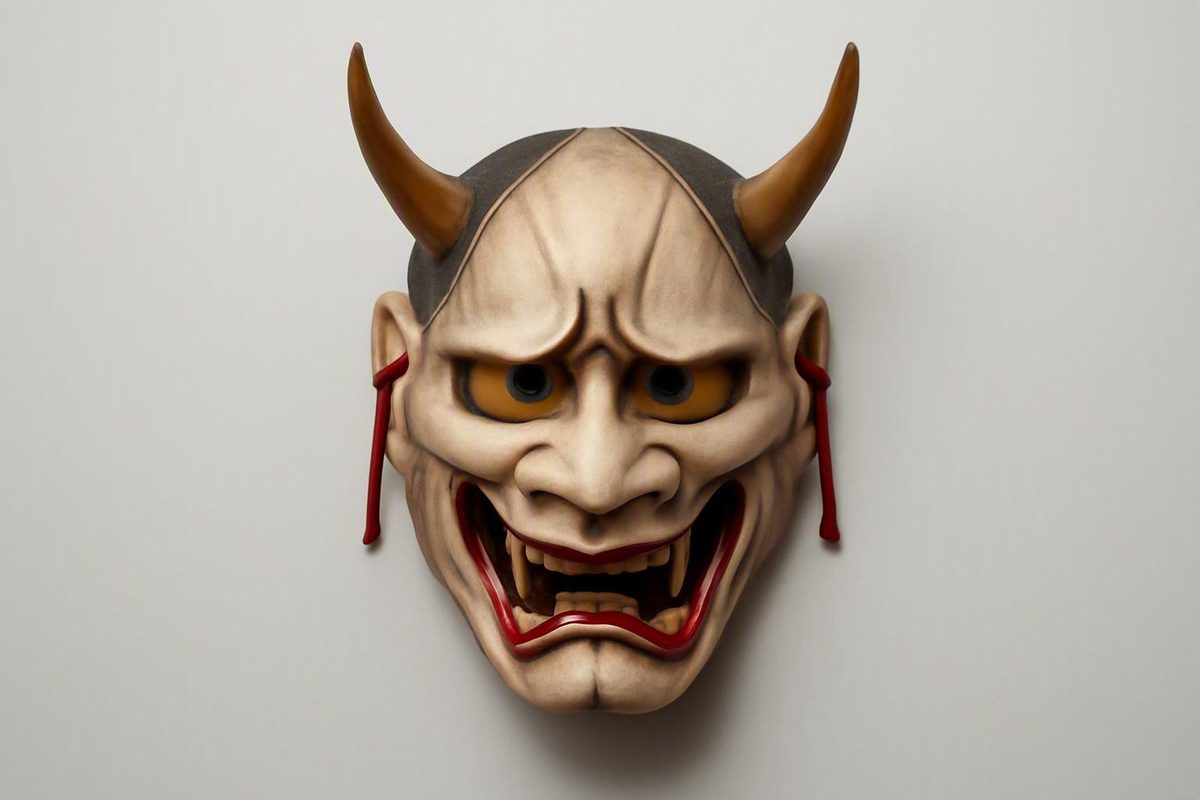
A Hannya is not satanic: that label imports a concept from a different religious and cultural framework into the mask's interpretation.
The Hannya mask meaning in one clear answer
A Hannya is a specific mask and dramatic figure from Japanese Noh theater, portraying a woman transformed into a demonic being by overwhelming jealousy, resentment, obsessive attachment, or anguish. Its central meaning is not simple evil: destructive fury appears together with grief, suffering, and traces of the character’s humanity.
That emotional combination is the key to understanding the Hannya mask meaning. Horns, fangs, glaring eyes, and a strained mouth make the figure dangerous, but the face also appears wounded. It suggests not only what the character may do, but what consuming emotion has done to her.
Hannya is therefore not a generic term for every Japanese demon mask. It belongs to a particular theatrical context and is associated with female demonic or vengeful figures in Noh. Oni, yōkai, ghosts, and other supernatural beings may share some visual traits, but they are not automatically Hannya.
It helps to keep four interpretive layers separate:
- Documented Noh context: the mask’s theatrical identity and its association with particular roles and works.
- Dramatic interpretation: the way jealousy, attachment, rage, and suffering become visible through character and performance.
- Later folklore explanations: origin stories and classification schemes that may not represent uniform Noh practice.
- Contemporary symbolism: meanings assigned in tattoos, illustration, fashion, decorative masks, and popular culture.
When these layers are mixed together, a theatrical convention can be mistaken for a universal spiritual rule, or a modern tattoo meaning can be presented as ancient doctrine. Several distinct characters may also be collapsed into a misleading story about one woman supposedly named Hannya.
A careful reading begins with the mask’s theatrical identity. Hannya represents human feeling taking a frightening form. Jealousy is central, but so are resentment, rejection, fixation, humiliation, and grief. The result is neither an ordinary woman nor a one-dimensional monster. It is a tragic image in which humanity remains visible within demonic transformation.
From human anguish to a demonic Noh figure
The word Hannya can refer both to a type of Noh mask and to the female demonic figure represented through it. Depending on the play and the aspect being discussed, that figure may be described as a woman, demoness, spirit, vengeful spirit, or transformed being. These labels overlap because they emphasize different parts of the dramatic condition.
The human origin matters. The character is not simply introduced as a supernatural monster that has always existed outside ordinary life. Her demonic form develops from jealousy, resentment, or attachment that has become consuming. One emotion no longer exists among many; it overtakes the character’s identity.
For that reason, “a woman transformed into a demon” is more accurate than simply “a demon woman.” The first description preserves the movement from humanity into monstrosity. The second can make the transformation—and therefore the tragedy—disappear. A third-party folklore reference likewise describes Hannya as the name of both a Noh mask and a once-human woman consumed by jealousy, although its broader supernatural taxonomy should not be treated as a technical system followed uniformly across Noh traditions (Yokai.com).
The frightening form embodies loss of control, but it does not erase the suffering beneath it. Demonic features communicate danger; the tense and sorrowful expression preserves an awareness that this danger emerged through anguish. Hannya can therefore be understood as both human and demonic rather than as a puzzle in which one label must exclude the other.
The figure’s gender belongs to established theatrical roles and narratives. It should not be turned into a general claim that jealousy, obsession, or emotional instability is inherently female. Noh presents a gendered dramatic image in which particular women undergo demonic transformation within particular stories. That convention describes those roles, not the emotional nature of women as a group.
Nor does the mask mean that women’s anger is inherently evil. Its dramatic force comes from showing how unresolved attachment and suffering can distort a person’s relationship with others and with herself. The emotional warning can be recognized without converting a theatrical convention into a universal judgment about gender.
Different terms remain useful in different contexts. Calling the figure a “spirit” emphasizes a supernatural dramatic role. “Demoness” emphasizes the transformed appearance. “Woman” preserves the human origin. No single term communicates the complete meaning by itself.
How one mask can look furious and sorrowful
The Hannya’s emotional duality is not an optional secondary interpretation. It is what makes the mask more than an intimidating demon face.
Seen directly, the horns, bright eyes, fangs, and open mouth can feel confrontational. The expression appears ready to attack. Yet the brow and eyes can also suggest torment, grief, or an almost crying intensity. Rage and sorrow occupy the same carved face.
In performance, the features themselves do not change. The performer changes how the audience perceives them by adjusting the mask’s presentation and coordinating it with bodily posture, movement, and light. A direct or slightly raised presentation can intensify the eyes and mouth, making the figure appear more forceful. Lowering the mask can deepen shadows and bring out an impression of heaviness, pain, or withdrawal.
Some discussions use teru and kumoru for brighter and darker expressive effects associated with presenting or lowering a Noh mask. Because the supplied explanation comes from a commercial craft-workshop article rather than a directly reviewed technical authority, these terms are best treated here as an attributed introduction, not a complete account of performance practice (Dai Yokai’s workshop explainer).
The familiar shortcut that “up means angry and down means sad” is therefore useful but incomplete. It helps a first-time viewer notice how presentation affects expression, yet it makes the technique sound like a mechanical switch. A lowered angle may emphasize sorrow, but it does not guarantee one fixed emotional reading. A direct presentation may intensify menace without removing pain from the face.
This matters symbolically because the anger cannot be separated cleanly from the hurt that produced it. The audience confronts danger while still being asked to perceive suffering. That tension makes Hannya tragic. A conventional monster face may tell viewers to fear something alien; Hannya can also invite them to recognize the human emotion within the monster.
An effective illustration would show the same mask at two angles, rather than two differently carved masks:
- Direct or slightly raised presentation: menace intensified
- Lowered presentation: sorrow emphasized
Its caption should explain that the images simplify an effect created through presentation and performance. They are not two masks with permanently different emotions.
This distinction is especially helpful for travelers encountering Hannya imagery in a museum display, theater program, shop, or decorative setting. A wall-mounted mask is stationary, and its selected angle may make it look entirely furious. Remembering that a theatrical mask is made to be presented in motion restores some of the ambiguity that a static display can conceal.
Reading the horns, eyes, teeth and mouth
A Hannya is commonly recognized through several features working together:
- Two horns rising from the forehead
- Metallic-looking, reflective, or glaring eyes
- Sharp teeth or projecting fangs
- A tense, open mouth
- A narrow or angular face
- A brow and eye area that can suggest distress
The combination of two horns, metallic-looking eyes, and sharp teeth is repeatedly identified in the supplied theatrical and tattoo-oriented accounts of the mask (Dai Yokai’s Noh-context overview).
These elements make demonic change legible to an audience. The horns move the character beyond an ordinary human role. The teeth and open mouth suggest threat. The eyes catch attention and can make the stare appear unnaturally intense. Together, the features create a visibly dangerous face even before a viewer knows the story.
No feature contains the entire meaning on its own. Horns do not independently translate as jealousy, the eyes do not invariably mean rage, and the mouth does not have a single fixed message. Meaning emerges from the whole design, the dramatic character, and the way the mask is presented.
The eyes are particularly important to the ambiguity. Their brightness can make the stare appear supernatural or aggressive, while the surrounding carving can create an impression of strain. The same intensity may be read as fury directed outward or torment held within.
The open mouth works similarly. It can resemble a cry, snarl, expression of anguish, or imminent attack. The dramatic situation and the performer’s presentation influence which possibility becomes most prominent.
Some modern explanations claim that horn length, facial redness, or fang size precisely measures how far a character has progressed toward complete transformation. Such schemes may belong to a particular account, artistic interpretation, or design practice, but the supplied evidence does not establish them as universal rules for every Hannya mask.
A performance mask must also be distinguished from Hannya-inspired art. A contemporary wall mask, souvenir, fashion object, game design, or tattoo may exaggerate the horns, widen the jaw, reposition the eyes, or use color for visual contrast. Such works can remain recognizably Hannya-inspired without reproducing the proportions or function of a Noh mask.
That does not make contemporary interpretations illegitimate. It changes the question. Instead of assuming that every visual choice is an ancient code, ask what the object was made for: performance, decorative display, commercial illustration, or tattoo composition. Function and provenance are better guides than appearance alone.
An annotated image can identify the horns, metallic-looking eyes, fangs, and tense mouth as recognizable features. If it depicts a replica or modern artwork, the caption should say so. Visual resemblance alone cannot establish that an object was made or used for Noh performance.
The stories behind the face: Aoi no Ue and Dōjōji
Hannya becomes clearer when returned to drama. The mask does not represent one universal legend about a woman named Hannya. Several characters and works provide its context, with Aoi no Ue and Dōjōji among the most frequently cited examples.
In Aoi no Ue, Lady Rokujō’s jealous and suffering spirit becomes central to a supernatural conflict involving Lady Aoi. It is a strong example of Hannya’s dramatic logic: an intelligible human wound takes a demonic form without ceasing to be tragic. The supplied Noh-context account identifies Lady Rokujō’s later demonic appearance with a Hannya mask.
Lady Rokujō should not be reduced to a flat villain. Her jealousy is destructive, but the role also draws its force from attachment, injury, suffering, and loss. The demonic appearance turns an inner condition into something visible and dangerous.
Dōjōji belongs to a related narrative world associated with Kiyo-hime, rejection by a monk, obsessive pursuit, serpent-like transformation, fire, and a temple bell. Retellings vary, but these elements have become recognizable clues to the story. The supplied accounts also indicate that productions may be discussed in relation to either Hannya or the more serpent-like Shinja mask, so one mask choice should not be treated as invariable across every performance.
These associations are particularly useful when reading tattoos. A standalone Hannya can evoke jealousy, grief, attachment, or emotional transformation in broad terms. A composition that combines Hannya with a snake, flames, and a temple bell can point more specifically toward Dōjōji-related material (Dai Yokai’s tattoo guide).
Not every snake beside a Hannya must refer exclusively to Dōjōji. Artists combine images for narrative, formal, and personal reasons. The reference becomes stronger when several story elements appear together and when the artist or wearer identifies the play or legend as an influence.
Kurozuka is another work associated in the supplied folklore and commercial Noh-context accounts with a female demonic figure. One source also notes the title Adachigahara in connection with the Kanze school. Because that school-specific detail is not supported here by a directly reviewed institutional record, it should be understood as an attributed example rather than a fully documented account of production history.
Together, these works show why “Hannya means one rejected woman seeking revenge” is inadequate. Hannya imagery belongs to dramas in which memory and attachment press into the present and suffering takes visible supernatural form. The mask is not merely a badge reading “revenge.” It participates in a staged encounter with desire, shame, anger, pain, and the possibility—or failure—of release.
Hannya versus oni: similar features, different categories
No, a Hannya mask is not the same as an oni mask.
Hannya refers to a particular Noh mask and dramatic identity associated with a woman’s demonic transformation. Oni is a much broader category of ogre-like or demonic supernatural beings appearing across Japanese folklore and other cultural traditions.
Confusion is understandable because both may be represented with horns, sharp teeth, glaring eyes, and threatening expressions. Modern illustrations, tattoos, product listings, and search results often blur the distinction further. A label such as “Hannya oni mask” may be used commercially even when it obscures the theatrical difference.
The clearest distinction is not one horn shape or color. It is dramatic specificity. Hannya retains a connection to a woman transformed through jealousy, resentment, attachment, and suffering. Oni vary widely in identity, appearance, behavior, gender, and moral role.
| Point of comparison | Hannya | Oni |
|---|---|---|
| Primary context | A specific mask and dramatic figure in Noh | A broad category found across folklore and other traditions |
| Typical identity | A woman or female spirit whose consuming emotion has taken demonic form | Varies by story; not one character, gender, appearance, or moral type |
| Human transformation | Transformation from human anguish is central to the dramatic identity | Human connections may occur, but transformation is not a universal defining rule |
| Visual form | Commonly recognized by two horns, metallic-looking eyes, fangs, and a tense face | Highly variable; may share horns and fangs without resembling Hannya closely |
| Emotional emphasis | Rage intertwined with grief, jealousy, attachment, and torment | Depends on the individual story and tradition |
| Modern uses | Noh-related imagery, tattoos, decorative art, fashion, and popular culture | Folklore imagery, festivals, tattoos, masks, games, and illustration |
It would be equally misleading to correct the confusion by claiming that all oni are male or purely evil. The supplied accounts describe oni as varied figures rather than one uniform character type.
A tattoo practitioner reports regularly encountering clients who request an oni while supplying a Hannya reference image, illustrating how common the visual confusion has become (Acala Tattoo Collective). The practical solution is to identify the source image and intended narrative, not to replace one broad rule with another.
When examining an unfamiliar mask, consider the whole structure. A narrow, tormented face with horns, bright eyes, and an expression poised between a snarl and a cry may be Hannya-inspired. A broader ogre face may be described as oni. Even then, an object’s documented title, maker, role, or use is stronger evidence than appearance alone.
What white, red and dark Hannya masks can—and cannot—tell you
Color can matter, but the supplied evidence does not support one universal chart that decodes every Noh mask, replica, illustration, and tattoo.
Some commercial and tattoo-oriented accounts associate pale or white masks with a noblewoman, a less advanced transformation, or greater proximity to the human condition. Red may indicate intensified jealousy or anger, a social characterization, or a particular role. Deep red and dark tones may make the figure appear more fully demonic or emotionally extreme.
These interpretations overlap, but they are not identical. One explanation treats color as emotional progression; another connects it with social position; another associates particular colors with roles or plays. Combining them into a single white-to-red-to-black ladder would create a certainty that the sources themselves do not justify.
A cautious summary is:
- Pale or white: may suggest nobility, a specific character, greater visible humanity, or a less intense transformation in a particular account.
- Red: may intensify anger or jealousy, distinguish a role, or reflect a specific artistic convention.
- Deep red or dark tones: may heighten the impression of emotional extremity or demonic transformation.
- Blue, gold, green, and other modern palettes: should not be given ancient meanings without evidence tied to the individual design.
The play, school, mask type, production, and maker can all affect the context. Modern artists also select colors for contrast, visibility, skin tone, compositional balance, or personal preference.
Several classification systems add to the confusion. Yokai.com presents namanari, chūnari, and honnari as three increasingly demonic grades, describing changes in appearance and supernatural condition. This is useful for understanding that folklore site’s scheme, but it should not be presented as a formal grading system uniformly used throughout Noh (Yokai.com).
Other commercial accounts propose sequences involving Deigan, Hashihime, Namanari, Hannya, and Shinja. Such sequences may provide an interpretive progression from human jealousy toward demonic or serpentine form, but they should not be merged with the three-grade folklore scheme and described as one settled taxonomy.
Horn length creates the same problem. Within a particular explanation or design, longer horns may signify deeper transformation. They do not provide a universal instrument for identifying an exact stage in every mask or tattoo.
For a contemporary design, the most useful question is not “What does red always mean?” It is:
Does this color refer to a particular play or mask tradition, a convention used by this artist, the wearer’s intended meaning, or simply the visual needs of the composition?
That question respects traditional context without pretending every modern design is governed by one theatrical code.
What a Hannya tattoo can mean today
The meanings most directly connected to the Noh figure are jealousy, resentment, grief, emotional conflict, destructive attachment, and transformation. A tattoo may draw on any combination of these themes, but it does not acquire one compulsory definition merely by depicting Hannya.
Modern personal readings can include:
- A warning about jealousy or uncontrolled attachment
- A record of surviving emotional pain
- An acknowledgment of anger rather than a denial of it
- Transformation after a destructive period
- Self-mastery
- Resilience or endurance
- Protection in a personal or tattoo-cultural sense
These are possible contemporary interpretations, not automatic historical meanings. Protection and good luck, in particular, should not be presented as effects inherent in every Hannya image. They describe a wearer’s intention or a tattoo-cultural reading, not a demonstrable property.
Tattoo artist Christopher Cockrill notes that people choose Hannya for many reasons. Some connect with suffering, jealousy, transformation, or conflict; others are drawn to Japanese tattooing or simply find the design visually powerful. His practitioner account emphasizes that Hannya tattoos do not have one fixed definition (Christopher Cockrill).
The medium also changes how the face communicates. A performer can alter the presentation of a stage mask. A tattoo is fixed, so the artist must select the emotional emphasis through composition.
A direct gaze, upward angle, exposed fangs, and intense color may privilege confrontation. Lowered eyes, heavier shadows, or a downward angle may emphasize grief. An artist can also preserve ambiguity by balancing a threatening mouth against sorrowful eyes.
Surrounding imagery creates another layer. A snake, flames, and a temple bell can evoke Dōjōji, particularly when used together. Flowers, waves, wind bars, clouds, or leaves may contribute seasonal, compositional, narrative, or personal associations, but no universal rule makes each addition translate into one permanent meaning.
Color requires the same caution. A pale mask may draw on a theatrical association or simply contrast with dark background work. Red may emphasize anger, but it may also anchor the composition. Blue, gold, and other stylized palettes are usually best interpreted through the artist’s concept rather than through an invented traditional chart.
Before commissioning a Hannya tattoo, discuss four questions with the artist:
- Source: Is the design based on a Noh mask, an existing tattoo convention, a modern illustration, or a decorative replica?
- Story: Does it refer to Aoi no Ue, Dōjōji, another work, or no particular narrative?
- Emotional emphasis: Should the face appear furious, sorrowful, conflicted, or deliberately ambiguous?
- Composition: What do the angle, color, and surrounding images contribute to this specific piece?
An artist knowledgeable about Japanese tattoo traditions can explain how a proposed design relates to established visual practice while adapting it to the wearer and placement. That conversation is more useful than copying a list of supposedly universal meanings.
Cultural care does not require inventing a profound explanation for every wearer. One person may connect the design with grief, jealousy, or survival. Another may value the theatrical story. Someone else may primarily admire its visual force. Meaning should be discussed rather than assigned on the wearer’s behalf.
Why hannya can mean ‘wisdom’—and why the name remains uncertain
The Japanese form is 般若, read はんにゃ (hannya). The term is associated with the Buddhist concept of prajñā, commonly translated as wisdom or Perfect Wisdom.
That association creates a striking interpretive contrast. Wisdom suggests clear perception and freedom from delusion or fixation. The Hannya figure displays the opposite condition: attachment has narrowed the character’s world until suffering takes demonic form. The language of wisdom and the dramatic image can therefore be placed in meaningful tension.
The contrast does not establish the mask’s precise etymology. A linguistic association may be relevant and evocative without proving exactly when or why the mask acquired its name.
An alternative theory attributes the name to a mask maker called Hannya-bō. A commercial retailer’s summary presents both the Buddhist association and the Hannya-bō account while acknowledging uncertainty and dispute; it does not establish either as settled history (Wabisabi Mart).
The careful conclusion is twofold:
- The association with Buddhist wisdom is linguistically and interpretively meaningful.
- The precise historical reason the mask bears the name Hannya remains uncertain.
That uncertainty reinforces the larger principle of interpretation: documented theatrical context, later folklore explanation, and modern symbolism should not be treated as interchangeable.
The Hannya remains terrifying because demonic transformation never fully conceals human anguish. Its horns and fangs announce danger, but its sorrow prevents the viewer from dismissing it as a simple embodiment of evil. Whether the image appears in Noh, decorative art, or a tattoo, interpretation should begin by identifying that context—and by resisting universal claims about color, luck, protection, or fixed symbolism.
Is a Hannya mask evil or satanic?
A Hannya is not satanic; that description imports a concept from a different religious and cultural framework. Nor is the mask simply an image of absolute evil. It represents demonic transformation driven by jealousy, resentment, attachment, and suffering within Noh drama.
The figure can be dangerous and destructive, but its grief is essential. Calling it merely evil removes the human tragedy that gives the mask its dramatic force.
Does a Hannya mask or tattoo provide protection or good luck?
Some contemporary tattoo explanations and personal interpretations treat Hannya imagery as protective, lucky, or cautionary. These are possible symbolic intentions, not universal meanings of the theatrical mask.
The supplied evidence does not support claiming that a mask or tattoo demonstrably wards off evil, prevents misfortune, or produces good luck. If a wearer describes a design as protective, that meaning belongs to the person and composition rather than to an automatic supernatural property.
Is Hannya a woman or a demon?
Both descriptions can be appropriate. The Hannya dramatic figure is a woman or female spirit whose overwhelming jealousy, resentment, or attachment has taken demonic form. “Woman” identifies the human origin; “demoness” identifies the transformed condition.
The mask’s power comes from holding those identities together. Transformation makes the figure frightening, while visible sorrow preserves her underlying humanity.
Does a red or black Hannya mask have one fixed meaning?
No. Red, deep red, and dark masks may intensify anger, jealousy, or demonic transformation in some accounts. Elsewhere, color is connected with roles, character types, plays, mask traditions, or artistic conventions.
A tattoo or decorative object may use red or black primarily for compositional effect. Identify the play, production, maker, or artist’s intention before assigning a fixed meaning.
What is the main difference between a Hannya and an oni?
Hannya is a specific Noh mask and dramatic figure associated with a woman’s emotional and demonic transformation. Oni are a much broader and more variable category of supernatural beings found across Japanese traditions.
They can look similar because both may have horns, fangs, and threatening expressions. The clearest distinction is Hannya’s theatrical and emotional specificity—not appearance alone.