
Best Beaches in Tokyo: In-City Sands, Day-Trip Coasts, and the Izu Islands
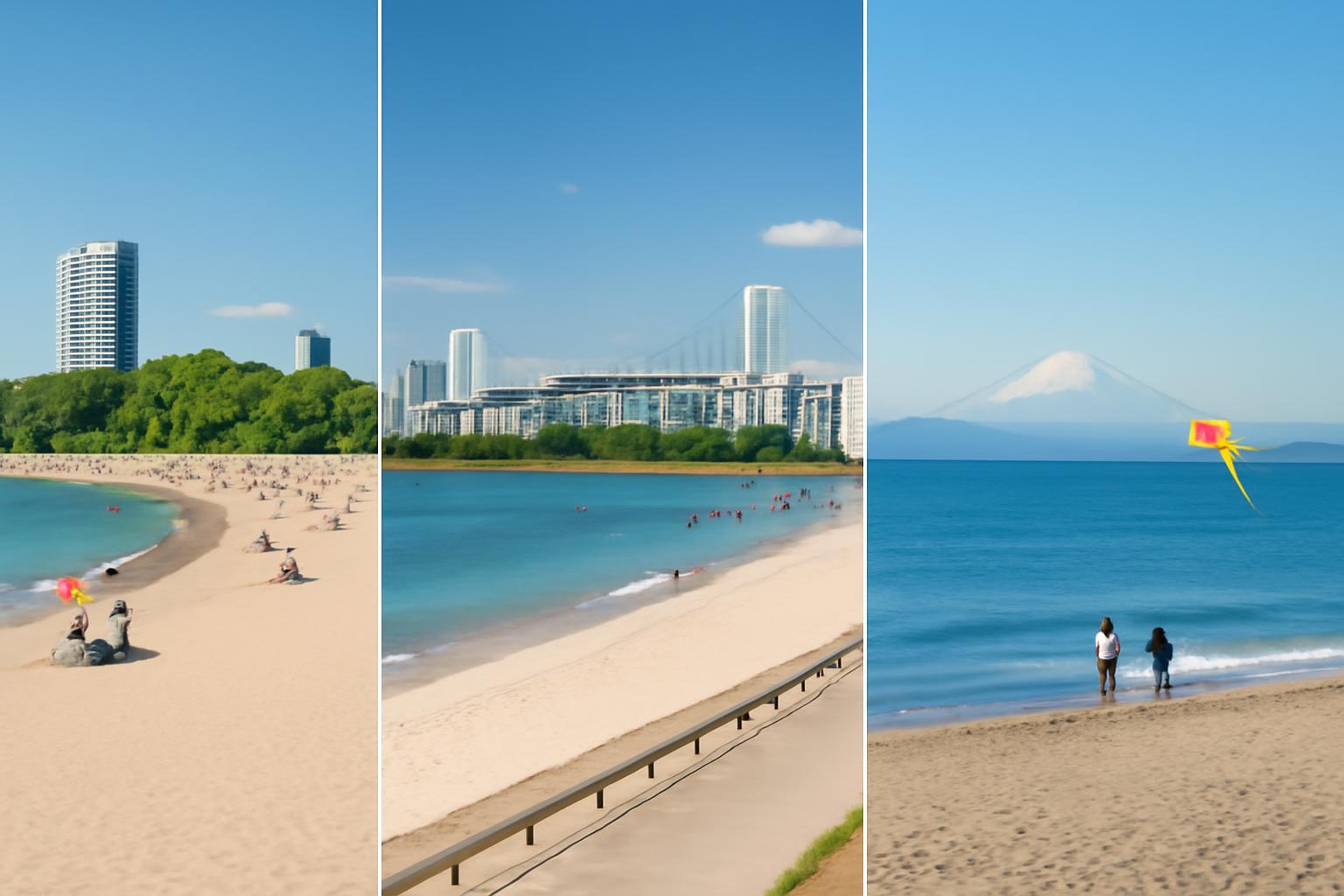
Central Tokyo has two heavily restricted beaches. Other picks are one to two hours away by train or on Tokyo's own Izu Islands.
Overview
There are almost no swimmable beaches in central Tokyo, so “best beaches in Tokyo” really means three different things: two in-city beaches with heavy restrictions (Odaiba and Kasai), day-trip beaches one to two hours away by train, and Tokyo’s own Izu Islands, which are the literal, highest-rated answer to the question.
Which of the three you should pick depends on your time budget and whether you actually want to swim. Odaiba Marine Park bans swimming outright, while Kasai Marine Park permits it only during a limited summer program, according to GO TOKYO and the park’s own announcements. The coasts of Kanagawa, Chiba, and the Izu Peninsula are where most Tokyo residents go for a real swim, typically within a one to two hour train ride per japan-guide. And Tokyo Prefecture administers a chain of islands with clean beaches, the closest of which, Oshima, is just under two hours away by boat according to GO TOKYO.
One more constraint shapes everything below: the official swimming season around Tokyo runs roughly mid-July through August, per japan-guide. This guide walks through each option, then gives you a comparison table, activity picks, and the ferry fare details no other ranking page includes, so you can choose one beach and go.
Why Central Tokyo Has Almost No Swimmable Beaches
The reason you cannot simply walk to a Tokyo beach and swim is water quality. Japan Starts Here puts it bluntly: the seawater within Tokyo’s urban area is industrial and polluted. Tokyo Bay is a working harbor ringed by one of the world’s largest metropolitan areas, and its inner waters have never been a swimming destination in the modern era.
The sources describing this do differ in framing, and it is worth reconciling them. Japan Starts Here says flatly that there are no swimmable beaches in the city, while japan-guide takes a more precise position: the water quality in the city is rather low, although it has been improving steadily over recent decades, which is why Kasai has recently started lifting its swim ban temporarily when conditions allow. Both are correct. There are sand beaches inside Tokyo, and you can have a genuine beach afternoon on them, but swimming ranges from prohibited to conditional.
The practical takeaway: treat central Tokyo’s shoreline as a place for sand, views, and waterfront time, not as a swimming destination. If swimming is the point of your day, plan for a train ride or a boat. The next section covers exactly what the two in-city beaches do and do not allow.
Beaches Inside Tokyo: Odaiba and Kasai Marine Park
You can have a beach experience without leaving Tokyo, but you can only swim at one of the two options, and only during a limited window. The two literal in-city beaches are Odaiba Marine Park and Kasai Marine Park, and their rules are very different.
Start with the most common mistake: arriving at Odaiba expecting to swim. Odaiba’s man-made beach looks inviting, and it sits in front of one of the city’s best skyline views, but swimming is prohibited. GO TOKYO states that swimming is not allowed there, though you can enjoy a variety of water sports with a permit, and japan-guide confirms the beach is popular for sunbathing and beach sports events despite the swim ban. Do not read people playing at the water’s edge as permission. Odaiba is the right choice for a short waterfront visit, sand time with kids, and sunset photos, not for getting in the water.
Kasai Marine Park, near Kasai-Rinkai Koen Station on the JR Keiyo Line, is the conditional exception. Japan-guide notes that Kasai has recently started to lift the swimming ban temporarily during the swimming season when the water quality allows. This is a time-boxed program, not a standing right to swim. For 2026, the park’s official site lists a supervised swimming experience at the West Nagisa area from July 19 through August 30, running 10:00 to 16:00, with free participation and a warning that the event can be cancelled at short notice for weather or other conditions.
Because permission depends on water quality and weather, check the park’s official announcements on the morning of your visit rather than trusting any article’s dates, including this one. If the program is running, Kasai is the only place you can swim in seawater without leaving Tokyo. If it is not, take the train.
Kamakura and the Shonan Coast: The Convenient Default
If you want the easiest good swim from central Tokyo, head southwest to Kamakura and the Shonan coast in Kanagawa. This stretch is the default beach escape for Tokyo residents because it sits within the one to two hour train range japan-guide describes, and because you can pair the beach with real sightseeing in the same day.
The anchor beaches are Yuigahama and Zaimokuza, two popular swimming beaches located beside one another on the Kamakura coast, per japan-guide. Yuigahama is the standout for families: JAL’s travel guide notes it has the longest shoreline of Kamakura City’s three swimming beaches and that children can swim safely there because the water is shallow and the waves are relatively calm. Its proximity to Tokyo, also noted by JAL, means you can spend the morning at Kamakura’s temples and reach the sand by early afternoon without backtracking.
West along the coast, the character shifts from swimming to board sports. At Kugenuma, Japan Travel reports that paddleboarding and windsurfing are popular, with several local schools offering lessons for beginners. Further west, Southern Beach Chigasaki is widely regarded as Japan’s surfing birthplace, according to Japan Travel, drawing both beginners and seasoned surfers with consistent waves and an established surf culture.
The trade-off on this coast is popularity: these are the closest real beaches to a city of many millions, so summer weekends are busy. But if your goal is a low-friction beach day with a swim, a lesson, or a temple detour, Kamakura and Shonan are the sensible first choice.
Zushi and Hayama: Mt. Fuji Views and the Wind Question
Zushi and Hayama, just south of Kamakura, are the beaches to pick if you want a Mt. Fuji view with your swim. Japan-guide notes that these west-facing towns hold the more popular beaches on this stretch of coast and offer views of Mount Fuji on clear days, while Japan Travel adds that clear days bring views of both Enoshima Island and Mt. Fuji from the Shonan shoreline.
Zushi comes with a caveat worth resolving, because published guides describe it inconsistently. Some accounts present it as a calm, shallow, family-friendly beach, while others describe days when wind makes swimming unpleasant or impractical. Both descriptions can be true; this is a west-facing bay where conditions vary day to day, not a beach that is permanently one thing or the other. The practical fix is simple: check the day’s wind forecast before committing, and if the forecast looks rough, Yuigahama’s calmer, shallower water one stop up the coast is the safer family fallback.
Also note that beaches in this area sit near residential towns, and japan-guide reports that some beaches near urban areas prohibit alcohol, exposed tattoos, and noise. Zushi is commonly cited among the stricter beaches, so read the posted rules when you arrive.
Izu Peninsula: The Best Water Near Tokyo
If water quality is your priority, the Izu Peninsula in Shizuoka Prefecture is the repeated answer across every serious source. Japan-guide states that the peninsula offers many of the best beaches near Tokyo, especially around its southern tip, and Japan Starts Here singles out Shirahama Beach in Shimoda as a personal favorite among all the beaches near Tokyo. The catch is distance: the southern tip is the far end of the day-trip range, and many visitors treat Shimoda as an overnight rather than a day trip.
The peninsula also holds the region’s snorkeling exception. Japan-guide notes that most beaches around Tokyo are not ideal for snorkeling and diving except for a few on the Izu Peninsula. The best known of these is Hirizo, near the peninsula’s southern tip, which is reachable only by a two-minute ferry ride from Nakagi Port at 2,000 yen for a round trip, per japan-guide. That boat-only access keeps the water clear and the crowds bounded, but it also means you should confirm the ferry is operating before building a day around it.
One access reality applies across southern Izu: the remoter the beach, the thinner the public transport. Some coves rely on infrequent buses or boats, so if you are traveling without a car, favor beaches near train stations and treat the remote ones as destinations you plan around, not spontaneous stops. Atami, at the peninsula’s northern gateway, is the easy entry point, roughly 50 minutes from Tokyo by bullet train according to Japan Travel, and it pairs a city beach with a famous hot spring town.
Chiba, the Boso Peninsula and Ibaraki
East of Tokyo, Chiba’s Boso Peninsula and Ibaraki offer beaches that trade Shonan’s convenience for space and, in places, clearer water. These are the right options if you want fewer people or a specific activity the western coast does not serve as well.
Onjuku, on Chiba’s outer coast, is the standout for surfers who want room. Japan Travel describes wide, sandy shores and clear water, and calls it a quieter alternative for experienced surfers. That “quieter” label is one of the few crowd signals in any source, which makes Onjuku a reasonable pick if busy Shonan weekends put you off.
Ubara, also along Chiba’s coastline, is the east side’s snorkeling answer. Japan Travel describes it as a secluded stretch with clear waters that is a favorite among snorkeling enthusiasts. Between Ubara and the Izu spots, snorkelers have exactly two mainland directions worth considering; everywhere else near Tokyo, japan-guide’s assessment that the region is not ideal for snorkeling holds.
North of Chiba, Oarai Sun Beach is one of the biggest beaches in Ibaraki Prefecture, and possibly the biggest, per japan-guide. Scale matters here: a large beach absorbs crowds better on peak days.
During the official season, these beaches share the region’s beach-hut culture. Japan-guide notes that temporary huts open during the swimming season selling food and drinks, which means you do not need to pack a full day’s provisions for an in-season visit. Outside the season, bring what you need.
Tokyo’s Izu Islands: The Literal Best Beaches in Tokyo
Here is the answer competitors bury: the best beaches actually in Tokyo are on Tokyo’s islands. GO TOKYO confirms that Tokyo has its own chain of islands offering beautiful, clean beaches and outdoor hot springs, and Japan Starts Here notes the Izu Islands are administered by Tokyo Prefecture even though they sit far from the city. If you take the search phrase literally, this is where it points.
The rankings back this up. On Tripadvisor’s list of the best Tokyo Prefecture beaches, Odaiba holds the top spot as an attraction, but the beaches behind it are almost entirely island beaches: Kominato, Kopepe, Sokodo, Tomari, and Habushiura. Traveler reviews on that page describe rich coral reefs with several snorkeling points at one beach, and a black sand beach formed from volcanic ash on Hachijojima. No mainland day-trip beach cracks the top of Tokyo’s own ranking.
The islands are also reachable. GO TOKYO states that Oshima, the closest island, is just under two hours away by boat, which puts an island beach inside the same travel envelope as the far end of the Izu Peninsula. Further out, Niijima holds the chain’s headline beach: Habushi Beach, on the island’s east side, has 6.5 kilometers of white sand and is an internationally renowned surfing destination that attracts professionals from around the world, per GO TOKYO.
So the honest hierarchy looks like this: for a beach in Tokyo, the islands beat the city’s own shoreline decisively. The question is logistics, which the next section answers.
Ferries to the Islands: Routes, Fares and Day-Trip Feasibility
Getting to the island beaches means a passenger ship, and the operator Tokai Kisen publishes the routes and fares. Its official fare table confirms a Tokyo route serving Oshima, Toshima, Niijima, Shikinejima, and Kozushima, plus jet ferry routes connecting Atami and Ito with Oshima, per the May 2026 fare table.
The table prices the Tokyo route by cabin class. Key points from the document:
- One listed fare row on the Tokyo route runs from 5,750 yen in 2nd class up to 16,090 yen for VIP, with intermediate tiers (Special 2nd 8,630 yen, 1st class 11,500 yen, Special 1st 13,790 yen) and a 9,310 yen jet ferry figure.
- All fares include consumption tax.
- Infants (age 1 to 6) and babies travel free, with the child fare applying in specific cases, such as a second and any further infants accompanying one adult.
- The table applies to a specific month (this one covers May 1 to 31, 2026), so fares change month to month.
Two honest caveats. First, the published table lists fare figures without unambiguous per-island labels in the excerpted format, so treat the numbers above as the documented fare structure rather than a quote for your specific island; confirm the exact fare for your destination when booking. Second, departure terminal details, sailing schedules, and journey times per island are not in the fare document, so check them on Tokai Kisen’s site before planning. With Oshima under two hours away per GO TOKYO, a long day trip to the nearest island is plausible; for Niijima and beyond, plan an overnight.
How to Choose Your Beach: Comparison at a Glance
Choosing comes down to four questions: how far will you travel, can you actually swim, what do you want to do there, and how strict are the local rules? The table below compares the beaches covered in this guide on exactly those axes, using only what the sources support.
| Beach / Area | Travel from Tokyo | Swimmable? | Best for | Rules and notes |
|---|---|---|---|---|
| Odaiba Marine Park | In the city | No (swimming prohibited, per GO TOKYO) | Sand, views, beach sports | Water sports need a permit |
| Kasai Marine Park | In the city | Conditional (limited summer program, per japan-guide and park site) | A swim without leaving Tokyo | Designated zone only; can be cancelled for weather |
| Yuigahama (Kamakura) | ~1 hr by train (within japan-guide’s 1–2 hr range) | Yes, in season | Families; shallow, calm water (JAL) | Standard seasonal rules |
| Kugenuma (Shonan) | ~1 hr by train | Yes, in season | Beginner SUP and windsurf lessons (Japan Travel) | Standard seasonal rules |
| Southern Beach Chigasaki | ~1 hr by train | Yes, in season | Surf culture, all levels (Japan Travel) | Standard seasonal rules |
| Zushi / Hayama | ~1 hr by train (Hayama ~50 km, per Japan Starts Here) | Yes, wind-dependent | Mt. Fuji views (japan-guide) | Urban-area beaches can ban alcohol, tattoos, noise |
| Shirahama (Shimoda, Izu) | Far end of day-trip range; overnight recommended | Yes, in season | Best water near Tokyo (japan-guide, Japan Starts Here) | Remote access; plan transport |
| Hirizo (southern Izu) | Boat-only, 2,000 yen round trip (japan-guide) | Snorkeling-focused | Snorkeling | Ferry-dependent access |
| Onjuku (Chiba) | Train, east coast | Yes, in season | Quieter surfing (Japan Travel) | Quieter than Shonan per Japan Travel |
| Ubara (Chiba) | Train, east coast | Snorkeling-focused | Snorkeling (Japan Travel) | Secluded |
| Oarai Sun Beach (Ibaraki) | Train, northeast | Yes, in season | Space; one of Ibaraki’s biggest (japan-guide) | Standard seasonal rules |
| Oshima (Izu Islands) | Just under 2 hr by boat (GO TOKYO) | Yes | Clean island beaches, hot springs | Ferry schedules govern the day |
| Habushi, Niijima (Izu Islands) | Ferry, overnight practical | Yes | World-class surf, 6.5 km sand (GO TOKYO) | Confirm sailings with Tokai Kisen |
On crowds, the evidence is thin but consistent in one direction: Japan Travel describes Onjuku as the quieter alternative, and the Shonan beaches are the closest sand to the metropolis. Reasonable planning follows from that: expect peak crowds on summer weekends at the convenient western beaches, and favor a weekday, an early arrival, or the eastern coast if crowds bother you.
Best Picks by Activity: Surfing, Snorkeling, SUP and Families
If you already know what you want to do, the choice narrows quickly. Match your activity to the coast that actually serves it, because the region’s beaches are not interchangeable.
- Families with small children: Yuigahama in Kamakura. JAL notes its shallow water and relatively calm waves make it a beach where children can swim safely, and it is the closest family-grade water to the city.
- Beginner SUP and windsurfing: Kugenuma, where Japan Travel reports several local schools offering beginner lessons.
- Surf culture and all-level surfing: Southern Beach Chigasaki, Japan’s surfing birthplace per Japan Travel. For serious waves, GO TOKYO says surfers head to Chiba, Kanagawa, or down to Izu, and Onjuku serves experienced surfers who want quieter water.
- World-class surf: Habushi Beach on Niijima, the internationally renowned destination GO TOKYO says draws professionals globally.
- Snorkeling: Hirizo on southern Izu or Ubara in Chiba, the two mainland exceptions japan-guide and Japan Travel identify, plus the island beaches where Tripadvisor reviewers report coral reefs and multiple snorkeling points.
If you fall into more than one category, weight the family constraint highest; the sports beaches all have alternatives, but calm shallow water close to Tokyo essentially means Yuigahama.
Convenience vs. Water Quality: The Core Trade-off
Every choice in this guide reduces to one trade-off: the closer the beach, the more compromised the experience, and the sources are unanimous about which end of the spectrum wins on quality. Japan Starts Here says you realistically need at least an hour to reach any swimmable beach from Tokyo, and that the nearest ones are in Hayama, about 50 km away. Meanwhile the beaches repeatedly named best, southern Izu per japan-guide and the clean island beaches per GO TOKYO, sit at two hours or beyond, or across a ferry ride.
A simple decision rule follows. If you have half a day to a full day, take the Kamakura and Shonan option: roughly an hour each way, a genuine swim at Yuigahama, and temples or the Enoshima area folded into the same trip without backtracking. If you have a full long day, Atami’s 50-minute bullet train ride (per Japan Travel) opens northern Izu, or a very early start reaches Oshima’s island beaches. If you have a night to spare, spend it in Shimoda for Shirahama or on an island; that is where the water everyone praises actually is.
Do not split the difference by rushing to far Izu and back in one day. The travel overhead eats the beach time that justified the trip.
Travel Times and Access From Central Tokyo
Plan around one honest baseline: the nearest swimmable beaches take about an hour to reach, per Japan Starts Here, and most good options sit within a one to two hour train ride in Chiba, Kanagawa, and on the Izu Peninsula, per japan-guide. Nothing worthwhile is closer, apart from the restricted in-city beaches.
The sourced access facts worth building your route around:
- Station-to-sand walks are short. Japan-guide notes coastal beaches can usually be reached in 5 to 20 minute walks from the nearest train station, so you rarely need a bus for the mainstream beaches.
- Kamakura and Shonan: about an hour southwest by train, with Yuigahama and Zaimokuza on the Kamakura coast per japan-guide.
- Atami (northern Izu): approximately 50 minutes by bullet train, per Japan Travel, the fastest route to Izu water.
- Southern Izu and Hirizo: the far end of the range; Hirizo adds a two-minute ferry from Nakagi Port at 2,000 yen round trip, per japan-guide.
- The islands: Oshima is just under two hours by boat per GO TOKYO, on Tokai Kisen’s Tokyo route.
Train fares for these day trips are not documented in this guide’s sources, so budget qualitatively: a nearer beach costs less and leaves more of the day for the sand. Where a route involves a boat leg, confirm operating status with the operator before you commit, since a missed or cancelled ferry can strand your plan in a way a missed train cannot.
Swimming Season, Rules and Beach Facilities
The single most important date range in this guide: the official swimming season at beaches around Tokyo typically runs from mid-July through August, and lifeguards are on duty during that window, per japan-guide. GO TOKYO puts it similarly, describing beach swimming season as generally limited to July and August. Individual municipalities set exact dates; for 2026, for example, Fujisawa City’s managed seasons for the Katase and Kugenuma beaches run from July 1 into September, according to a 2026 swimming guide citing the city’s announcements, so check the specific beach’s dates rather than assuming a uniform calendar.
In-season beaches come with real infrastructure. Japan-guide describes temporary beach huts that open during the swimming season and provide showers, changing rooms, shaded rest areas, food, drinks, and rental beach gear. You can arrive light during the season; outside it, none of that exists.
The rules deserve equal attention, because they are stricter than many visitors expect:
- Tattoos: some beaches near urban areas prohibit exposed tattoos, per japan-guide, and the restriction extends to pools. GO TOKYO states that persons with tattoos, including temporary tattoo stickers and body paint, are not permitted to enter Tokyo Summerland. If you have visible ink, check each venue’s policy before traveling and plan to cover up on stricter beaches.
- Alcohol and noise: the same urban-area beaches can prohibit alcohol consumption and noise, per japan-guide. Zushi is commonly associated with strict enforcement.
- Designated swim zones: where swimming is permitted conditionally, as at Kasai’s West Nagisa program, stay inside the marked zone and follow staff instructions.
None of these rules should stop your trip, but any of them can end it at the entrance if you are surprised by them. Read the posted signage when you arrive; it overrides anything you read online.
Visiting Beaches Outside the Official Season
A beach trip outside mid-July through August can still be worthwhile, but it is a different kind of trip. The season facts from japan-guide cut both ways: lifeguards are on duty during the official season, which means outside it there are no lifeguards, and the beach huts that supply showers, changing rooms, and food are seasonal too. Treat off-season swimming with real caution and self-sufficiency, and skip it entirely with children.
What survives the season’s end is everything that never depended on swimming. Odaiba’s sand, skyline views, and beach sports scene are year-round draws, since swimming was never allowed there anyway, per GO TOKYO and japan-guide. Surf destinations keep their purpose too; waves do not follow the municipal calendar, and Chigasaki’s surf culture and Chiba’s breaks remain active for equipped surfers. Scenic coasts, from Zushi’s Mt. Fuji sightlines on clear days to the islands’ volcanic shorelines described in Tripadvisor reviews, reward a visit in any month.
The practical rule: off-season, go for views, walks, and board sports you are equipped for, and save the swim for July and August.