
Use the Right Gate for a Simple Shinjuku Gyoen Visit
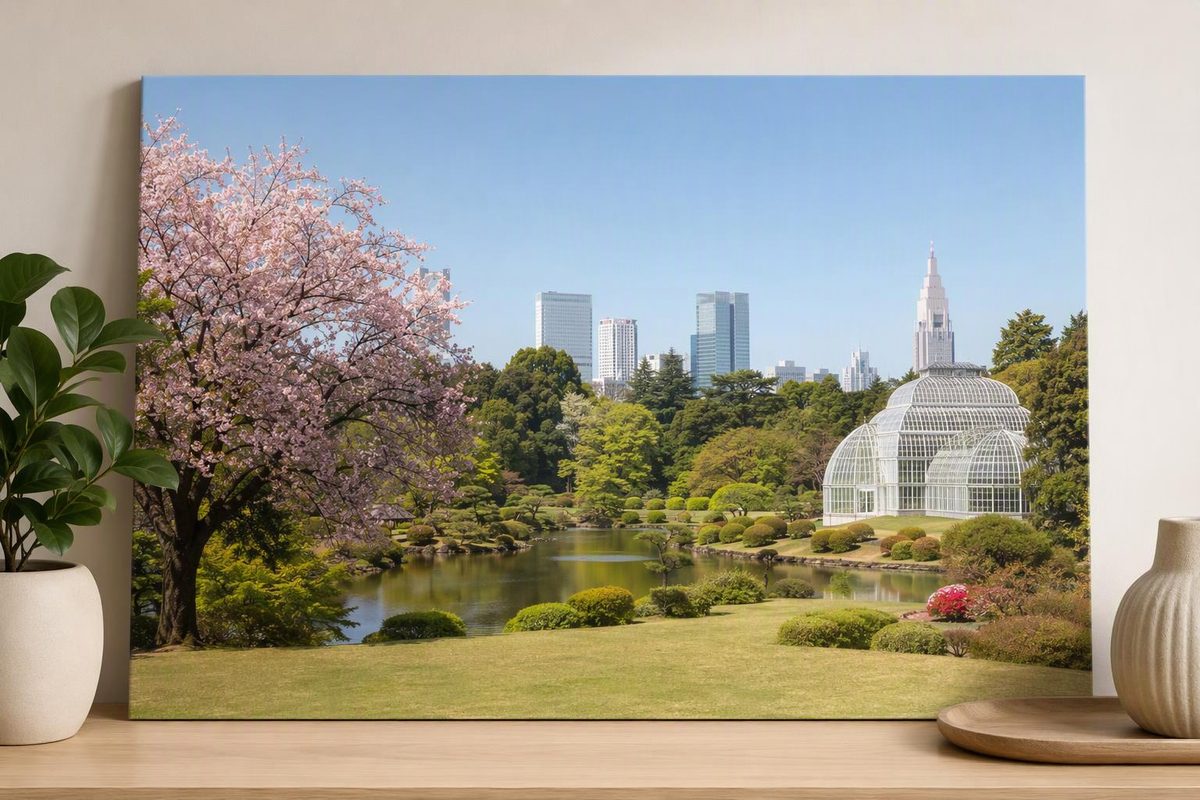
Choose the right gate, check seasonal hours and follow a compact route through Shinjuku Gyoen’s lawns, formal garden, ponds and greenhouse.
Shinjuku Gyoen National Garden is the spacious, paid garden southeast of Shinjuku Station—not a small neighborhood park beside the station. Its 58.3 hectares combine broad lawns, a geometric formal garden and a Japanese strolling garden, so gate choice matters if you want to avoid crossing the grounds twice. The garden’s perimeter is 3.5 kilometers, and it contains roughly 10,000 trees (Ministry of the Environment).
Allow about two hours for a purposeful first visit, or three hours if you want tea, a leisurely greenhouse stop or time on the lawn. It also fits naturally into a wider Shinjuku day; see how it compares with other green spaces in our guide to the best parks in Tokyo.
Choose the gate before choosing the station
| Starting point | Use this gate | Official walking time | Best reason to use it |
|---|---|---|---|
| JR, Keio or Odakyu Shinjuku Station | Shinjuku Gate via the South Exit | 10 minutes | Easiest choice when already in central Shinjuku |
| Shinjuku-sanchome Station, Fukutoshin Line | Shinjuku Gate via Exit E5 | 5 minutes | Short approach from the shopping district |
| Shinjuku-gyoemmae Station, Marunouchi Line | Shinjuku Gate via Exit 1 | 5 minutes | Best for the standard garden route below |
| Shinjuku-gyoemmae Station, Marunouchi Line | Okido Gate via Exit 2 | 5 minutes | Closest gate for starting at the greenhouse |
| JR Sendagaya Station, Chuo-Sobu Line | Sendagaya Gate | 5 minutes | Useful when approaching from the south side of the garden |
| Kokuritsu-kyogijo Station, Oedo Line | Sendagaya Gate via Exit A5 | 5 minutes | Convenient from the National Stadium side |
These routes and walking estimates come from the garden’s official access guide.
Do not automatically route through JR Shinjuku Station. If your train already serves Shinjuku-gyoemmae or Shinjuku-sanchome, getting off there avoids navigating the much larger JR station and shortens the street walk. Conversely, an extra train transfer may not be worthwhile merely to save five minutes outside.
A compact two-hour route
Enter at Shinjuku Gate and leave through Okido Gate. Without long stops, this creates a roughly two-hour, one-way visit through the main landscapes and ends near Shinjuku-gyoemmae Station.
- Landscape Garden: Start across the open lawn, where large tulip trees, Himalayan cedars and other mature trees frame the skyline.
- Formal Garden: Walk through the rose beds and straight rows of sycamores. Its symmetry contrasts with the open lawn; the sycamore avenues turn gold in autumn.
- Japanese Traditional Garden: Follow the path beside Upper Pond. This section contains the Kyu-Goryo-Tei, or Taiwan Pavilion, and two teahouses.
- Greenhouse: Continue toward Okido Gate. The 2,750-square-meter greenhouse displays about 1,000 plant varieties (official highlights).
- Exit at Okido Gate: From here, Shinjuku-gyoemmae Station is about a five-minute walk; the official station-to-gate route uses Exit 2.
The design is part of the attraction, not merely scenery between blossom trees. The Formal Garden uses geometric beds and axes, the Landscape Garden centers on an open naturalistic lawn, and the Japanese garden follows a pond-side strolling layout (official garden description).
For a shorter visit, enter and leave at Okido Gate, combining the greenhouse with the Japanese garden. For a longer route, enter at Sendagaya Gate and finish at Shinjuku Gate, then continue into central Shinjuku. Grouping stops this way follows the same logic as our four-day Tokyo itinerary by area: finish near the neighborhood you want next.
Hours, closure days and admission
Opening hours change by season:
- March 15–June 10 and August 1–September 30: 9:00 a.m.–6:00 p.m.; last entry 5:30 p.m.
- June 11–July 31: 9:00 a.m.–7:00 p.m.; last entry 6:30 p.m.
- October 1–March 14: 9:00 a.m.–4:30 p.m.; last entry 4:00 p.m.
The garden normally closes on Mondays, or the following weekday when Monday is a public holiday, and from December 29 through January 3. It opens daily during the spring special-opening period from March 25 to April 24 and during the November 1–15 Chrysanthemum Exhibition.
Admission is ¥500 for adults, ¥250 for students aged 16 and over, ¥250 for visitors aged 65 and over, and free for those 15 and under. Transportation IC cards are accepted at the entrance gates. An advance e-ticket avoids the ticket-counter line; scan its QR code at the entrance (official admission information).
Check the garden homepage immediately before going because temporary notices can supersede the normal schedule. Internal facilities also close earlier than the grounds. The greenhouse opens at 9:30 a.m.; from October 1 to March 14, its last entry is 3:30 p.m. (facility guide).
Cherry blossom season needs a separate plan
Shinjuku Gyoen has around 900 cherry trees representing approximately 70 varieties. Their staggered flowering periods extend from early-blooming trees in February and early March through Somei Yoshino around late March and early April to double-flowered varieties later in April (official cherry guide). That makes the garden useful even when a forecasted peak date does not match your trip.
The trade-off is crowd control. The garden warns that advance reservations may be imposed on busy weekends, public holidays and other busy days during blossom season. These requirements are date- and time-specific rather than permanent. In 2026, for example, timed booking applied from 10:00 a.m. to 4:00 p.m. on selected late-March and early-April dates; the requirement for April 4 was subsequently removed (Ministry of the Environment notice). Check the current notice rather than relying on a previous year’s procedure.
Lockers, facilities and rules
Cafés, food counters and rest areas operate inside, but their hours vary by facility. Coin lockers sit just inside all three gates: ¥300 for a small locker and ¥500 for a large one. Free wheelchairs are available at every entrance without reservation (official admission information).
Do not bring alcohol, pets other than assistance dogs, bicycles, drones or sports equipment. Smoking—including electronic cigarettes—is prohibited throughout the garden, promenade and parking area. Fires and portable stoves are also banned, as are ball games, badminton, Frisbees and loud musical equipment (official garden rules).
Wheelchair users should consult the garden’s Universal Design map before visiting. It marks slopes, steps, stairs, unpaved or hilly paths and other potential barriers. The official guidance specifically notes gravel paving in the Formal and Japanese gardens.