
Choose Your Route Through Kabukiza and Chuo Dori
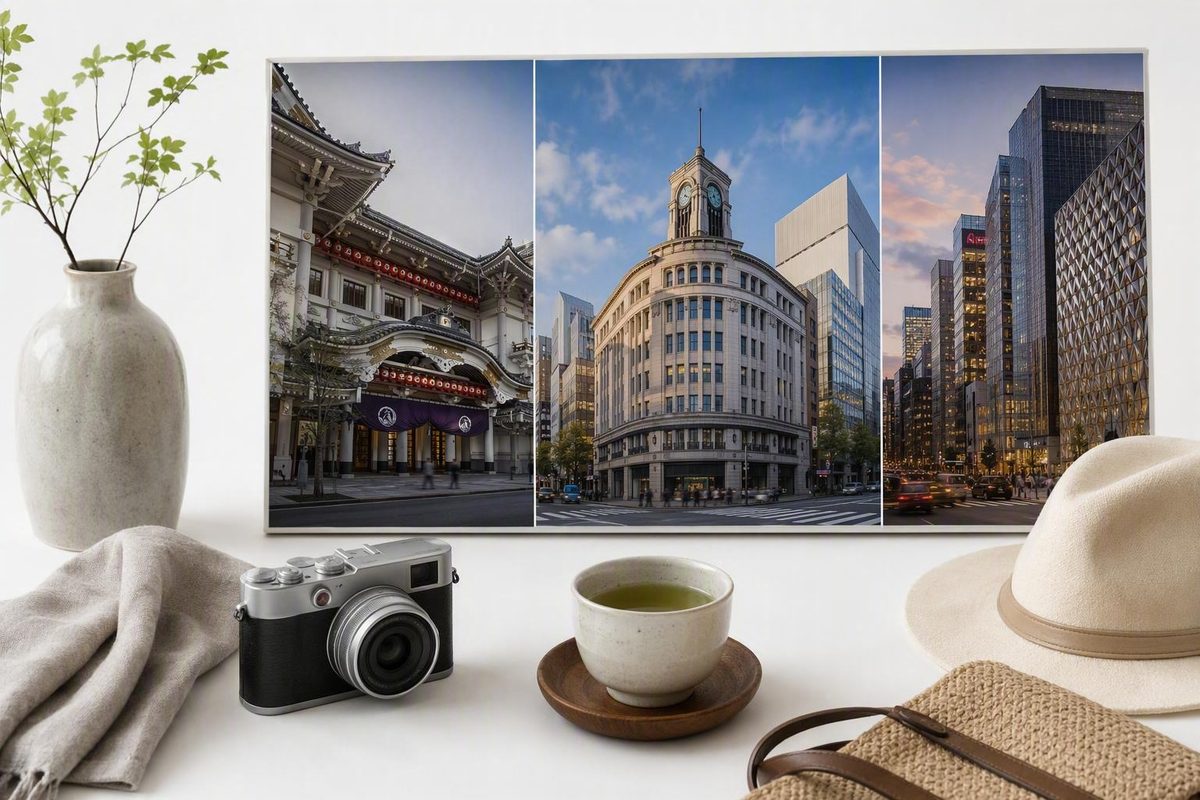
Start at Higashi-Ginza for Kabukiza, or Ginza Station for Chuo Dori shopping, then finish near the station that fits your next trip.
Choose your starting station by priority. Begin at Higashi-Ginza if you want Kabukiza to set the architectural context, then work toward Ginza Six and central Chuo Dori. Begin at Ginza Station if department stores and flagship façades matter more, then continue toward Ginza Six and finish at Kabukiza.
Treat either version as an ordered landmark framework, not a tested turn-by-turn route. Do not assign it a fixed distance or duration: an exterior-only walk is a different commitment from browsing stores, visiting galleries or attending a performance.
The simplest way to structure a Ginza visit
Use two anchors: Kabukiza at the eastern side of the visit and Chuo Dori as the main shopping spine. Between them, Ginza Six provides a contemporary commercial landmark. The central cluster around Ginza Mitsukoshi, Ginza Place and Wako then gives the walk a clear finish.
For an architecture-first visit, use this general order:
- Arrive at Higashi-Ginza Station.
- View the Kabukiza exterior.
- Continue to Ginza Six.
- Join the central Chuo Dori shopping area.
- See Ginza Mitsukoshi, Ginza Place and Wako.
- Finish near Ginza Station or continue toward Yurakucho.
For shopping first, reverse the priorities rather than automatically retracing the same sequence. Start around central Chuo Dori, continue to Ginza Six and finish at Kabukiza before departing from Higashi-Ginza.
This ordering is meant to make the district easier to read, but it is not presented as the shortest possible route. Consult a current map before setting out, particularly if you want to minimize crossings or add side-street venues.
Here, Ginza means the district in Chuo, Tokyo. It is associated with department stores, boutiques, restaurants, cafés, galleries and cultural venues. Its name is connected to the silver-coin mint formerly located in the area. GO TOKYO’s dedicated Ginza guide provides the district history and identifies its principal shopping and cultural landmarks.
A broader GO TOKYO attractions overview also presents Ginza as a Tokyo destination for shopping and gourmet dining, although it does not supply route-level guidance.
Choose your Ginza station by where you want to start
Higashi-Ginza suits a Kabukiza-first visit. Ginza Station puts you directly in the main shopping district. JR Yurakucho is the useful western approach when its location or your onward JR journey fits the rest of the day.
| Station | Supported service or access | Best route role | Limitation |
|---|---|---|---|
| Higashi-Ginza | Tokyo Metro Hibiya Line; Toei Asakusa Line | Begin with Kabukiza | Confirm the current exit and accessible route with the operator |
| Ginza | Tokyo Metro Ginza, Marunouchi and Hibiya lines | Begin in the central shopping district | No particular exit is recommended here |
| JR Yurakucho | JR station west of Ginza | Approach or finish from the west | Requires a street-level walk into Ginza |
The line information and broad access options are listed in the official GO TOKYO Ginza guide. That guide estimates that Ginza is about a five-minute walk from JR Yurakucho Station and around a 15-minute walk from Tokyo Station. These are general estimates, not guaranteed journey times: the stated figures do not define an exact origin, route, pace or street conditions.
Tokyo Station can therefore work as a secondary approach when Ginza follows another central Tokyo stop, but it is not part of the core station comparison. Ginza, Higashi-Ginza and Yurakucho place you closer to the proposed walk.
For Kabukiza, arrive at Higashi-Ginza and follow the station’s current signs rather than relying on an exit number remembered from an older guide. Check the Tokyo Metro Higashi-Ginza station page shortly before travel for current exit, service and accessibility information.
Do not interpret the presence of an elevator or other station facility as proof of a complete step-free journey. A whole-route assessment must also consider the path from the platform, ticket gates, street crossings, curbs and the entrances of any buildings you intend to visit.
Architecture-first route: Kabukiza to central Chuo Dori
Begin outside Kabukiza after arriving at Higashi-Ginza. Its traditional-style exterior provides the clearest architectural starting point, especially when viewed against Ginza’s modern commercial buildings.
Continue toward Ginza Six as the first major contemporary shopping landmark in the sequence. Keep the plan exterior-first unless you have checked the building’s current operating information. Do not assume that a particular exhibition, rooftop area or other interior space will be accessible when you arrive.
From Ginza Six, continue toward the central shopping area and use Chuo Dori to organize the next part of the visit. The street contains department stores, fashion and cosmetics shops, restaurants and cafés. It is more useful here as a visual and navigational spine than as a requirement to enter every major building.
In the central cluster, look for Ginza Mitsukoshi, Ginza Place and Wako. Wako’s clock tower is the most distinctive exterior marker in this group. Treat the three buildings as one central streetscape cluster rather than three separate excursions unless you specifically intend to shop inside.
Ordered stops
- Kabukiza exterior
- Ginza Six
- Chuo Dori
- Ginza Mitsukoshi and Ginza Place
- Wako and its clock tower
- Optional Yurakucho finish
After Wako, finish near Ginza Station or continue toward Yurakucho according to the transport needed next. Ginza Station may suit a journey on the Ginza, Marunouchi or Hibiya line; Yurakucho may make more sense for an onward JR trip. Neither ending should be treated as universally faster.
Shopping-first and no-purchase versions
For a shopping-first visit, begin at Ginza Station and see the central Chuo Dori cluster before continuing to Ginza Six. Matsuya Ginza can be added while you are in the central shopping area. Finish outside Kabukiza and depart from Higashi-Ginza if that station suits your next journey.
GO TOKYO identifies Ginza Mitsukoshi, Matsuya Ginza, Wako, Ginza Place and Ginza Six among Ginza’s established shopping landmarks. It also names Shiseido Gallery, Maison de Hermès, Creation Gallery G8 and Ginza Graphic Gallery as cultural or design-oriented stops in the district.
Those names are options, not assurances of current access. Before adding an interior, check the venue’s own information for:
- Opening hours and closure days
- Current exhibitions
- Admission charges or conditions
- Reservation or timed-entry requirements
- Temporary closures or restricted areas
A gallery or showroom should not be assumed to be free, open or available for casual entry merely because it appears in a destination guide.
Ginza also works without a luxury-shopping budget. An exterior-only version can focus on:
- Kabukiza’s traditional-style façade
- Modern commercial façades around Ginza Six and Chuo Dori
- Wako’s clock tower
- Department-store and flagship window displays
- The changing scale of the central shopping streets
Itoya is another possible stop if stationery and art supplies are more appealing than fashion. A commercial Ginza guide identifies both Itoya and the Wako clock-tower building among the district’s visitor landmarks, but current operating details should be checked directly with each venue before relying on an interior visit.
When a pedestrianized Chuo Dori may improve the walk
A traffic-free period can make Chuo Dori itself part of the experience rather than merely the road between landmarks. Without moving motor traffic, visitors may find it easier to take in the width of the street, its façades and the relationship between the principal storefronts.
JNTO describes the highlighted central shopping strip as approximately one kilometer long and says that Chuo Dori is closed to motor traffic on weekend afternoons (JNTO’s Ginza and Nihonbashi guide). That general description does not establish that pedestrianization will operate on a particular date.
Published destination guides differ in how much detail they provide about applicable days, national holidays and seasonal hours. Confirm the latest schedule, exceptions and cancellation notices against a current official traffic notice shortly before visiting.
If no current notice can be confirmed, plan the route so it still works with ordinary road traffic. The buildings and window displays remain visible, but crossings and pavement conditions will shape how the walk feels.
Checks to make before setting out
A compact exterior walk needs relatively little preparation. Every interior stop adds more variables, so check only the details relevant to the version you intend to follow.
- Stores and galleries: Confirm hours, closure days, current exhibitions, admission terms and reservations.
- Kabukiza: Check performance tickets and visitor access separately from viewing the exterior.
- Temporary restrictions: Look for construction, event controls, closed entrances or other route changes.
- Chuo Dori: Confirm the current traffic-free schedule, exceptions and cancellations.
- Higashi-Ginza: Check the operator’s current exit and accessibility information.
- Onward transport: Decide whether Ginza, Higashi-Ginza or Yurakucho best serves the next journey.
Travelers using wheelchairs, strollers or luggage should assess the complete route rather than a single station facility. Relevant questions include the platform-to-street path, elevator operation, curb conditions, crossings, accessible entrances and facilities inside any planned venue.
Avoid giving the walk a fixed duration. Passing the landmarks from outside may be relatively simple, while entering department stores, visiting a gallery or attending a performance can add queues, browsing time and admission requirements.
The core decision remains straightforward: begin at Higashi-Ginza for Kabukiza and an architecture-first progression, or start at Ginza Station when central shopping is the priority. Use Chuo Dori to structure the visit, finish near the station that fits the next trip and verify changeable access and operating details before leaving.