Feature
What Your Cast-Iron Tub Could Weigh Empty, Filled, and in Use
By Mina Kuroda · · 16 min read
The short answer: typical cast-iron bathtub weight
Many cast-iron bathtubs weigh about 300–500 pounds (136–227 kilograms) empty. That is the most useful general estimate, not a universal specification. Commercial bathtub guides report a broader span of approximately 240–600-plus pounds (109–272-plus kilograms) when standard alcove, compact freestanding, clawfoot, and oversized tubs are considered. These figures are retailer-produced planning estimates rather than an independently measured market average. Aquatica’s commercial weight guide lists style-based estimates from 240 to 600-plus pounds.
For a standard 60 × 30-inch alcove tub, published commercial estimates generally fall around 240–350 pounds empty. When the exact model is unknown, 300–350 pounds is a useful provisional planning range—not a measured average or guaranteed upper limit. One retailer estimates a 60 × 30-inch model at about 320 pounds and emphasizes that weight varies by model and configuration. Horow’s cast-iron bathtub guide provides the 60 × 30-inch estimate.
Cast-iron bathtub weight at a glance
Tub type Useful empty-weight estimate Many cast-iron tubs 300–500 lb (136–227 kg) Standard 60-inch alcove tub About 240–350 lb (109–159 kg) Unknown 60 × 30-inch alcove model Use 300–350 lb (136–159 kg) provisionally Freestanding or clawfoot tub Often about 300–550 lb (136–249 kg) Oversized cast-iron soaker About 500–600+ lb (227–272+ kg)
No single average fits every cast-iron bathtub. Weight can vary with the tub’s full dimensions, shape, iron wall thickness, enamel, integrated skirt, removable feet, support system, and manufacturer-specific design. Two tubs with the same nominal length can therefore differ substantially.
Use the ranges in this guide to begin planning delivery, compare materials, or make a preliminary load calculation. Before purchasing, installing, or moving a tub, obtain the manufacturer’s specification for the exact model. Its stated product weight should supersede every generic estimate in this article.
Estimated empty weight by bathtub style and size
Style is a more useful starting point than length alone because it provides clues about shape, depth, support, and construction. Even so, all figures below are commercial planning estimates, not verified weights for unidentified tubs.
| Tub category | Common size description | Estimated empty weight | Approximate kilograms | Figure type |
|---|---|---|---|---|
| Standard alcove or drop-in | Around 60 in long | 240–320 lb | 109–145 kg | Planning estimate |
| Unknown standard alcove | About 60 × 30 in | 300–350 lb | 136–159 kg | Provisional working range |
| Petite freestanding | About 45–55 in | Around 250 lb | Around 113 kg | Planning estimate |
| Smaller model | About 55 in long | 240–300 lb | 109–136 kg | Planning estimate |
| Modern freestanding or slipper | About 60–75 in | 300–500+ lb | 136–227+ kg | Broad category estimate |
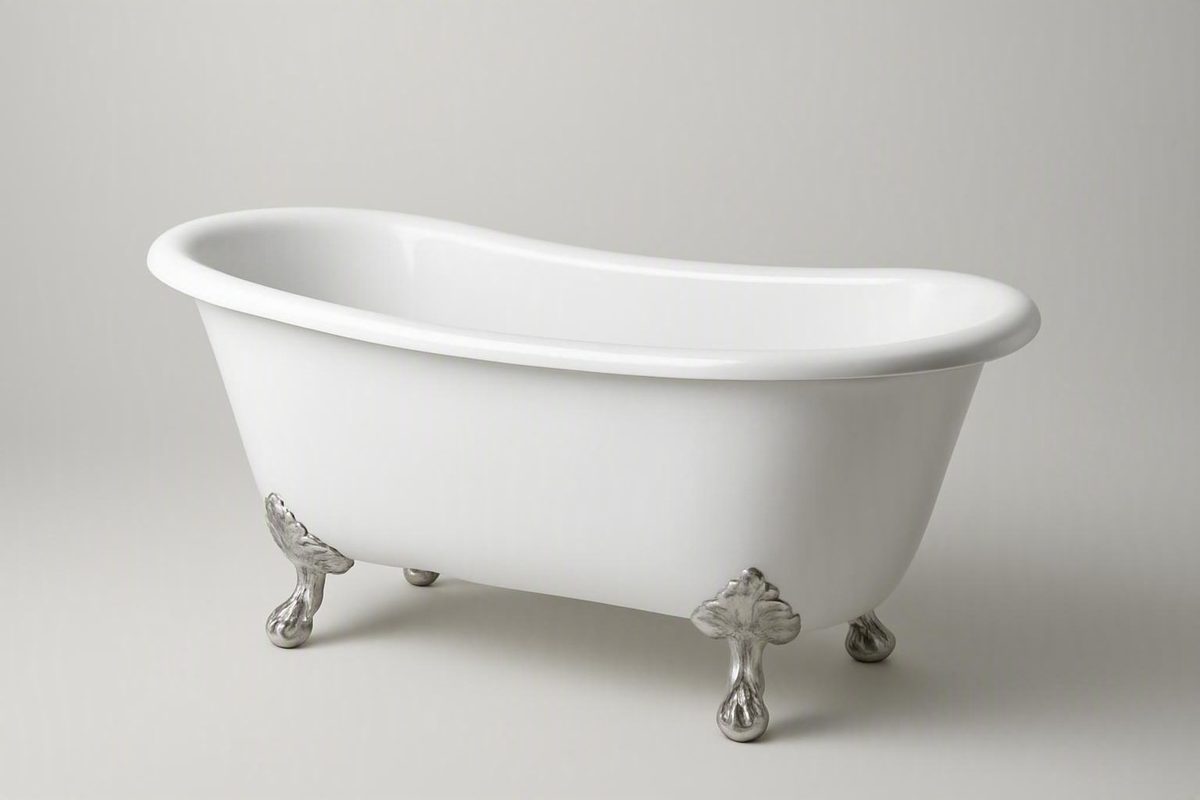
| Vintage clawfoot | About 60–72 in | 350–550 lb | 159–249 kg | Broad category estimate |
| Oversized soaker | More than 70 in | 500–600+ lb | 227–272+ kg | Broad category estimate |
The style categories and most associated ranges are drawn from a commercial bathtub guide, while the 55-inch and alternative 60-inch figures come from a separate length-based retailer guide. They should be read as rough planning categories, not as a dataset proving the average weight of each type.
Commercial estimates do not align perfectly. One style-based table lists a standard 60-inch alcove or drop-in tub at 240–320 pounds, whereas a length-based guide places 60-inch tubs at 300–360 pounds. The latter also estimates 55-inch tubs at 240–300 pounds and 71-inch tubs at 450–500-plus pounds. MonBlari’s commercial guide provides the length-based estimates.
That disagreement is important. It does not establish that either range applies to every model; instead, it shows why “standard size” does not mean standard weight. For an unidentified 60 × 30-inch alcove tub, 300–350 pounds is a practical working range, but it should not be treated as a safety margin or maximum possible weight.
Petite freestanding tubs also resist simple classification. One commercial estimate places 45–55-inch petite models around 250 pounds, while the length-based guide puts 55-inch models at approximately 240–300 pounds. A compact exterior does not necessarily make a tub proportionately light because its base, walls, feet, and other construction details may differ from those of another model.
Modern freestanding tubs are broadly estimated at 300–500-plus pounds, while vintage clawfoot tubs are estimated at approximately 350–550 pounds. These categories can help with early planning, but they cannot identify the weight of a particular antique. An old tub may have replacement feet, missing identification, unusual dimensions, or construction details that do not correspond to modern categories.
At the upper end, oversized 70-inch-plus soaking tubs are estimated at approximately 500–600-plus pounds empty. This category is why the broad planning span extends beyond the frequently quoted 300–500-pound range.
Length belongs in the estimate, but it should not control it. Compare overall width, bathing-well depth, shape, skirt or foot configuration, support system, and any model-specific construction information. Never assign an exact weight to an unidentified vintage tub solely from its length or appearance.
Empty weight, filled weight, and occupied load are different numbers
A bathtub can have several relevant weights. Confusing them can undermine delivery planning and any review of the load during use.
Empty weight, sometimes called product weight, generally means the tub itself before water and occupants are added. Check what the specification includes rather than assuming it covers removable feet, an apron, a skirt, drain hardware, fixtures, or installation materials.
Water-filled weight is the empty tub plus the water actually placed in it. It does not include a person unless the source or calculation explicitly says so.
Occupied load adds every bather to the tub and water. For a two-person tub, include both occupants.
Shipping weight is a separate figure.
Water weighs approximately 8.34 pounds per US gallon. Commercial bathtub guides use this conversion when calculating filled loads. Horow’s guide gives the 8.34-pound conversion and a 32-gallon load example.
Use this formula:
Estimated operating load = empty tub weight + (gallons of water × 8.34 lb) + combined occupant weight
For example:
- Empty tub: 320 lb
- Water: 32 gal × 8.34 lb = 266.88 lb
- Occupant: 180 lb
- Estimated operating load: 320 + 266.88 + 180 = 766.88 lb, or about 767 lb
Useful water-only reference points are:
| Water volume | Added water weight |
|---|---|
| 30 US gal | About 250 lb |
| 50 US gal | About 417 lb |
| 70 US gal | About 584 lb |
The arithmetic is straightforward, but selecting a realistic water volume takes care. A listed capacity may describe filling to a specified level, potentially near the overflow.
For a two-person tub, include both occupants but do not automatically add their weights to the maximum listed capacity. Instead, estimate the water level expected with both people in the tub. If that volume is uncertain, calculate two scenarios:
- A normal-use estimate based on the expected occupied water level.
- A higher plausible estimate for more cautious planning.
The formula does not automatically include platforms, framing, mortar, fixtures, or other installation materials. Those items may matter to a project-specific structural review even though they are not part of the tub’s published product weight.
How heavy can a cast-iron bathtub be when in use?
A filled and occupied cast-iron tub can readily reach approximately 700–1,000-plus pounds. Large-capacity examples may exceed 1,200 pounds, depending on the tub’s empty weight, the actual water volume, and the occupants. These totals are illustrations based on assumed inputs—not predictions for every installation.
A standard-sized planning example is:
- Tub: 320 lb
- Water: 32 gal × 8.34 lb = about 267 lb
- One occupant: 180 lb
- Illustrated total: about 767 lb
This shows why empty weight is useful for delivery planning but incomplete for evaluating the load during use. The movers may handle a 320-pound product, while the floor experiences the combined weight of the tub, water, and bather.
A larger planning example is:
- Tub: 360 lb
- Water: 70 gal × 8.34 lb = about 584 lb
- One occupant: 180 lb
- Illustrated total: about 1,124 lb
The 360-pound tub, 70-gallon water volume, and 1,124-pound total come from a commercial length-based example. MonBlari publishes the assumptions used in that calculation.
Another commercial style guide gives an oversized double-ended example reaching 1,260 pounds under its stated assumptions. That figure is not a standard operating weight for oversized tubs. It demonstrates how quickly a heavy product, a large water volume, and a bather can add up. Aquatica lists the 1,260-pound oversized example in its load table.
Every total depends on its inputs. Reducing water volume from 70 gallons to 50 gallons lowers the calculated water load by about 167 pounds. Adding another bather increases occupant weight but may reduce the water that can remain below the overflow.
For planning, calculate at least two cases:
- Normal-use case: verified empty product weight, realistic occupied water volume, and expected occupants.
- Higher plausible case: a higher realistic water level and the heaviest realistic combination of occupants.
Do not assume that maximum published capacity represents ordinary occupied use. Conversely, do not omit a second occupant or relevant installation materials merely because they are absent from a simplified retailer example.
Can the bathroom floor support the tub?
Possibly—but total weight alone cannot answer the question. Some cast-iron bathtub installations may need reinforcement or professional structural review; others may not. The available evidence does not support saying that every cast-iron tub requires reinforcement.
Floor suitability depends on the complete load path, including:
- Joist dimensions
- Joist spacing
- Unsupported joist span
- Joist direction relative to the tub
- Framing condition
- Previous cuts, holes, notches, or alterations
- Subfloor condition
- Tub location within the span
- Support configuration beneath the tub
- Water and occupant load
- Relevant permanent installation materials
Support style also affects how the load reaches the floor. Apron-front and drop-in tubs may transfer weight through a broader frame or base, while a clawfoot tub transfers its weight through four smaller contact areas. That distinction does not by itself prove that either installation is safe; it identifies a factor that a qualified reviewer may need to consider. Rise distinguishes broader framed support from the four contact points of a clawfoot tub.
Project-specific review is particularly prudent when:
- The tub is oversized or unusually deep
- The installation is on an upper floor
- The building is old or the framing condition is uncertain
- Joists have long unsupported spans
- Framing is damaged, altered, or deteriorated
- Previous renovations cannot be documented
- The tub stands on concentrated support points
- The proposed location differs from the original bathroom layout
Some commercial guides quote a residential live-load design figure of 40 pounds per square foot. That is presented as a uniform design-load value, not as a simple bathtub point-load limit. Multiplying the bathroom’s total area by 40 and comparing the result with the tub’s weight does not establish that a specific location is suitable. Generic figures cannot account for the actual framing, placement, support points, or load path.
Use this checklist before installation:
- [ ] Exact empty product weight
- [ ] Realistic occupied water volume
- [ ] Number and combined weight of occupants
- [ ] Normal and higher-plausible operating-load calculations
- [ ] Support type: continuous base, frame, apron, platform, or feet
- [ ] Number and location of contact points
- [ ] Joist size and spacing
- [ ] Unsupported joist span
- [ ] Joist direction beneath the proposed tub
- [ ] Visible damage, drilling, notching, or alterations
- [ ] Subfloor thickness and condition
- [ ] Tub location relative to walls and bearing supports
- [ ] Weight of relevant permanent installation materials
If the framing or load path is uncertain, consult a qualified contractor or structural engineer. A generic weight guide can identify the questions to ask, but it cannot declare an individual floor safe or unsafe.
Planning delivery, installation, or removal
Cast-iron tubs generally require multiple people or suitable lifting and moving equipment. No universal crew size is safe for every tub because the handling problem involves more than nominal weight.
Commercial recommendations vary. Kingston Brass says moving a cast-iron tub may require two or three people, while other retailer guidance suggests three or four helpers or suitable lifting equipment. The disagreement shows why a crew should not be selected solely from an online rule of thumb. Kingston Brass provides its two-or-three-person guidance and a 483-pound model example.
Before delivery or removal, verify the empty product weight and exterior dimensions.
Walk the entire access route and document:
- [ ] Exterior and interior door widths
- [ ] Hallway width
- [ ] Stair width, rise, run, and overhead clearance
- [ ] Tight corners and changes in direction
- [ ] Landings and turning space
- [ ] Thresholds and other elevation changes
- [ ] Floor and wall protection
- [ ] Secure grip or approved lifting points
- [ ] Locations where moving equipment can be positioned
- [ ] Final tub orientation in the bathroom
- [ ] Whether the tub must be tilted, rotated, or stood on end
- [ ] Doors, trim, railings, or fixtures that obstruct the route
Tight turns can prevent a long tub from rotating even when each doorway is individually wide enough.
Do not attempt to move a 250–500-pound tub alone. A commercial removal guide gives that approximate weight range and specifically warns against solo handling. Dumpsters.com provides the handling warning in its cast-iron tub removal guide.
Follow the manufacturer’s handling instructions when available. If the tub’s weight, geometry, stairs, grip points, or access route create uncertainty, use professional installers or appropriate moving and lifting equipment.
Intact delivery and destructive removal are different projects. Removal planning may involve additional hazards and requires its own safety assessment; destructive removal methods are outside the scope of this weight guide.
How cast iron compares with acrylic and enameled steel
Cast iron is substantially heavier than the two common alternatives considered here.
| Bathtub material | Commonly cited empty-weight range |
|---|---|
| Cast iron | 300–500 lb |
| Enameled steel | Approximately 150–200 lb |
| Acrylic | Approximately 50–100 lb |
These are broad commercial estimates rather than specifications for every model. Long Home reports the 300–500-pound cast-iron range and 150–200-pound enameled-steel range, while other commercial material guides place acrylic tubs at approximately 50–100 pounds. Long Home provides the cast-iron and enameled-steel comparison.
Actual weight still depends on the model and dimensions. An oversized acrylic tub may weigh more than a compact acrylic tub, just as cast-iron products vary by size and configuration.
The practical difference is substantial. Lighter acrylic and enameled-steel tubs are generally easier to carry, turn, and position. They may also simplify handling where stairs, narrow halls, or restricted landings are involved. Cast iron’s dense iron body and enamel finish account for much of its greater product weight.
Choosing cast iron makes it especially important to verify the access route, calculate the complete operating load, and investigate questionable framing before the tub arrives. That does not mean every cast-iron installation needs reinforcement; it means the project should not rely on an unverified generic assumption.
How to get the exact weight before work begins
For a modern tub, the preferred source is the manufacturer’s current specification sheet for the exact product. Match all of the following:
- Brand
- Complete model number
- Length and width
- Installation type
- Drain orientation, if configurations differ
- Base, apron, skirt, or foot configuration
- Water-capacity specification
Do not rely only on a collection or product-family name.
Confirm whether the published figure is product weight or packaged shipping weight. Also check whether feet, skirts, aprons, drain components, or accessories are included. If the documentation is unclear, ask the manufacturer or seller rather than assuming.
For an existing or discontinued tub, record any available identifying information before demolition or refinishing:
- Manufacturer name or logo
- Model number
- Casting marks
- Labels or stamped codes
- Overall length, width, and height
- Interior well dimensions
- Foot or base configuration
- Drain position
- Photographs of distinctive features
Compare those details with reliable archival manufacturer documentation where available.
If no specification can be found, use the style-and-size ranges only for preliminary planning. Apply a suitably cautious project assumption until an installer or another qualified professional can evaluate the tub and working conditions.
Complete this worksheet before installation:
| Planning field | Project entry |
|---|---|
| Brand and exact model | |
| Empty product weight | |
| Does the weight include feet or skirt? | |
| Product weight or shipping weight? | |
| Realistic occupied water volume | |
| Water weight: gallons × 8.34 lb | |
| Number of occupants | |
| Combined occupant weight | |
| Normal-use operating load | |
| Higher-plausible operating load | |
| Support type and contact points | |
| Tub exterior dimensions | |
| Narrowest doorway or passage | |
| Stair and landing constraints | |
| Required moving equipment | |
| Joist size, spacing, span, and direction | |
| Visible framing or subfloor concerns | |
| Structural review needed? |
The most useful general answer remains 300–500 pounds empty, but it is not a universal specification. For an unknown standard 60 × 30-inch tub, approximately 300–350 pounds is a practical preliminary estimate; freestanding, clawfoot, and oversized tubs may be considerably heavier.
Verify the model, calculate water at 8.34 pounds per gallon, include every occupant, and inspect the entire delivery route. That process can produce a responsible planning estimate. Exact product weight and floor suitability require model-specific and building-specific evidence.
Frequently asked questions
How much does a standard 5-foot cast-iron bathtub weigh?
A standard 5-foot, or 60-inch, cast-iron bathtub is commonly estimated at approximately 240–350 pounds empty, although one commercial length-based guide extends the 60-inch estimate to about 300–360 pounds.
When the model is unknown, 300–350 pounds is a practical preliminary range, not an exact average or guaranteed maximum. Check the manufacturer’s specification before ordering labor, selecting equipment, or making structural decisions.
How much does a clawfoot cast-iron tub weigh?
Commercial style guides broadly estimate vintage 60–72-inch clawfoot tubs at approximately 350–550 pounds empty. Smaller models may fall below that range, but compact size alone does not establish the weight.
Do not assign an exact figure to an unidentified antique based on appearance or length. Look for casting marks, manufacturer information, dimensions, archival documentation, and confirmation of whether the feet are included.
How much does a cast-iron tub weigh when filled with water and occupied?
A filled and occupied cast-iron tub can readily reach approximately 700–1,000-plus pounds, while large-capacity examples may exceed 1,200 pounds.
Use:
Operating load = empty tub weight + (gallons × 8.34 lb) + all occupants
A 320-pound tub with 32 gallons of water and a 180-pound occupant totals about 767 pounds. A 360-pound tub with 70 gallons and a 180-pound occupant totals about 1,124 pounds. Actual occupied water volume may be lower than maximum capacity because a bather displaces water.
Will an upstairs floor support a cast-iron bathtub?
It may, but total tub weight alone cannot determine that. Floor suitability depends on joist dimensions, spacing, unsupported span, orientation, condition, subfloor, tub location, support configuration, and the complete occupied load.
Upper floors, older or altered framing, oversized tubs, long spans, and concentrated clawfoot contact points are reasons to seek project-specific review. Do not treat a uniform pounds-per-square-foot figure as a bathtub point-load rating. Ask a qualified contractor or structural engineer to assess the framing when the load path is uncertain.
How many people are needed to move a cast-iron tub?
There is no universally safe number. Commercial guidance ranges from two or three movers to three or four helpers, sometimes with specialized equipment. The correct plan depends on the verified weight, exterior dimensions, grip points, stairs, turns, landings, and available lifting equipment.
Never move a 250–500-pound tub alone. Follow the manufacturer’s instructions and use professional installers or suitable equipment whenever the route or tub geometry makes controlled handling uncertain.