
The Two Tokyo Metro Gates Where Suica Fails
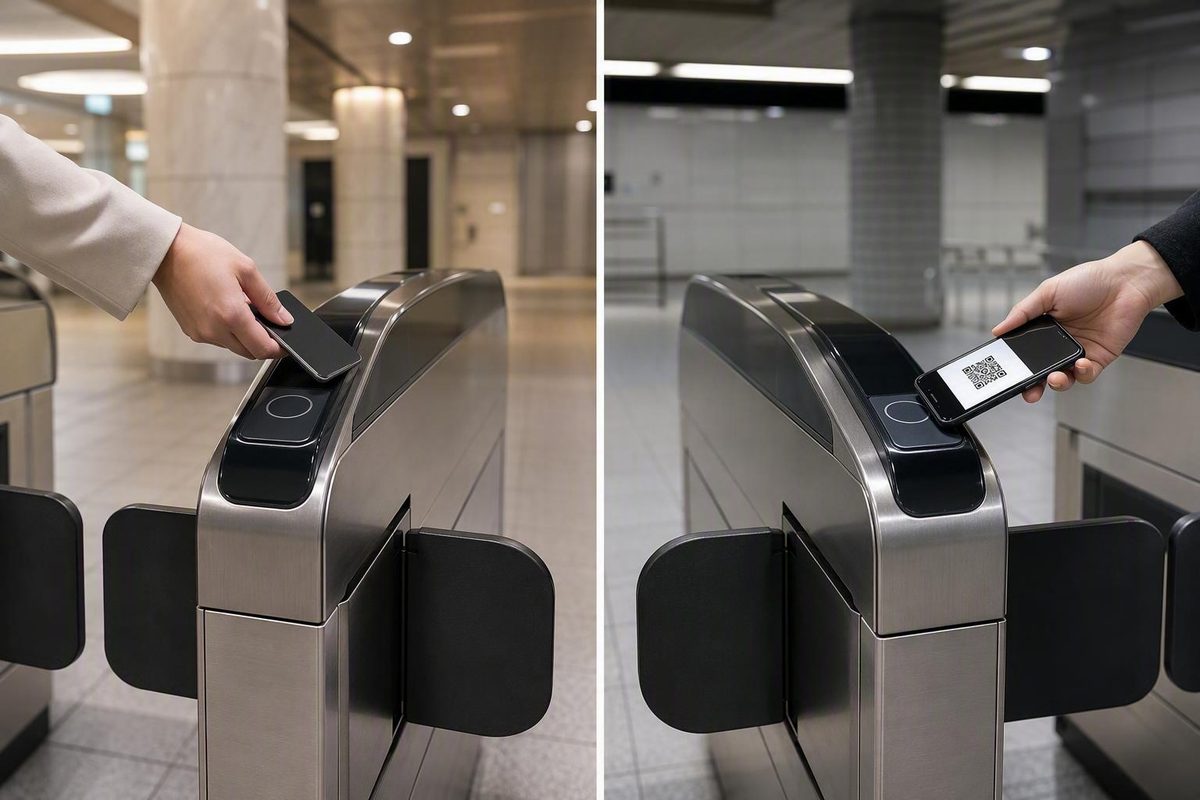
Ginza and Ueno each have one trial gate that takes contactless cards and QR tickets but rejects Suica. Check locations, dates, and alternatives.
Only two Tokyo Metro gates reject Suica: one experimental machine at Ginza Station and one at Ueno Station. Ginza’s machine opened July 22, 2026, Ueno’s opened July 31, and the trial is scheduled through February 2027. Each takes eligible contactless bank cards and QR tickets but rejects Suica, PASMO, Icoca, other transport IC cards, and paper tickets—the reverse of the ordinary gate choice. Every IC-card traveler should use an adjacent conventional gate instead. Japan Today reported the one-machine trial and its payment rules, while a later operating report confirmed both opening dates.
This is not a station-wide conversion or a Tokyo Metro network change. Both stations retain ordinary gates for IC cards and paper tickets. The unusual rule applies only to the single experimental machine in each named gate area.
Choose your gate and payment method; the checker shows which gate wins.
Select the exact gate and what you plan to present. “Eligible” means the card, device, or QR product meets Tokyo Metro’s conditions.
FAIL — The Adjacent Regular Gate Wins
The Ginza trial machine rejects Suica, PASMO, Icoca, and other transport IC cards by design.
Use an adjacent conventional IC-compatible gate in the same station.
TRIAL GATE: FAILAll Gate And Payment Combinations
| Gate | Payment Method | Result | What To Do |
|---|---|---|---|
| Ginza trial | Transport IC card | FAIL | Use the adjacent conventional IC gate. |
| Ginza trial | Eligible contactless bank card | PASS | Tap the same card or device at entry and exit. |
| Ginza trial | Eligible QR ticket or pass | PASS | Present the eligible product to the QR scanner. |
| Ginza trial | Paper ticket | FAIL | Use an adjacent conventional paper-ticket gate. |
| Ueno trial | Transport IC card | FAIL | Use the adjacent conventional IC gate. |
| Ueno trial | Eligible contactless bank card | PASS | Tap the same card or device at entry and exit. |
| Ueno trial | Eligible QR ticket or pass | PASS | Present the eligible product to the QR scanner. |
| Ueno trial | Paper ticket | FAIL | Use an adjacent conventional paper-ticket gate. |
| Other conventional gate | Transport IC card | PASS* | Choose an IC-compatible conventional gate. |
| Other conventional gate | Eligible contactless bank card | CHECK | Choose an equipped gate and confirm the complete route. |
| Other conventional gate | Eligible QR ticket or pass | CHECK | Follow the product instructions and find its compatible scanner. |
| Other conventional gate | Paper ticket | PASS* | Choose an ordinary paper-ticket gate. |
The default result above is Ginza plus Suica: the experimental gate fails, and the adjacent conventional gate is the correct choice.
*Gate equipment still matters. Sources: Japan Today and SoraNews24.
The Usual Suica Advice Is Still Mostly Right
The received wisdom is that Suica or PASMO is the safest default for a visitor using Tokyo transport, while a foreign contactless card is an optional backup. That remains sound advice for mixed itineraries involving Tokyo Metro, JR East, buses, and multiple private railways. Japan’s major transport IC cards are interoperable across most urban trains, subways, and buses, although route-specific exceptions remain. Japan Guide summarizes that broad IC-card coverage.
The Ginza and Ueno machines are narrow exceptions, not evidence against the broader advice. Only one machine at each station excludes transport IC cards. The conventional gates beside it continue to handle Suica, PASMO, other accepted IC cards, and paper tickets.
What has changed is the assumption that every Tokyo Metro gate displaying an open lane will accept Suica. At these two experimental machines, bank-card and QR acceptance was not added alongside the usual media; those are the only media the machine accepts. Tokyo Metro described them as the first credit-card-and-QR-exclusive gates in use in eastern Japan, according to the reports on the trial.
A bank card has also become a viable primary payment method for some Metro-only journeys. Tokyo Metro’s broader Tap to Ride service covers supported journeys on all Tokyo Metro lines, subject to station, equipped-gate, route, transfer, and through-service restrictions. It does not make bank cards identical to Suica. Tokyo Metro’s official Tap to Ride guide gives the current rules.
The Two Machines Are In Specific Gate Areas
Both experimental machines are on the Ginza Line. Their locations matter because Ginza and Ueno have multiple entrances and gate arrays.
| Station | Exact Gate Area | Opened | Trial Machine Accepts |
|---|---|---|---|
| Ginza | Ginza Yonchome Crossing Gate | July 22, 2026 | Eligible contactless cards and QR tickets |
| Ueno | JR Ueno Station Gate | July 31, 2026 | Eligible contactless cards and QR tickets |
Both machines reject Suica, PASMO, Icoca, other transport IC cards, and paper tickets. The reported trial runs through February 2027. SoraNews24 reported the locations, one-machine deployment, accepted media, and planned endpoint.
The machines are visually distinct from conventional gates. Before joining a lane, check the symbols above or on the reader. A contactless bank-card symbol or QR scanner does not imply that the machine also has an IC-card reader.
At Ginza, look specifically within the Ginza Yonchome Crossing Gate area. At Ueno, the machine is at the JR Ueno Station Gate, but its name does not mean a Tokyo Metro bank-card journey can continue directly onto JR East. It remains a Tokyo Metro gate.
If you are approaching with Suica, PASMO, Icoca, or a paper ticket, choose an ordinary adjacent lane. When orienting yourself in a large interchange, identify the operator and gate area before tapping; the same distinction is central to navigating large Tokyo train stations.
The February 2027 date is the reported end of the trial, not a promise about what follows. No cited source establishes whether the machines will remain, be removed, or receive different readers afterward. Travelers using them after that point should verify the current gate rules.
“Credit-Card-Only” Is Not Quite Accurate
The experimental machines accept three related forms of access:
- An eligible physical contactless credit, debit, or prepaid card
- A compatible phone or wearable carrying an eligible payment card
- An eligible QR ticket or pass
They are therefore card-and-QR-exclusive machines, not strictly credit-card-only gates.
A phone can use the machine in two different ways. A wallet containing an eligible bank card communicates with the contactless reader. A phone displaying an eligible QR ticket presents that code to the scanner. These are separate processes even though the same gate houses both readers.
The reporting identifies Tokyo Metro QR products such as single-day unlimited-ride passes as examples. It does not establish that visitors can routinely buy an ordinary single-fare QR ticket. “QR accepted” means that an eligible product can be scanned, not that any QR image or ticketing app will work.
Paper tickets are excluded from the trial machine. Anyone holding one should use a conventional paper-ticket gate in the same station.
Tokyo Metro Can Be Ridden By Bank Card Without Suica
For a supported journey, Tokyo Metro Tap to Ride does not require advance registration, a stored-value balance, or a ticket purchase. Tap an eligible card or compatible device at an equipped origin gate, then present the identical credential at an equipped destination gate.
Tokyo Metro lists Visa, Mastercard, JCB, American Express, Diners Club, Discover, and UnionPay for eligible physical contactless cards. Its displayed smartphone-card list is narrower: Visa, Mastercard, JCB, American Express, and Discover. A network logo does not guarantee approval; the card must support contactless payment and its issuer must authorize the transaction.
The same-credential rule is literal. A plastic card and its version in Apple Pay, Google Pay, or another phone wallet may present different payment credentials. A phone and watch linked to the same account can also be treated separately. Entering with plastic and attempting to exit with the phone can therefore fail. Japan Guide explains the equipped-gate and same-credential requirements.
One card or device covers one passenger. It cannot admit a group by being tapped repeatedly. Every traveler needs a separate card, device, IC card, ticket, or pass.
Tokyo Metro charges the adult paper-ticket fare in 10-yen increments for Tap to Ride. Child fares are unavailable through direct bank-card tapping, so a child using an eligible card is charged the adult fare. Families seeking child pricing should compare a child IC card or appropriate child ticket instead.
A qualifying Tokyo Metro–Toei Subway connection receives a ¥70 discount. Other general fare discounts are not provided, and Tap to Ride cannot be combined with commuter passes or promotional tickets. The cited evidence does not establish automatic daily fare capping for Tokyo Metro.
An overseas issuer may separately apply foreign-transaction or currency-conversion charges. Tokyo Metro does not set those issuer charges, and the draft sources provide no universal figure for them.
Bank-Card Coverage Ends At Some Operator Boundaries
A contactless card can be simpler than Suica for a supported adult Metro-only journey, but it is less forgiving when a route crosses operators.
Tokyo Metro Tap to Ride cannot continue as one journey onto JR East, Saitama Rapid Railway, or Toyo Rapid Railway. A traveler changing from Tokyo Metro to the JR Yamanote Line must finish the Metro journey with the card or device used at entry, then enter JR separately with a fare medium accepted there.
That distinction applies even when a train physically continues onto another company’s tracks. Staying in the same carriage does not prove that the complete journey supports Tokyo Metro’s bank-card payment. Check the destination and every operator involved before entering.
For qualifying Tokyo Metro–Toei Subway transfers that require leaving one gate area and entering another, the out-of-gate transfer must be completed within 60 minutes. Beyond that interval, the later entry can be treated as a new journey.
Nakano has separate handling. A Tap to Ride journey cannot begin there. A journey ending at Nakano must be processed at the staffed gate using the same card or device presented at the origin.
These limits are where the consensus preference for Suica or PASMO is strongest. An IC card is generally more practical for a day combining Tokyo Metro, JR East, buses, and several operators, subject to normal IC-card coverage. A bank card is most compelling when the journey is adult, Metro-only, supported from end to end, and made through equipped gates.
A Rejected Suica Usually Means The Wrong Lane
At Ginza or Ueno, a Suica rejection at the experimental machine is expected behavior. Step away from that lane and use an adjacent conventional IC-compatible gate. Do not interpret the rejection as a blocked card, insufficient balance, or a station-wide refusal of IC cards unless the ordinary gate also reports a problem.
If a bank card is rejected before entry, first confirm that the gate displays the contactless bank-card symbol and that the entire route is supported. Each passenger must have a separate fare medium. If an eligible card continues to be declined, use another accepted method and ask the issuer about the transaction rather than assuming that all foreign cards are blocked.
If entry succeeded but exit fails, retain the exact physical card, phone, or watch used at the origin and go to a staffed gate. Do not substitute another card or switch between a plastic card and its wallet version.
The practical split is narrow but absolute: at the two trial machines, eligible bank cards and QR tickets work while Suica and paper tickets do not. Everywhere else, follow the symbols on the specific gate. Suica remains the more flexible credential for mixed Tokyo transport, while a contactless bank card can remove the need to obtain or top up an IC card for a supported Metro journey.