
Which Tokyo IC Card Should You Get?
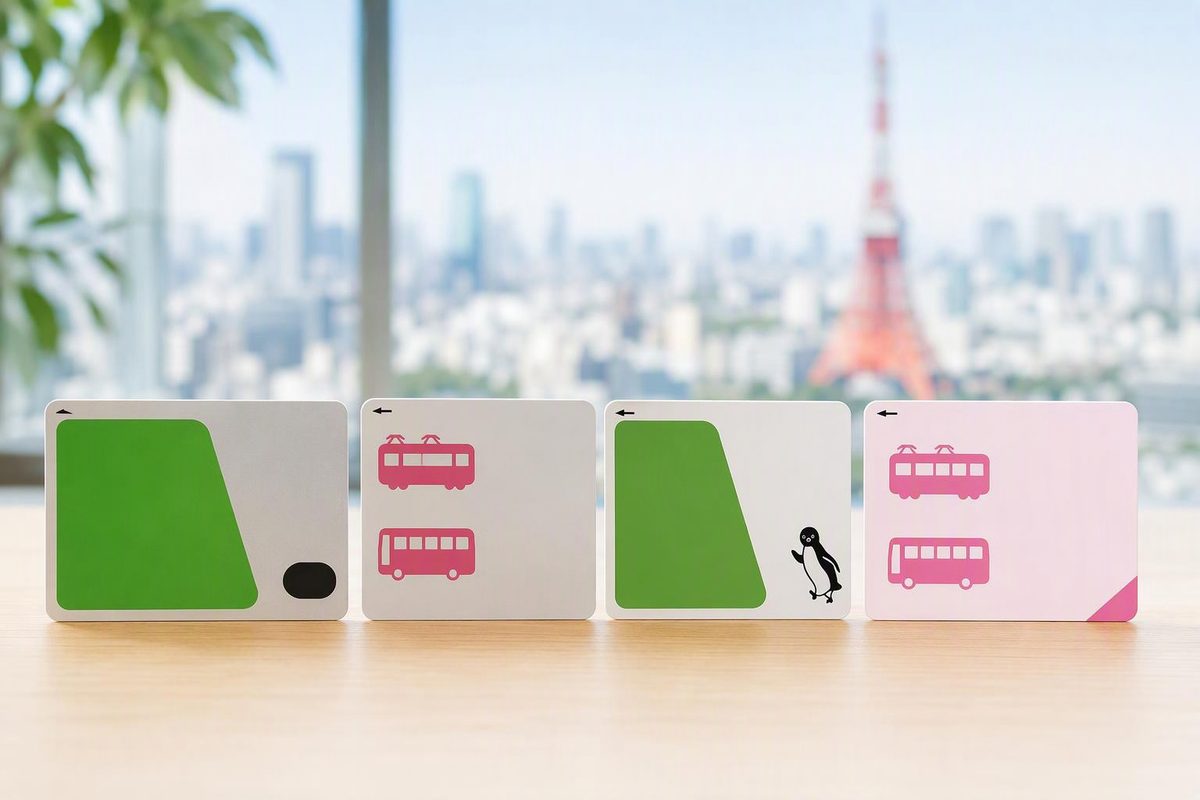
Compare Suica, PASMO, Welcome Suica and TOURIST PASMO by device, validity, refund rules and airport availability.
For most Tokyo trips, Suica and PASMO do the same job. Both pay ordinary fares on participating JR, Tokyo Metro, Toei, private-railway and bus services, and both work for small purchases where a compatible transport-IC logo appears. The important choice is not the brand but the format: physical or mobile, standard or visitor-only.
The short answer:
- Compatible iPhone or Apple Watch: add a regular Suica or PASMO to Apple Wallet. Choose Welcome Suica Mobile if you prefer its English visitor app and accept a 180-day expiry.
- Android phone: check the exact model before relying on mobile IC. Google requires Osaifu-Keitai compatibility for Japanese e-money; a physical card avoids that uncertainty (Google Wallet).
- Trip of 28 days or less, arriving at Narita or Haneda: Welcome Suica or TOURIST PASMO is convenient, but any unused balance is forfeited.
- Longer trip or likely return to Japan: get a standard Suica or PASMO, which has a refundable ¥500 deposit.
Quick comparison
| Card | Best for | Validity | Deposit | Unused balance |
|---|---|---|---|---|
| Regular Suica | Physical card from JR East | Invalid after 10 years without use | ¥500 | Refundable under JR East rules |
| Regular PASMO | Physical card from a participating operator | Standard card, not visitor-limited | ¥500 | Refundable when the card is returned |
| Suica or PASMO in Apple Wallet | Compatible iPhone or Apple Watch | Standard mobile card | None | Issuer procedures apply |
| Welcome Suica | Short visit; physical card | 28 days including purchase date | None | Not refundable |
| Welcome Suica Mobile | Visitors with a compatible Apple device | 180 days from issue | None | Not refundable |
| TOURIST PASMO | Short visit arriving at Haneda or Narita | 28 days from purchase | None | Not refundable |
Suica or PASMO: choose by where you are standing
Suica is issued by JR East; PASMO comes from Tokyo’s subway, private-railway and bus network. In daily Tokyo travel, each can be used across the other’s participating network. PASMO says it works across metropolitan Tokyo and on participating networks elsewhere in Japan, while JR East lists Suica use on trains, subways, buses and monorails in Tokyo and other participating regions (PASMO; JR East).
There is little reason to cross a large station for one brand. If the machine or counter in front of you sells new Suica cards, buy Suica; at a participating PASMO operator, buy PASMO. A regular PASMO purchase includes a ¥500 deposit, and PASMO says credit cards are not accepted for the purchase (PASMO purchasing guide).
Standard cards suit repeat visitors. A regular Suica becomes invalid after 10 years without use. When it is returned to JR East, the ¥500 deposit and remaining value are refundable, with a handling fee of up to ¥220 deducted from the balance (JR East refund rules). PASMO refunds its deposit and stored fare when the card is returned; the balance cannot be refunded while leaving the card active (PASMO procedures).
Best mobile option for an iPhone
Apple Wallet can create a new Suica or PASMO. Apple requires a compatible iPhone or Apple Watch, an Apple Account using two-factor authentication and an eligible payment card in Wallet. Express Mode lets the selected transit card work without opening an app or authenticating at each gate (Apple setup instructions). Apple also notes that some iPhone models may retain Express Mode when the phone needs charging (Apple usage guide).
Welcome Suica Mobile is the visitor-focused alternative. It requires an Apple Pay-compatible device, is for users aged 13 or older and remains valid for 180 days from issue. It can be topped up with a card registered in Apple Pay, but its remaining value expires and is not refundable (JR East Welcome Suica Mobile).
Choose a physical card if device compatibility is uncertain or if each family member needs a simple, separate card.
Welcome Suica or TOURIST PASMO at the airport
The two physical visitor cards have similar core rules: no ¥500 deposit, 28-day validity and no voluntary refund of unused value.
Welcome Suica is available at JR East Travel Service Centers at Narita Airport Terminal 1, Narita Airport Terminals 2–3 and Haneda Airport Terminal 3’s Tokyo Monorail station. It is also sold at centers in major stations including Tokyo, Shibuya, Shinjuku, Ikebukuro and Ueno. Dedicated airport vending machines are at those two Narita stations and Haneda Terminal 3. Its 28 days begin on the purchase date, and JR East asks users to keep the reference paper showing the expiry date (Welcome Suica locations and rules).
TOURIST PASMO is sold by Keikyu at Haneda and Keisei at Narita. Haneda’s traveler ticket machines sell values from ¥1,000 to ¥10,000 and accept credit cards; the Narita information centers sell a ¥2,000 card. Keep its reference paper, and note that a lost card cannot be reissued (TOURIST PASMO).
Choose by arrival railway:
- Keikyu from Haneda or Keisei from Narita: TOURIST PASMO is placed along that route.
- Tokyo Monorail from Haneda or JR/Narita Express from Narita: Welcome Suica is the natural choice.
- Buying later in central Tokyo: use a listed Welcome Suica center or buy a regular Suica or PASMO from a participating operator.
Start with about ¥2,000–¥3,000 rather than automatically loading the maximum. Both visitor cards can be topped up with cash and hold up to ¥20,000, but unused value is not refundable (Welcome Suica; TOURIST PASMO). Make smaller top-ups near the end of the trip.
What an IC card does not cover
An IC card pays the base fare for ordinary local travel. It does not automatically replace every ticket. JR East requires a separate limited-express, express or Green Car ticket where applicable (JR East Suica guide). For the Narita Express or Shinkansen, confirm the required ticket or IC-linked booking instead of relying on stored value alone.
Interoperability also does not make Japan one continuous IC fare zone. JR East warns that Suica cannot be used for a single journey crossing between separate IC areas; buy the appropriate ticket before such a trip.
Each traveler needs a separate card or device at rail gates. Tap the same card once when entering and once when exiting. If the gate closes, move aside and show the original card to station staff rather than trying several cards. At a large hub, decide on your line, gate and exit before walking; the guide to navigating large Tokyo stations explains that sequence, while the Tokyo Station guide applies it to Marunouchi, Yaesu, the Shinkansen and the Keiyo Line transfer.