
A Three-Day Tokyo Itinerary Without Crossing the City Twice
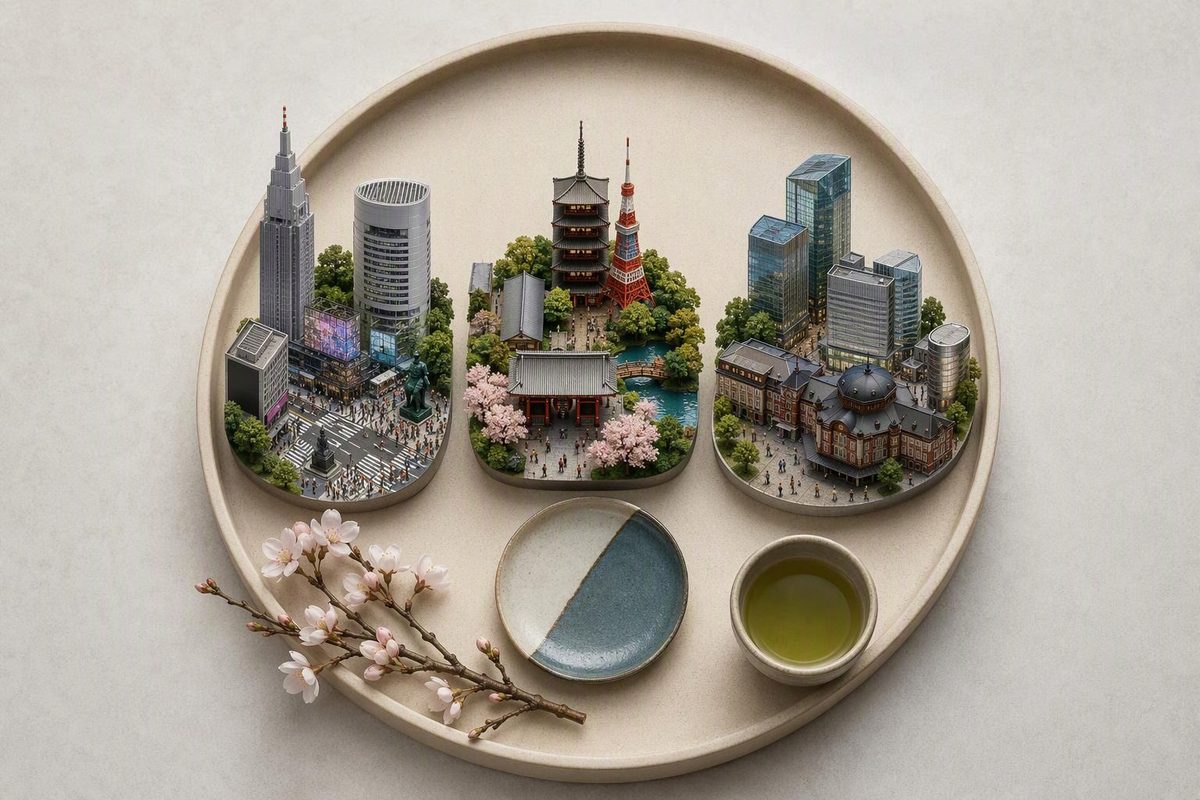
Plan three efficient Tokyo days around Harajuku, Shibuya and Shinjuku; Asakusa and Ueno; then Tsukiji, Ginza and Marunouchi.
The most efficient way to use three full days in Tokyo is to divide them into western, eastern and central clusters. This itinerary keeps the long cross-city rides out of the sightseeing day: most movement is on foot, with one main rail hop when the neighborhoods stop joining naturally.
| Day | Areas | Main rail hop | Booking to make first |
|---|---|---|---|
| 1 | Meiji Jingu, Harajuku, Shibuya, Shinjuku | Shibuya to Shinjuku | Shibuya Sky |
| 2 | Asakusa, Ueno, optional Akihabara | Asakusa to Ueno | Museum or special exhibition |
| 3 | Tsukiji, Ginza, Imperial Palace, Marunouchi | None within the route | Restaurant, if wanted |
This is a walking-heavy plan. An IC card is convenient because the route can involve JR, Tokyo Metro and Toei; it also avoids restricting each day to one operator. For the underlying routing method, see how to plan Tokyo days by area.
Day 1: Meiji Jingu to Shibuya, then Shinjuku
8:30–10:00 — Meiji Jingu Arrive at JR Harajuku Station and follow signs for Meiji Jingu. Do not judge the visit by the short station-to-entrance distance: the wooded approach continues well beyond the first torii, so allow about 90 minutes for the walk to the inner shrine and back.
The shrine is free and opens at sunrise, but closes at sunset. Published closing times range from 4:00 p.m. in December to 6:30 p.m. in June, and some facilities inside keep shorter hours (Meiji Jingu visitor information). Starting here removes that deadline from the rest of the day.
10:00–12:30 — Harajuku and Omotesando Choose one emphasis rather than trying to cover every shopping street:
- Takeshita Street for a compact, crowded strip of youth fashion and snack shops. Return to Meiji-dori afterward to continue toward Shibuya.
- Omotesando for architecture and larger shops. Follow the avenue southeast, then turn toward Shibuya.
Walking between the Harajuku area and central Shibuya is more useful than returning to Harajuku Station, but leave extra time for shopping stops.
12:30–17:30 — Shibuya Have lunch, cross at Shibuya Scramble, then make a compact loop through Center-gai, Spain-zaka, PARCO and Miyashita Park. The detailed Shibuya station and one-day route explains which side of the station each stop occupies.
If Shibuya Sky matters, reserve a timed ticket before the trip. As checked September 30, 2026, it operates from 10:00 a.m. to 10:30 p.m., with last entry at 9:20 p.m. (official Shibuya Sky information). Dated adult admission is ¥2,700 for entry by 2:59 p.m. and ¥3,400 from 3:00 p.m. The rooftop may close because of wind, rain or other weather conditions even when the indoor observatory remains available (official ticket page).
17:30 onward — Shinjuku Take the JR Yamanote Line toward Shinjuku and Ikebukuro. The train ride is brief, but budget roughly 20 minutes overall for reaching the platform, waiting and walking through Shinjuku Station.
Pick one side of Shinjuku:
- East side: Kabukicho, Golden Gai and the restaurant streets around Shinjuku-sanchome.
- West side: Nishi-shinjuku’s skyscrapers and a quieter evening.
Trying to cover both adds station or street crossings without improving the day. Choose the side that fits dinner and your route back to the hotel.
Day 2: Asakusa, Ueno and optional Akihabara
8:30–11:30 — Asakusa Begin at Kaminarimon, continue along Nakamise, pass Hozomon and finish at Senso-ji’s Main Hall. Senso-ji is a Buddhist temple, so pray with your hands together rather than clapping. The temple identifies itself as Tokyo’s oldest and says the present Main Hall was rebuilt in 1958 after the earlier building was destroyed in 1945 (Senso-ji history and visitor information).
After the temple, loop east to the Sumida River or west through the side streets. The Senso-ji route and station guide is useful because “Asakusa Station” can refer to stations run by Tokyo Metro, Toei, Tobu or Tsukuba Express.
11:30–12:00 — Transfer to Ueno Use the Tokyo Metro Ginza Line from Asakusa to Ueno. It is a direct three-station trip. Walking via Kappabashi kitchenware street is possible, but treat that as an additional sightseeing block rather than a quick substitute for the train.
12:00–17:00 — Ueno Eat around Ameyoko or Ueno Station, then choose one substantial afternoon activity. For a first visit, the Tokyo National Museum is the clearest choice. The Honkan presents a chronological route through Japanese art; the museum says a visit needs at least an hour, while two to three hours gives a selective visit room to breathe.
For 2026, the museum lists hours of 9:30 a.m.–5:00 p.m., extended to 8:00 p.m. on Friday and Saturday. It normally closes Monday, or the following day when Monday is a holiday. Regular-collection admission is ¥1,000 for adults; special exhibitions may require a separately priced ticket (Tokyo National Museum hours and fees).
If museums are not the priority, combine Ueno Park and Ameyoko, then take a short JR ride to Akihabara for the evening. Skip Akihabara if you spent most of the afternoon in the museum; forcing both into the same block makes each feel abbreviated.
Day 3: Tsukiji, Ginza, the East Gardens and Marunouchi
8:30–10:30 — Tsukiji Outer Market Use Tsukiji Station on the Hibiya Line or Tsukijishijo Station on the Oedo Line. The market association lists both as about a one-minute walk away; Higashi-ginza is another approach, about three minutes away (official access map).
Tsukiji remains a working district of wholesale and retail food shops and restaurants, but it is no longer the municipal wholesale auction site. That operation moved elsewhere in Tokyo, while the surrounding businesses remained as Tsukiji Outer Market (official Tsukiji Outer Market overview). Have breakfast here, but check the market calendar and the hours of any specific shop rather than assuming every business opens daily.
10:30–13:30 — Ginza Walk northwest through Higashi-ginza, passing Kabukiza, then continue to Chuo-dori. This is more direct than descending into a station for a one-stop ride. It also places Ginza after late morning, when more department stores and shops are open. For a more detailed street sequence, use the Ginza shopping and architecture walk.
13:30–16:00 — Imperial Palace East Gardens Walk north through Yurakucho and Marunouchi toward Ote-mon Gate. This is the longest continuous street segment of Day 3, so take a train to Otemachi instead if energy is more important than maintaining the all-walking route. Once inside, allow 60–90 minutes and carry as little as possible: the Imperial Household Agency conducts baggage inspection at the entrance.
The East Gardens are free but normally close on Mondays and Fridays, with exceptions around national holidays and additional closures for court functions. Seasonal closing time ranges from 4:00 to 6:00 p.m.; last entry is 30 minutes earlier (Imperial Household Agency visitor information).
If the East Gardens are closed, visit Hama-rikyu after Tsukiji and then continue to Ginza. The garden is listed as a seven-minute walk from Tsukijishijo or Shiodome stations and ten minutes from Shimbashi (Tokyo Metropolitan Park Association access). This substitution keeps the day in the same part of the city.
16:00 onward — Marunouchi and Tokyo Station Finish on the Marunouchi side of Tokyo Station. The red-brick station frontage, Marunouchi Naka-dori and the Imperial Palace outer plaza form a compact final walk. Enter Tokyo Station when you are ready to eat or travel; crossing the surface streets is usually simpler than treating its large underground concourses as a shortcut to Yaesu.
Closure checks before you assign the days
- Put Ueno on a non-Monday if the Tokyo National Museum is essential, then check holiday exceptions.
- Put the Imperial Palace East Gardens on Tuesday, Wednesday, Thursday, Saturday or Sunday, then verify the official calendar.
- Reserve Shibuya Sky for a fixed time, but keep an indoor alternative in case the rooftop closes.
- Recheck Tsukiji’s calendar and the hours of any restaurant you specifically want.
- Carry a day bag rather than large luggage; none of these routes returns to its starting station.
If the closure pattern is awkward, swap whole days rather than individual attractions. The three neighborhood clusters work in any order without adding cross-city backtracking.