
Shinjuku by Station Side: Gardens, Skyline Views and Evening Alleys
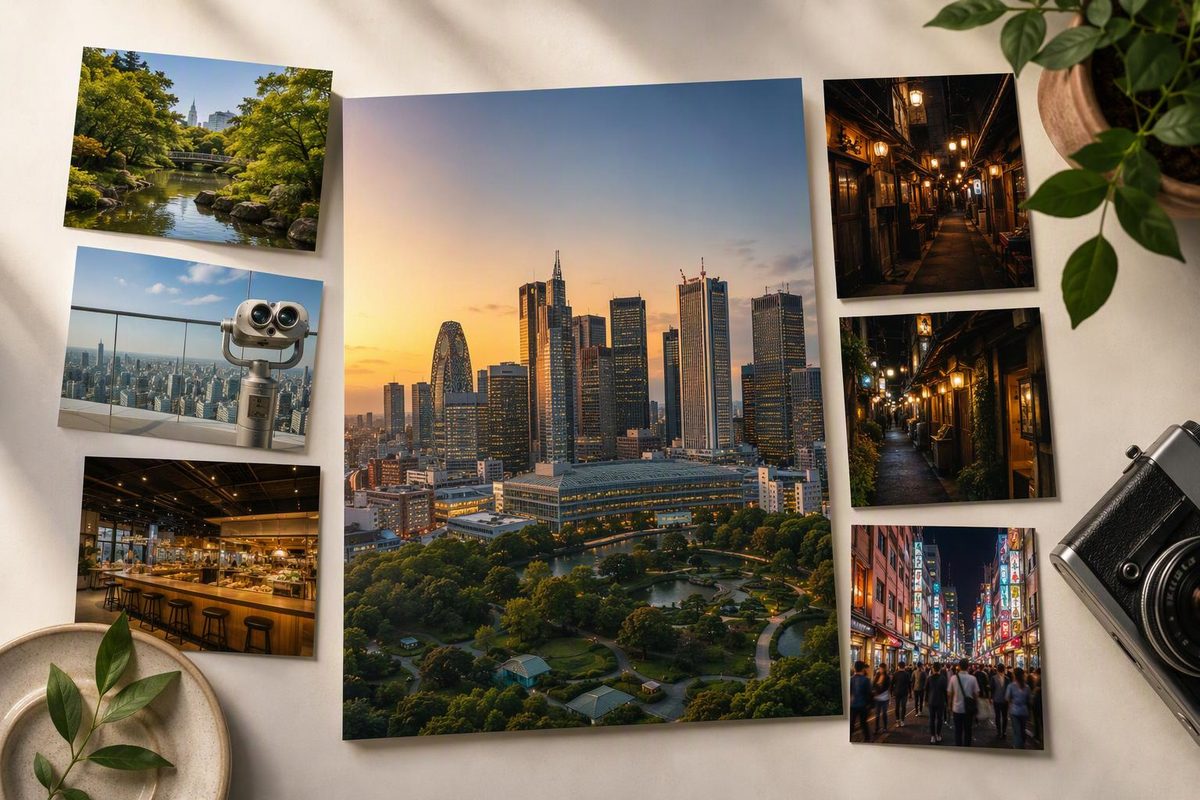
Plan Shinjuku around the right station side, with garden hours, free skyline views, a food hall and a compact route into Kabukicho and Golden Gai.
For a first visit, build Shinjuku around Shinjuku Gyoen in daylight, shopping or a food hall in the afternoon, and Kabukicho after dark. Add the free Tokyo Metropolitan Government observatory if you want skyline views; choose Omoide Yokocho for a meal or Golden Gai for a late drink rather than treating both as compulsory stops.
The useful distinction is station side. The observatory sits west of Shinjuku Station; the garden, Isetan and nightlife route sit east or southeast. Group those stops instead of repeatedly crossing the station area.
Choose your arrival station and exit
| First stop | Useful arrival point | What to follow |
|---|---|---|
| Metropolitan Government observatory | JR Shinjuku, or Tochomae on the Oedo Line | JR West Gate toward the government buildings; the city lists roughly 10 minutes on foot |
| Shinjuku Gyoen, Shinjuku Gate | Shinjuku South Exit, or Shinjuku-sanchome | About 10 minutes from the South Exit; about five minutes from E5 for the Fukutoshin Line or C1/C5 for the Toei Shinjuku Line |
| Isetan | Shinjuku-sanchome | Isetan-directed signs |
| Hanazono Shrine | Shinjuku-sanchome | Exit E2, immediately beside the shrine |
| Kabukicho and Golden Gai | Shinjuku’s east side, or Seibu-Shinjuku | Leave toward the east-side entertainment district |
See the official government-building access information, garden gate directions, Isetan access guide and Hanazono Shrine listing for those arrival points.
These are destination choices, not interchangeable exits. Shinjuku-sanchome and Seibu-Shinjuku are separate stations serving the neighborhood. If your train already stops nearest your first sight, avoid adding a transfer simply to arrive at JR Shinjuku. The official Shinjuku area guide explains the station-side layout.
Hours and admission below checked on 4 October 2026.
Seven worthwhile stops
1. Walk Shinjuku Gyoen before the evening sights
This is the strongest daytime anchor: lawns, a formal garden and a Japanese traditional garden give you a different Shinjuku from the streets around the station. Allow 90 minutes to two hours as a planning budget rather than trying to cover every path. Garden highlights
Adult admission is ¥500. Regular opening starts at 9:00, with these closing times:
- 1 October–14 March: 16:30; last entry 16:00.
- 15 March–30 September, except below: 18:00; last entry 17:30.
- 11 June–31 July: 19:00; last entry 18:30.
It normally closes Mondays, or the following weekday when Monday is a public holiday, and 29 December–3 January. There are daily-opening exceptions during 25 March–24 April and 1–15 November. Busy cherry-blossom dates may require advance reservations. Official admission information
For this neighborhood route, enter and leave through Shinjuku Gate. The Shinjuku Gyoen gate and walking guide helps if you want a longer garden visit.
2. Get a free skyline view at the Metropolitan Government Building
The observatories are on the 45th floor, 202 meters above ground, and admission is free. Take the dedicated observatory elevator from the first floor of Main Building No. 1; on weekends and holidays, use the first-floor front entrance because the second-floor entrances are closed. Official observatory guide
The South Observatory normally opens 9:30–22:00, with last entry at 21:30, and closes on the first and third Tuesdays. The North Observatory normally closes at 17:30, with last entry at 17:00, and closes on the second and fourth Mondays. It extends its hours when the south side is closed. Check the opening schedule for holiday substitutions, inspections and short-notice closures.
Budget about an hour for the visit, with extra time if queues are long. Construction is underway around the government buildings, so follow current approach signs. Building access information
If you prefer an evening on the west side, the building also hosts the free Tokyo Night & Light projection show; performance times vary. GO TOKYO’s building guide
3. Browse Isetan’s basement food hall
At Isetan Shinjuku’s main building, head to B1 for prepared food, Japanese and Western sweets, bread, tea and groceries. It is a useful shopping stop even if clothing is not your priority. Official floor guide
The store normally opens 10:00–20:00. For a seated meal rather than food shopping, the seventh-floor restaurant area opens 11:00–22:00. Shinjuku-sanchome is the useful subway arrival point. Hours and access
4. Make a short stop at Hanazono Shrine
Hanazono Shrine adds a cultural stop to the east-side walk without a cross-city detour. Shinjuku-sanchome Exit E2 is immediately beside the shrine, and the local tourism bureau lists seven minutes from Shinjuku’s East Exit. Shinjuku tourism directory
Allow 15–30 minutes for the grounds. Visit before the bar portion of the evening rather than assuming shrine services will be available late.
5. Eat in Omoide Yokocho
Omoide Yokocho is the west-exit food-and-drink alley: many businesses specialize in chicken skewers or grilled offal. Choose it when you want to sit down for a meal, not just pass through a photogenic lane. Official district website
Opening hours belong to individual shops, not the district as a whole. Bring cash as a backup and ask about table charges, minimum orders and any time limit before sitting down—the association’s visitor guide explains that rules differ between businesses. First-time visitor guidance
It pairs naturally with the west-side observatory. Adding it between east-side sights means another crossing of the station area.
6. See Kabukicho and the Godzilla head
For the neon-street portion of Shinjuku, walk into Kabukicho and look for the Godzilla head above the Shinjuku Toho Building at 1-19-1 Kabukicho. It sits on the eighth-floor terrace; treat this as a street-level landmark stop, not a promise of terrace access. Official landmark listing
Choose venues yourself rather than following someone recruiting customers on the street. Tokyo police specifically warn against touts in Kabukicho because they can lead visitors to rip-off establishments. Police nightlife guidance
7. Finish with one Golden Gai bar
Golden Gai is better for an intimate drink than a full dinner. Many bars seat only five or six people, some are members-only, and most open relatively late—typically around 20:00. Check that visitors are welcome and ask about the cover charge before entering.
Do not smoke or drink in the street, and do not photograph without permission. GO TOKYO’s Golden Gai guide sets out the district’s visiting rules. For bar-selection details, use the Golden Gai visiting guide.
Put the stops into a manageable route
Afternoon and evening, mostly east-side: arrive at Shinjuku-sanchome → Shinjuku Gyoen via Shinjuku Gate → Isetan → Hanazono Shrine → Kabukicho and Godzilla → dinner → optional Golden Gai drink around 20:00. In October–mid-March, aim to reach the garden by 14:00 to leave room for a relaxed visit before its 16:30 closing.
Full day with skyline views: start at the Metropolitan Government observatory, then cross to the garden and follow the east-side route. Leave time for the west-to-east walk rather than scheduling the garden immediately after the observatory; the published station-access times are not a sight-to-sight estimate.
Evening only: choose Omoide Yokocho for dinner, then Kabukicho and an optional Golden Gai drink. Skip the garden rather than racing its last-entry cutoff.
For rain, make Isetan and a seated meal the core, with the observatory only if visibility makes the trip worthwhile. Before settling into a late bar, check the last usable train all the way to your accommodation—not merely the last departure from Shinjuku.