
Five Tokyo Days With Shorter, Saner Routes
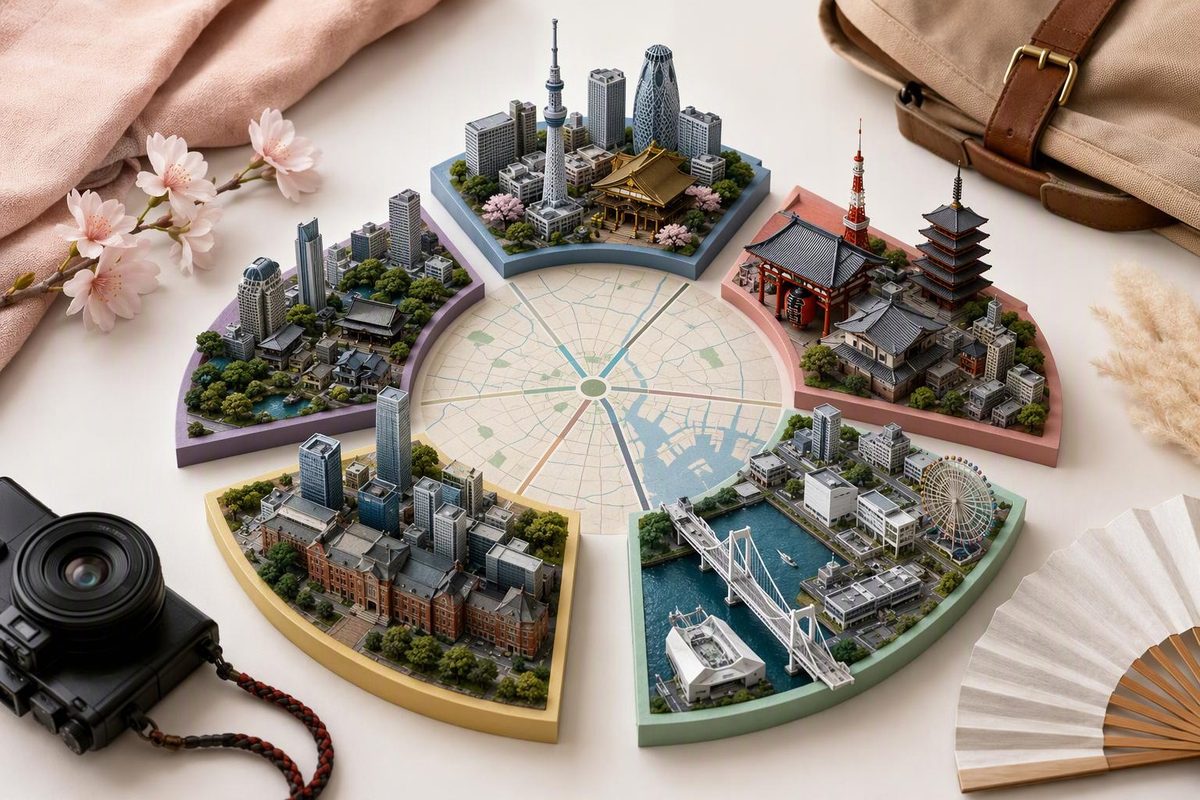
Group Tokyo sights into five directional days, with station choices, walking order, timed entries and closure checks that prevent wasted cross-city trips.
This five-day Tokyo itinerary assigns each day one geographic direction: Harajuku to Shibuya; Asakusa to Ueno; Tsukiji to Tokyo Station; east to west across Shinjuku; and Toyosu to Odaiba. The order minimizes cross-city backtracking by linking sights that are walkable or connected by one useful rail move.
Choose the weekday when you start; the planner flags likely closure conflicts and shows the resulting day order.
Five-Day Weekday Planner
The geographic route stays the same; this changes which itinerary day falls on each weekday.
What the warnings cover
Standard Monday closures at the Tokyo National Museum and Shinjuku Gyoen, plus normal Monday and Friday closures at the East Gardens. Holiday substitutions, seasonal exceptions and dated closures still require official-calendar checks.
Source note: standard closure rules cited in the article from the Tokyo National Museum, Shinjuku Gyoen and Imperial Palace East Gardens; always verify dated calendars.
| Day | Area | Start | Finish |
|---|---|---|---|
| 1 | Harajuku, Omotesando, Shibuya | Harajuku | Shibuya |
| 2 | Asakusa and Ueno | Asakusa | Ueno |
| 3 | Tsukiji, Ginza, Marunouchi | Tsukiji | Tokyo Station |
| 4 | Shinjuku | Shinjuku-gyoemmae | West Shinjuku |
| 5 | Toyosu and Odaiba | Shin-Toyosu | Daiba or Tokyo Teleport |
Expect substantial walking even with this structure. Treat the times as planning anchors, not reservations, and allow an extra 10–15 minutes whenever the route enters a large station. The same organizing method is explained in how to plan Tokyo days by area.
Day 1: Walk From Meiji Jingu To Shibuya
8:30 — Meiji Jingu
Arrive at JR Harajuku Station and visit the shrine before the shopping streets. Meiji Jingu is free and opens at sunrise. Closing time changes by month, ranging from 4:00 p.m. in December to 6:30 p.m. in June, so placing it first avoids an early-closing problem (Meiji Jingu).
After the shrine, return toward Harajuku. This is the day’s one short retrace; from here, the route continues south toward Shibuya.
10:30 — Harajuku And Omotesando
Choose Takeshita Street for youth fashion and snacks, or walk south along Omotesando for architecture, larger shops and broader pavements. Trying to cover both sides in detail can consume most of the morning, so prioritize one.
13:00 — Lunch Near Omotesando Or Cat Street
Continue southeast through Cat Street rather than taking a train between adjoining neighborhoods. This maintains the one-direction route and brings you toward central Shibuya without another station transfer.
15:00 — Shibuya Crossing, Center-Gai And PARCO
Use Shibuya Crossing as an orientation point, then choose one shopping cluster. Center-Gai and PARCO fit together more easily than repeatedly switching between opposite sides of the station. The compact Shibuya route explains how to avoid unnecessary station crossings.
Sunset Or Evening — Shibuya Sky
Book ahead if sunset matters. Shibuya Sky is directly connected to Shibuya Station and, as of September 2026, opens 10:00–22:30 with last admission at 21:20. The rooftop may close in bad weather (GO TOKYO).
A later booking creates more flexibility for shopping and dinner. A sunset booking makes the afternoon less forgiving, so work backward from the admission time rather than treating it as an approximate finish.
Day 2: Travel From Sensoji To Ueno
8:00 — Sensoji And Nakamise
Start at Asakusa Station and walk from Kaminarimon through Nakamise to the Main Hall. The central Asakusa stations serve the Tokyo Metro Ginza, Toei Asakusa and Tobu Skytree lines; the separate Tsukuba Express station is farther west. Check the operator and line before following an exit sign. GO TOKYO confirms the three lines serving the main Asakusa Station complex (GO TOKYO).
For the temple approach and etiquette, use the Sensoji station-to-hall route.
10:00 — Sumida River Or Kappabashi
Choose the river for a compact extension near Asakusa Station. This works best when you want more time at the museum in Ueno.
Kappabashi is the longer option and shifts the route west. It suits travelers interested in cookware, knives and restaurant supplies, but it leaves less margin for a long museum visit.
11:30 — Take The Ginza Line To Ueno
If you stayed near the river, board at Asakusa. If you walked through Kappabashi, continue to Tawaramachi Station instead of retracing the route to Asakusa. Both options join the Ginza Line to Ueno.
Have lunch around Ueno or Ameyoko at about noon. Eating before entering the museum keeps the afternoon together.
13:30 — Tokyo National Museum
Allow at least two hours. Standard hours are 9:30 a.m.–5:00 p.m., with later hours on specified dates. The museum generally closes Monday; when Monday is a holiday, it opens Monday and closes the following day. Its own guidance says an hour is the minimum and that a full day may not be enough for a detailed visit (Tokyo National Museum).
Do not lock this day to Monday without checking the dated museum calendar. If the museum is closed, keep the day local with Ueno Park, Ameyoko and Yanaka rather than crossing Tokyo for a substitute.
Day 3: Walk From Tsukiji To Tokyo Station
9:00 — Tsukiji Outer Market
Arrive after the professional-buyer period rather than at dawn. The market’s guidance assigns 6:00–9:00 to professional buyers and 9:00–14:00 to the public. Individual shops set their own schedules, so check the dated calendar before making one stall essential. The market also asks visitors to store large bags because its lanes are narrow (Tsukiji Outer Market).
This is primarily a morning stop. Starting here at 9:00 leaves time for food without depending on shops remaining open later in the day.
11:00 — Walk To Ginza
Continue via Kabukiza and Chuo-dori. The route in Ginza’s shopping and architecture walk can be shortened to fit about two hours.
Have lunch in Ginza or Yurakucho at about 13:00. Yurakucho naturally continues the route toward Marunouchi, while central Ginza works better if a specific shop or restaurant is a priority.
14:30 — Choose The East Gardens Or Marunouchi
For the Imperial Palace East Gardens, walk north to Ote-mon Gate and check the clock before entering. Closing time ranges from 4:00 to 6:00 p.m., with last entry 30 minutes before closing. The gardens normally close Mondays and Fridays, from December 28 to January 3, and occasionally in other circumstances (East Gardens).
On a winter day, shorten lunch and reach Ote-mon earlier. If the gardens are closed or the available time is too short, skip that detour and continue through Marunouchi.
Finish on the Marunouchi side of Tokyo Station for the red-brick frontage, station plaza and Marunouchi Naka-dori. Keeping the gardens optional prevents an early closure from breaking the rest of the day.
Day 4: Cross Shinjuku From East To West
9:00 — Shinjuku Gyoen
Use Shinjuku-gyoemmae Station rather than entering the JR Shinjuku Station complex first. Spend about two hours on the landscape gardens, lawns and greenhouse.
The garden opens at 9:00, but closing hours vary by season. Adult admission is ¥500. It normally closes Monday or the following weekday when Monday is a public holiday, except during specified spring and autumn periods (Ministry of the Environment).
11:30 — Shinjuku-Sanchome And East Shinjuku
Leave through Shinjuku Gate for lunch and department stores. Add Kabukicho only if its entertainment streets interest you; it is not required to reach the west side and creates a northward detour.
15:00 — West Shinjuku
Either follow the signed east–west passage on foot or take the Marunouchi Line from Shinjuku-sanchome to Nishi-shinjuku. If you enter JR Shinjuku Station, decide which side and gate you need before leaving the platform. The station’s separate 1F, 2F and B1F plans mark gates, concourses, stairs and elevators.
Finish at the free Tokyo Metropolitan Government observatory. Its 45th-floor observatories accept entry until 21:30 when operating, but closing days vary (GO TOKYO). For the general exit-first method, see navigating large Tokyo stations.
Day 5: Ride From Toyosu To Odaiba
Morning — teamLab Planets
Book a practical morning slot and travel to Shin-Toyosu Station. The entrance is one minute on foot from the north exit. The venue currently lists an operating term through the end of 2027 and regular hours of 8:00–22:00, but dated closures can change. Tickets are not sold on site. Some installations require bare feet, and water can reach adult knee height (teamLab Planets).
The timed ticket should govern the morning. Allow enough margin for the train and station exit rather than planning to arrive at Shin-Toyosu at the admission time.
Lunch — Toyosu
Eat near the venue or continue toward Ariake. Do not make Toyosu Market’s wholesale areas the anchor unless you have checked its separate business calendar.
Afternoon — Take The Yurikamome To Odaiba
At Shin-Toyosu, board the Yurikamome toward Shimbashi and alight at Daiba. Walk the waterfront around Odaiba Marine Park, the Statue of Liberty viewpoint and the nearby malls.
Odaiba is also served by the Rinkai Line at Tokyo Teleport, often making that the cleaner return toward Shibuya or Shinjuku (GO TOKYO). There is no need to return to Shin-Toyosu merely because the day began there.
Finish beside the bay after sunset. The Odaiba waterfront itinerary provides a more detailed step-free route and the current evening fountain option.
Let Closures Determine The Weekday Order
The numbered sequence is geographically tidy, but it does not need to match Monday through Friday. Assign the days after checking closures and timed admission:
- Keep Ueno and the Tokyo National Museum off Monday unless its dated calendar shows a holiday opening. When Monday is a holiday, check the following day instead.
- Keep Shinjuku Gyoen off its normal Monday closure or the substitute weekday after a Monday public holiday, subject to its specified seasonal exceptions.
- Put Tsukiji on a confirmed market business day. Individual shops can still follow different schedules.
- The Imperial Palace East Gardens normally close Monday and Friday, so treat them as optional if the Tsukiji–Ginza day falls on either weekday.
- Treat Harajuku–Shibuya and Toyosu–Odaiba as the more flexible Monday or Friday candidates, after checking the timed-ticket venues.
- Reserve Shibuya Sky and teamLab Planets first, then arrange the flexible days around those entries.
This ordering keeps each morning in one part of Tokyo and moves the day in one direction. If a closure forces a change, move the whole area day rather than extracting one sight and creating an extra cross-city trip.