
Tokyo Station: Choose Marunouchi or Yaesu Before You Follow an Exit
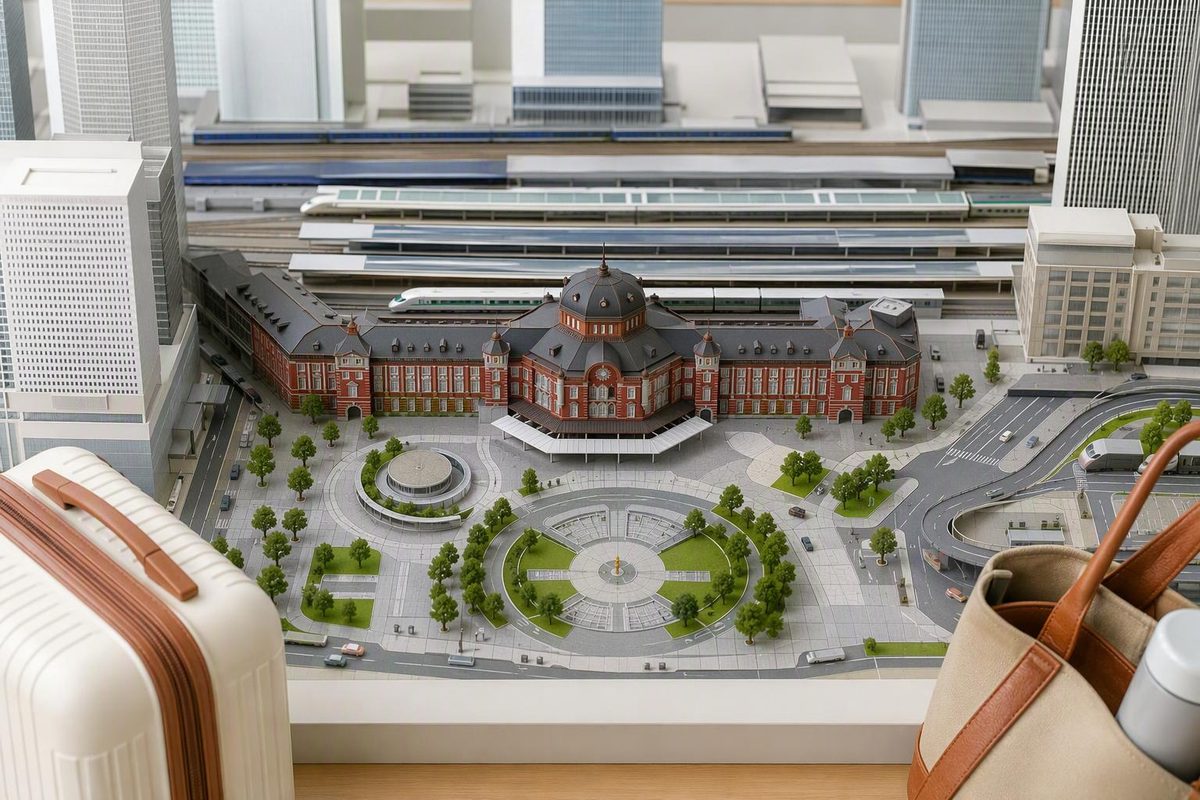
Navigate Tokyo Station by side, gate and line, with practical routes for the Shinkansen, Imperial Palace, Ginza, Keiyo Line and luggage.
Tokyo Station becomes manageable once you make one decision: Marunouchi or Yaesu.
- Marunouchi is the west side, facing the red-brick station building, Marunouchi business district and Imperial Palace.
- Yaesu is the east side, useful for the Shinkansen, highway buses, Nihonbashi and the northern edge of Ginza.
Both sides have North, Central and South gates. Choose the side first, then the gate. If you follow only the nearest “Exit” sign, you can emerge on the wrong side of a large city block.
Tokyo Station exits at a glance
| Your destination | Side or gate to follow | What to know |
|---|---|---|
| Imperial Palace and Gyoko-dori Avenue | Marunouchi Central | The clearest westward route from the station |
| KITTE and Tokyo International Forum | Marunouchi South | KITTE is immediately outside; the forum is farther south |
| Marunouchi hotels and office towers | Marunouchi North or Central | Check whether the building is north or south of Gyoko-dori before choosing |
| Nihonbashi | Yaesu North or Nihombashi Exit | Better than crossing from Marunouchi at street level |
| Daimaru and Tokyo Character Street | Yaesu North | Daimaru is above the Yaesu side; Character Street is on B1 |
| JR Expressway Bus Terminal | Yaesu South | Do not confuse it with the other bus stops around Yaesu |
| Tokyo Midtown Yaesu and Bus Terminal Tokyo Yaesu | Yaesu Central area | The bus terminal is below the complex, outside JR’s paid area |
| Ginza | Yaesu South | A practical walking direction; use the subway if your destination is deeper in Ginza |
Tokyo’s official visitor guide confirms the basic geography: Marunouchi exits lead west toward the Imperial Palace, while Yaesu exits lead east toward Ginza and Nihonbashi (GO TOKYO).
Think of it as several stations stacked together
Do not treat Tokyo Station as one concourse. JR East publishes separate floor maps and distinguishes ordinary JR lines, Shinkansen areas and concourses outside the fare gates (JR East station map).
That structure explains the transfers most likely to consume extra time.
Shinkansen to a local JR line
The Shinkansen platforms and transfer gates are concentrated toward the Yaesu side. Follow signs for the specific Shinkansen operator and destination: JR Central operates the Tokaido Shinkansen toward Nagoya, Kyoto and Shin-Osaka, while JR East operates the northbound Shinkansen routes.
If your tickets permit the transfer, use a Shinkansen transfer gate rather than leaving through a street exit. JR Central provides a separate layout for its Tokyo Station area (JR Central station maps). For the east-side orientation before a bullet-train trip, see the Tokyo Station Shinkansen guide.
As a planning allowance, give an unfamiliar local-line-to-Shinkansen transfer about 15 minutes, and more with children, large luggage or a ticket issue. This is not an operator-guaranteed connection time.
Keiyo Line to the main concourse
The Keiyo Line platforms are deep underground and south of the main east–west concourse. Follow “Keiyo Line” signs early and continue through the long connecting corridor. Reaching the Tokyo Station building does not mean you are close to the platform.
Allow roughly 15–20 minutes from the main JR concourse when you do not know the route. For Tokyo Disney Resort, confirm Maihama on the departure board rather than boarding on the line name alone.
Sobu Rapid, Yokosuka Line and Narita Express
The Sobu Rapid and Yokosuka Line platforms are also deep underground, but in a different part of the station from the Keiyo Line. Follow signs for “Sobu Line (Rapid) / Yokosuka Line,” not simply “JR Lines.” Narita Express services use this underground area, so allow time for elevators and several level changes.
Tokyo Metro is a separate station area
Tokyo Metro’s Tokyo Station is M17 on the Marunouchi Line. It is beneath the Marunouchi side, not Yaesu. A transfer between JR and the Marunouchi Line therefore requires a walk toward the west side and passage through separate fare gates. Tokyo Metro publishes its own station and exit map rather than treating the subway as part of the JR concourse (Tokyo Metro Tokyo Station).
For Ginza, the Marunouchi Line is useful when the final address is near Ginza Station. For Kyobashi, eastern Ginza or Nihonbashi, walking from Yaesu or using another nearby subway station may involve less backtracking.
A reliable exit-first routine
- Save the destination’s full name and address. Large complexes may have several towers and entrances.
- Identify Marunouchi or Yaesu before arriving. Treat that as the primary instruction.
- Choose North, Central or South. Match it to the destination rather than the nearest staircase.
- Stay inside the gates until the correct gate appears. Exiting early can force an awkward street-level detour.
- Check the final block after reaching the surface. Station signs are generally more useful than phone GPS underground; use GPS for the last outdoor section.
This is the same goal-led method used in our guide to navigating large Tokyo train stations.
Luggage, elevators and food
JR East’s maps mark elevators, accessible facilities, ticket offices, information points and coin lockers. Check the relevant floor rather than assuming every gate has the same facilities (JR East station map). With a large suitcase, follow the signed elevator route even when it looks less direct; changing course at a staircase usually costs more time.
Do not make a tight itinerary depend on finding an empty large locker. Gransta’s official site lists station services, including baggage options, but the location and hours should be checked for the day of travel (Gransta). Gransta also spans areas inside and outside the ticket gates, so confirm which side of the gates a shop or service occupies before tapping out.
Buying an ekiben before a train is straightforward, but reserve time: the shop you want may be on another floor or on the opposite side of a fare gate.
If you have an hour around Tokyo Station
Use Marunouchi Central for the red-brick facade, then walk along Gyoko-dori toward the Imperial Palace plaza. Return through Marunouchi or continue south toward KITTE and the Tokyo International Forum. This keeps the outing on one side of the station.
For shopping or a meal, remain on the Yaesu side: First Avenue, Tokyo Character Street and Tokyo Ramen Street make a compact underground stop. If continuing to Ginza, head south instead of crossing back through the station. A longer area plan can continue with this Ginza architecture and shopping walk.