
Tokyo Skytree Without the Station or Ticket Confusion
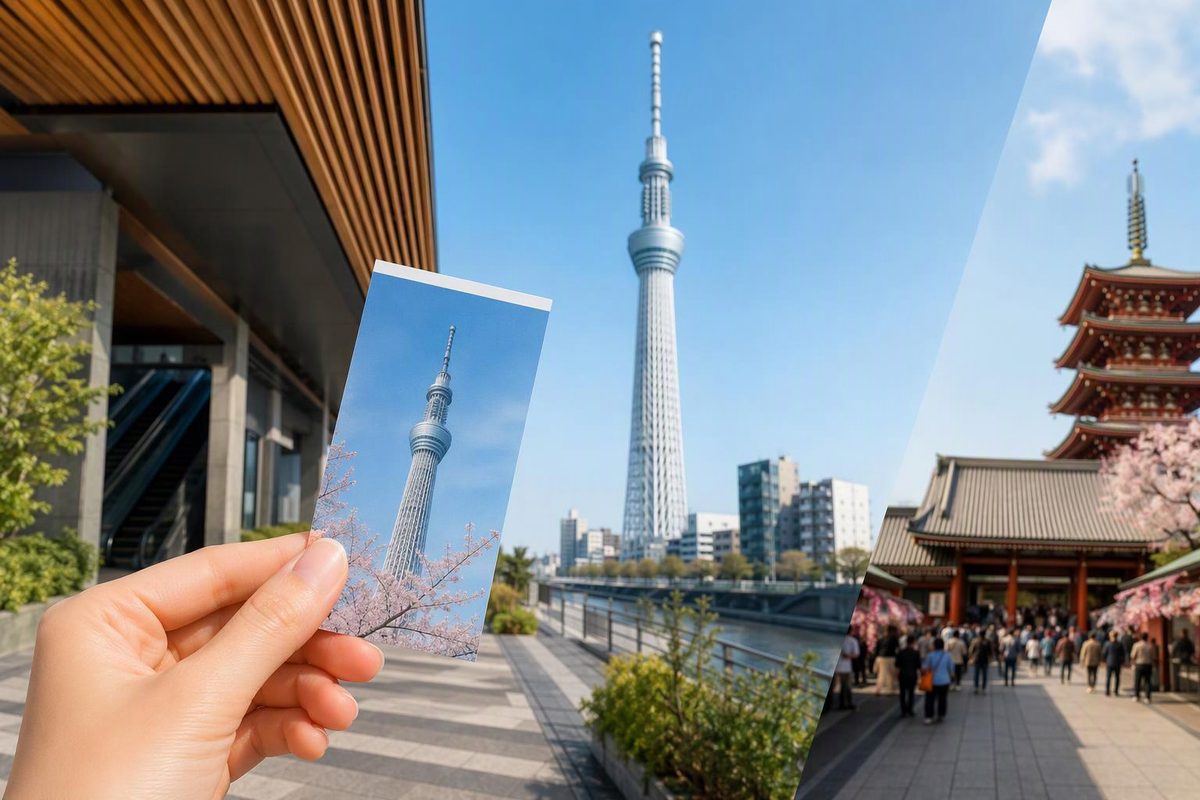
Choose a Tokyo Skytree ticket, find the fourth-floor entrance from Oshiage, and combine the tower with Asakusa or Solamachi.
Tokyo Skytree is easiest when you make three decisions before arriving: which station produces the cleanest journey, whether Floor 350 is enough, and whether a fixed sunset slot matters more than flexibility.
For most first-time visitors, the simple plan is Oshiage Station → fourth-floor entrance → Tembo Deck on Floor 350. Add the Tembo Galleria on Floor 450 if reaching the tower’s highest public level is an important part of the visit.
Tokyo Skytree at a glance
- Address: 1-1-2 Oshiage, Sumida City, Tokyo
- Nearest stations: Oshiage Station and TOKYO SKYTREE Station
- Admission entrance: Fourth floor, not street level
- Main observatory: Tembo Deck, Floor 350
- Higher observatory: Tembo Galleria, Floors 445–450
- Best pairing: Asakusa before the tower, or Tokyo Solamachi below it afterward
The tower’s floor guide describes the Tembo Deck as a 360-degree observatory and the Galleria as a glass-walled corridor rising from Floor 445 to Floor 450. Floor 340 has the glass floor, while cafés and a restaurant occupy other Tembo Deck levels (Tokyo Skytree floor guide).
Which station should you use?
Both nearby stations work. The useful distinction is not a small difference in walking time but which station avoids an unnecessary transfer.
- Oshiage Station: Usually the more versatile arrival point. After leaving the ticket gate, follow signs for Tokyo Skytree and go up through the complex to Floor 4.
- TOKYO SKYTREE Station: Convenient when arriving on the Tobu Skytree Line, including from Asakusa.
Do not navigate only to the tower’s base. Admission starts at the 4F Main Entrance. Tokyo Skytree’s directions estimate about seven minutes from Oshiage Station, six minutes from TOKYO SKYTREE Station’s west exit and seven minutes from its east exit. The published accessible route from Oshiage uses the elevator hall after the gate and continues by elevator to Floor 4 (official entrance directions).
From Oshiage, the basic sequence is:
- Leave the ticket gate and follow Tokyo Skytree signs.
- Use the escalators or elevator to reach Floor 4.
- Continue through the complex to the main entrance.
- Join the line for your timed ticket or same-day purchase.
Budget for those indoor minutes when choosing an admission time. Arriving at Oshiage does not mean you have reached the tower’s ticket counter.
Tembo Deck or Tembo Galleria?
Choose Floor 350 only when:
- You mainly want the broad Tokyo panorama.
- The tower is one stop in a larger Asakusa and Sumida day.
- Visibility is uncertain.
- You want to limit both cost and time.
As of September 2026, online Tembo Deck tickets start at ¥1,800 for adults aged 15 and over and ¥900 for children aged 6–14. Children five and under enter free; the official FAQ also exempts six-year-olds who are still preschool children. Prices vary by visit date, so these are starting prices rather than a flat admission charge (official ticket prices; Tokyo Skytree FAQ).
Add Floor 450 when:
- Skytree is one of your trip’s priority attractions.
- You want the sloping glass corridor and highest public level.
- Conditions are clear enough to justify a second viewing experience.
The combined Floor 350 and Floor 450 ticket starts at ¥3,000 for adults and ¥1,500 for children aged 6–14. If you initially buy only Floor 350, the adult Galleria supplement costs ¥1,400 from the ticket machines inside the Tembo Deck. Sales of that supplement can be suspended when capacity is restricted (official ticket prices).
The practical verdict: Floor 350 is enough if you primarily want the view. Floor 450 is worth adding when going as high as possible is part of the attraction.
Book online or buy on the day?
Book online when you want a sunset slot, are visiting at a busy time, or have built the day around Skytree. The venue adds a ¥500 service fee per ticket to purchases at the fourth-floor counter or ticket machines (official ticket prices).
A timed ticket is not a fast pass. The official FAQ says there is no priority admission and that waits can still occur during busy periods. It also says re-entry is not permitted, so finish the observation decks before leaving for Solamachi (Tokyo Skytree FAQ).
Check the forecast before committing to a fixed time. Clouds and haze affect a high observatory more than they affect the surrounding neighborhood plan.
Check the hours for your exact date
Tokyo Skytree publishes a date-by-date calendar rather than one dependable daily schedule. In September 2026, listed opening times ranged from 8:00 to 10:00 and closing times from 17:00 to 22:30. Last admission is one hour before closing, and the venue warns that hours can change without notice (official opening-hours calendar).
Check the calendar again shortly before visiting, especially for an early or late booking. Shops, restaurants and other attractions in the wider Skytree Town complex may operate on separate schedules.
When should you go?
Choose morning for schedule flexibility. An early booking leaves more room for Asakusa, Solamachi or another stop afterward.
Choose late afternoon for daylight, sunset and night views in one visit. This is the slot to reserve rather than leave to chance. Reach the complex early enough to find Floor 4 without rushing.
Choose night for the illuminated city grid. You lose some distant detail but gain bright roads, bridges and dense neighborhoods. It also pairs naturally with dinner in Solamachi.
Let visibility settle the ticket choice. On a heavily clouded day, Floor 350 is the lower-cost option. If the tower is wrapped in low cloud, keep the neighborhood plan but consider postponing the paid observatory if your itinerary allows.
A compact Asakusa and Skytree plan
Asakusa and Skytree fit naturally into one area day; there is little reason to place them on separate cross-city itineraries.
- Morning: Sensoji and Asakusa. Start before the busiest part of the day and use this Sensoji route and etiquette guide.
- Lunch: Asakusa or Solamachi. Eat before a fixed Skytree slot rather than depending on the observation-deck cafés at a busy time.
- Afternoon: Continue to Oshiage or TOKYO SKYTREE Station. Choose the station that gives you the simpler journey from your lunch stop.
- Late afternoon: Enter on Floor 4. Buy the combined ticket only if Floor 450 matters to you.
- Evening: Solamachi. Shop or eat after descending. The tower’s exit floor is Floor 5, where the official guide lists a shop, café and currency exchange (Tokyo Skytree floor guide).
If you dislike fixed sightseeing slots, reverse the emphasis: visit Asakusa without rushing, check visibility during the day, then buy a Skytree ticket only if conditions and availability still work. The trade-off is that a popular entry time may no longer be available.
Small details that prevent wasted time
- Have one ticket or QR code ready for each person before reaching the admission line.
- Only drinks in capped plastic bottles are allowed on the observation deck; the official FAQ says there are no vending machines there.
- Use the published accessible route from Oshiage when travelling with a wheelchair or stroller. Accessible toilets are available in the facility.
- Do not schedule another timed activity immediately afterward. The reservation controls entry time, not the pace of queues, elevators or viewing floors.
- Decide on Floor 450 before booking if it is important. An upstairs supplement may be available, but sales can stop when the Galleria is crowded.
The cleanest first visit is straightforward: arrive at Oshiage with enough time to reach Floor 4, reserve Floor 350 for a clear morning or late afternoon, and keep Asakusa and Solamachi in the same compact day.