
Choose Tokyo’s Right teamLab Experience for the Way You Like to Explore
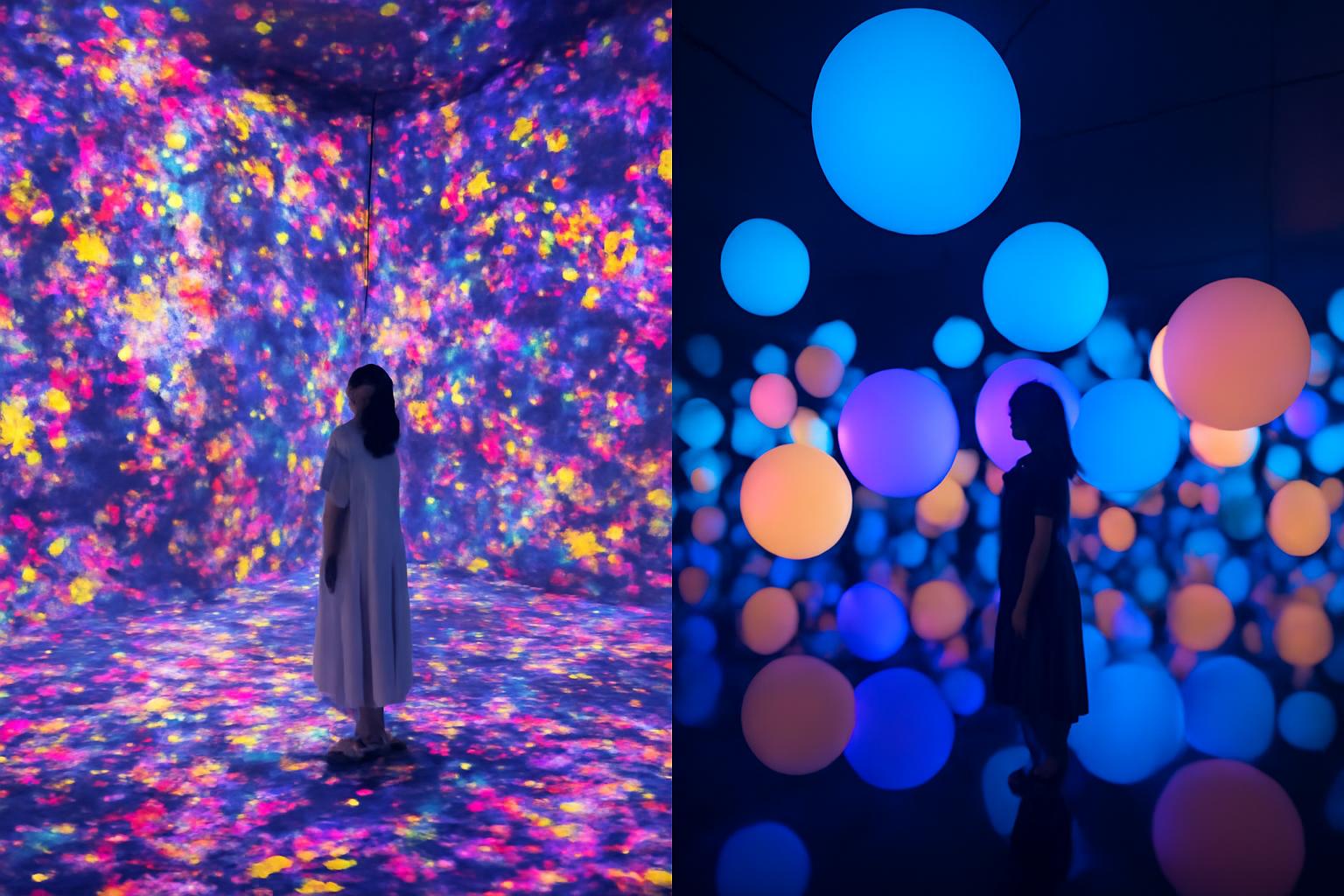
Allow approximately two hours for a selective visit and around three hours for a more relaxed experience overall.
Tokyo’s two teamLab museums share a visual vocabulary—projected light, mirrors, responsive imagery and rooms designed to blur the boundary between visitor and artwork. Yet they ask you to experience that art in very different ways.
Choose teamLab Planets if you want physical immersion: removing your shoes, walking through water, crossing soft or changing surfaces, participating with your whole body and entering gardens built around living flowers.
Choose teamLab Borderless if you would rather remain dry and wander freely through interconnected digital-art rooms without following a prescribed sequence.
Neither is objectively better. The right choice depends less on which photographs look most impressive and more on how you want to move, which physical conditions suit you and where the museum fits into your Tokyo itinerary.
Practical details reviewed July 30, 2026. Exhibits, visitor rules, accessibility arrangements and operating dates can change; official venue information should be checked before booking.
The quick verdict: Planets for physical immersion, Borderless for open exploration
If you have time or budget for only one museum, start with this comparison:
| Decision point | teamLab Borderless | teamLab Planets |
|---|---|---|
| Route style | Open-ended and mapless; you choose where to go and may revisit rooms | More structured progression through distinct sensory environments |
| Physical interaction | Primarily visual exploration, with responsive projections and participatory activities | Strong full-body component involving water, tactile floors and physical participation |
| Water exposure | No Planets-style barefoot water rooms | Water is central to the experience |
| Floor conditions | Generally reported as hard, flat and even | Includes water, soft flooring and changing or unstable-feeling surfaces |
| Defining experiences | Roaming projection art, interconnected rooms and currently reported activities such as Sketch Ocean and digital tea | Reactive koi water, soft floors, light installations, living orchids and an outdoor garden |
| Location | Azabudai Hills, near Kamiyacho and Tokyo Tower | Toyosu, beside Shin-Toyosu Station |
| Schedule predictability | Less predictable because there is no fixed endpoint or required sequence | Somewhat more predictable because the experience is routed, although queues and activities add variation |
Planets is the stronger choice when barefoot water, unusual floor textures, active participation and flower installations are the main reasons you want to visit. It is designed as a full-body experience in which visitors enter water and affect artworks in real time, rather than as a conventional gallery observed from the edge.
Borderless is the better fit when you want a dry experience on generally flat floors and prefer exploring projection-led rooms at your own pace. Its appeal lies in discovery: turning into an unexpected passage, watching imagery travel across surfaces and returning to a room after its composition has changed.
Several recent reviewers favor Planets for its physical variety, but that preference is not universal. Other visitors prefer Borderless for its visual atmosphere, freedom and absence of water. Traveler discussions are similarly divided, with Planets’ water repeatedly emerging as something visitors either particularly enjoy or actively dislike (traveler discussion comparing both museums).
For many Tokyo itineraries, one museum is enough. Both deliver immersive environments made with projections, light, mirrors and responsive imagery, so a second admission may compete with higher-priority neighborhoods or attractions. The meaningful distinction is whether you want to move bodily through a directed experience or wander through a visually driven one.
Do not decide based on claims that one venue is always quieter, universally better for children or guaranteed to take a particular amount of time. Crowd conditions, family preferences and visit lengths vary. Water tolerance, route style and location are more dependable filters.
How the experiences differ once you enter
Borderless behaves more like an environment than a sequence of exhibits. There is no prescribed route leading from Room 1 to Room 2. Visitors move among darkened spaces filled with projections, light, music, mirrors and imagery that appears to cross conventional room boundaries.
That freedom is the point. A doorway missed on the first pass may lead to a different installation, while revisiting a familiar space can be worthwhile because the visual composition may have shifted. If you enjoy finding your own path, Borderless can feel generous and absorbing.
The same design can frustrate visitors who like to know whether they have completed an attraction. You may wonder whether you overlooked a corridor, whether you are circling familiar spaces or when you have truly seen enough. Borderless rewards curiosity more than completionism.
Planets has a more directed rhythm. Visitors remove their shoes, store their belongings and progress through environments that place greater emphasis on the body: water around the feet, soft or deforming floors, reflected light, large-scale imagery and flower-filled spaces.
The venue’s official framing is explicitly physical. Planets describes itself as a museum where people walk through water and where artworks change according to visitors’ presence in real time (official teamLab Planets overview).
A directed route does not guarantee that every visitor will find the experience straightforward. One firsthand reviewer described Planets as confusing despite its generally sequential format. Entrance procedures, lockers, branching areas and transitions can still make the visit feel less obvious than expected.
Water tolerance should be your first practical filter. Entering water is integral to Planets, not a decorative flourish that should be assumed optional. If bare feet, wet areas or uncertain footing would make the visit uncomfortable, Borderless is the dry alternative.
If those elements sound appealing, Planets offers a type of immersion that photographs cannot fully communicate. Sensation underfoot and the relationship between your movement and the projected work are part of the artwork rather than incidental effects.
Both museums can involve darkness, music, mirrors, moving imagery and intense fields of projected color. Planets adds water and changing floor textures; Borderless adds open navigation and uncertainty about where corridors lead. Sensory preferences are individual, so neither should automatically be described as the calm or low-intensity option.
What you gain—and miss—at each museum
Planets’ clearest point of difference is its combination of responsive digital art and physical sensation.
In its koi water artwork, visitors enter water while projected koi move across the surface. The imagery responds to the presence of people and is generated in real time rather than playing as a fixed prerecorded loop. Visitors’ movement therefore becomes part of the composition.
Other prominent Planets experiences include the Infinite Crystal Universe, a soft floor that deforms beneath visitors, a floating garden of living orchids and an outdoor moss garden with interactive ovoid forms. The moss garden changes between daylight and after sunset and may be unavailable during heavy rain or severe winds, according to the official Planets artwork descriptions.
These installations reinforce Planets’ defining idea: you do not only view the art. Your feet, balance, pace and physical position shape how you perceive it. That can feel playful and memorable, but it also asks more of the visitor.
Borderless replaces the directed bodily journey with roaming visual discovery. Artworks appear to travel through interconnected spaces, and the absence of a fixed route encourages visitors to follow imagery or light rather than a museum map. The experience can feel less like progressing through separate set pieces and more like exploring one shifting digital world.
Current third-party accounts describe Sketch Ocean, in which visitors color a sea creature that is scanned and projected into a digital environment, and a tea experience in which digital flowers appear around a drink. The tea costs extra. Because installations and activities can change, confirm both against current venue information rather than treating them as guaranteed (firsthand Borderless and Planets comparison).
Sketch Ocean also illustrates why Borderless should not be dismissed as passive. It includes opportunities to contribute to digital environments even though its overall emphasis is more visually exploratory than physically tactile.
Both museums use responsive imagery, mirrored spaces, light and large projections. Some colors, natural motifs or visual techniques may therefore feel familiar if you visit both. That does not make the museums duplicates, but it means the second may deliver less novelty to someone mainly interested in luminous rooms and photographs.
A definitive inventory of shared and exclusive works would age quickly. Installations can change, and older accounts may refer to the former Odaiba version of Borderless or an earlier configuration of Planets. It is more useful to choose by format:
- Planets: bodily immersion through water, texture, movement, light and flowers.
- Borderless: exploratory immersion through roaming imagery, interconnected rooms and free-form discovery.
That distinction will shape your visit more than counting the number of projected flowers or mirrored environments at each museum.
Which museum fits families, mobility needs, and sensory preferences?
There is no universal family winner because the features that make Planets exciting for one child can make it complicated for another.
For many school-age children and teenagers, Planets has obvious appeal. Water, unusual floors, physical activities and artwork that reacts to movement can make it feel more participatory than a conventional gallery. Children who enjoy tactile play and active exploration may engage strongly with it.
Families with toddlers or very young children need to weigh those same features differently. Water requires closer supervision and may mean wet clothing, while soft or changing surfaces can affect balance. Carrying a child can also make those conditions more demanding. Water depth is experienced relative to the visitor’s height, so an adult’s description should not be applied directly to a small child.
Borderless may be simpler for families that want to avoid barefoot water, wet clothes and Planets’ physically demanding surfaces. It is generally described as having hard, flat floors without Planets-style water, climbing or balancing requirements (comparison of the venues’ physical formats).
That does not make Borderless effortless for every family. Its open layout can make it harder to maintain a clear sense of direction or agree when the visit is finished. Darkness, mirrors and moving projections may also require close supervision, especially when children are eager to run toward the next visual effect.
Flat floors alone do not establish that Borderless is fully accessible. They do not answer questions about wheelchair routes, lifts, seating, accessible restrooms, stroller policies, caregiver arrangements or the suitability of individual installations. Planets introduces additional questions about water, barefoot movement, balance and bypass routes.
Anyone with mobility, balance, stroller, caregiver or other access requirements should consult each venue’s current official accessibility information before purchasing tickets. If a particular accommodation is essential, contact the venue rather than relying on a general comparison or older visitor report.
Sensory considerations at either museum can include:
- Dark rooms and abrupt transitions between spaces
- Mirrors that make physical boundaries difficult to read
- Moving projections across walls and floors
- Music and environmental sound
- Other visitors moving unpredictably through the artwork
Planets adds bare feet, water and unstable-feeling surfaces. Borderless adds open navigation and uncertainty about where a passage leads. These observations cannot predict an individual response, but they can help identify what to investigate before booking.
Azabudai Hills or Toyosu: choose the museum that fits your day
The current Borderless is in Azabudai Hills, with Kamiyacho as a nearby station and Tokyo Tower in the surrounding area. Planets is in Toyosu, beside Shin-Toyosu Station and approximately a ten-minute walk from Toyosu Station according to current travel guidance (NAVITIME’s access comparison).
That makes Borderless a natural anchor for a day already focused on Azabudai Hills, Tokyo Tower or nearby central neighborhoods. Keeping the day in one area may be more valuable than crossing the city because a reviewer marginally preferred Planets.
Planets fits naturally into a Toyosu-area day. Its location should not be treated as categorically inconvenient: convenience depends on your starting point, rail route and plans before and after the museum.
Tokyo is large enough that geography can outweigh a slight experiential preference. If you lean only narrowly toward Planets but the rest of your day is around Azabudai Hills, Borderless may produce the smoother itinerary. The reverse applies if Toyosu already fits your plans.
Compare actual door-to-door routes from your accommodation and adjacent activities. A venue requiring fewer transfers from your hotel may be easier even if it appears farther from Tokyo’s conventional center on a map.
Avoid building your schedule around a fixed journey time between the museums. Routes, transfers, walking pace and service conditions vary. If you will be navigating large Tokyo train stations or an unfamiliar interchange, leave enough slack to find the correct platform and exit rather than treating the fastest journey estimate as a promise.
What to wear and expect at Planets and Borderless
At Planets, expect to remove your shoes and socks and enter barefoot areas, including water installations. This is fundamental to the experience rather than a minor possibility.
Wear shorts or trousers that can be rolled comfortably above the water. Avoid garments that are difficult to lift or that become cumbersome when wet. Water depth feels different according to visitor height, so no single label—ankle, calf or knee level—will accurately describe it for everyone.
Planets provides lockers and towels for the wet-area experience according to firsthand comparative guides. These facilities help with the transition through the water rooms, but they do not remove the need to arrive in suitable clothing.
At least one third-party guide reports that free rental shorts are available. Because this is an operational detail that can change, confirm availability rather than arriving in unsuitable clothes and depending on a loan pair (practical clothing and access guide).
Mirrored floors and ceilings are a consideration at both museums. Trousers, shorts or suitable underlayers are advisable because reflections may reveal more than expected beneath a skirt or loose dress. This remains relevant at dry, flat-floored Borderless.
Useful clothing principles include:
- Choose comfortable clothes that permit easy movement.
- Avoid delicate garments that could be affected by water or floor contact at Planets.
- Wear secure, easy-to-remove footwear for Planets.
- Use suitable underlayers with skirts or dresses.
- Keep pockets secure when leaning, crouching or moving through mirrored rooms.
A bypass corridor has been reported beside Planets’ Soft Black Hole, an unstable soft-floor installation (firsthand Planets visitor guide). That report does not establish that every water area, uneven surface or physical section can be bypassed. If you need to avoid a particular environment, verify the current route directly with the venue before booking.
Rules for large bags, tripods, selfie sticks, strollers, photography and other equipment can change. Check current official visitor information shortly before your date, especially if a stroller, mobility aid, camera setup or large bag is essential.
How long to allow, when to book, and what crowds can change
Published visit estimates vary widely. Recent comparisons suggest approximately two to three hours for Borderless and two to four hours for Planets, while individual visits may be shorter or longer depending on pace, queues, activities and the current venue configuration (recent firsthand duration comparison).
Use those ranges as planning scenarios rather than promised averages:
- About two hours: A selective visit in which you keep moving, skip optional extras and do not repeatedly revisit rooms.
- Around three hours: A more relaxed visit with time to pause, participate and absorb the larger installations.
- More than three hours: Plausible if you search for additional Borderless rooms, repeat favorite spaces, complete activities, stop for tea or food, or encounter queues.
Older comparisons often describe Planets as reliably shorter. That is no longer a dependable basis for choosing because its content and configuration have changed, and supplied reports disagree about the details and timing of its expansion.
Borderless is inherently difficult to time precisely. Its mapless layout encourages detours, repeat visits and searches for rooms you suspect you missed. There is no single moment when every visitor will agree that the experience is complete.
Planets may feel more predictable because of its structured progression. Even there, admission lines, locker procedures, changing, capacity-controlled areas and participatory activities can lengthen the visit.
Reserve timed admission in advance when the museum is a fixed part of your itinerary or when you are traveling during a popular period. There is no universally correct lead time; availability depends on the date, season and entry slot.
Do not choose between the museums based on claims that one is consistently quieter. Firsthand crowd reports conflict because visitors attended on different dates and at different times. A calm morning reported by one traveler does not guarantee similar conditions on your day.
Leave a schedule buffer for:
- Finding the entrance
- Admission lines
- Locker or changing procedures
- Unexpectedly long activity waits
- Transit and station navigation
- A meal or rest afterward
Before purchasing, use the venues’ official booking information to confirm current prices, hours, final admission, availability and ticket-change or refund rules. Conditions may differ by ticket source, and third-party policies should not be assumed to match direct purchases.
Is it worth visiting both?
One teamLab museum is enough for many visitors. If your Tokyo stay is short, your budget is limited or you have only a casual interest in immersive digital art, choosing the better-fitting museum preserves time for another neighborhood or experience.
Both museums use projections, mirrors, light and imagery that reacts to visitors. Seeing both may therefore produce moments of familiarity. Someone primarily interested in colorful photographs may experience diminishing returns sooner than someone interested in how digital art changes movement, space and participation.
For enthusiasts, however, the formats differ enough to justify both. Planets is a routed, bodily encounter built around bare feet, water, texture and flowers. Borderless is an open visual environment built around wandering, rediscovery and art that appears to move between rooms.
Choose only one if visiting both would:
- Force unnecessary travel across Tokyo
- Cut into a higher-priority neighborhood
- Create a rushed schedule
- Compete with limited attraction funds
- Leave insufficient recovery time between intense indoor experiences
Consider both if digital art is a major interest and you can place the museums on separate area-based days. Pair Borderless with Azabudai Hills and the Tokyo Tower area; pair Planets with Toyosu. That allows the contrast between them to feel intentional rather than repetitive.
It is possible to place both on the same date, but doing so should not be presented as easy for everyone. Transit, queues, meals, walking pace and fatigue all matter. Two spacious, dark and immersive attractions can occupy much more of a day than their ticket times suggest.
The final recommendation is conditional:
- Choose Planets for a guided, barefoot and tactile encounter involving water, changing surfaces, interactive light and living flowers.
- Choose Borderless for a dry, visually immersive experience built around free exploration.
If both sound equally attractive, let geography decide: Azabudai Hills for Borderless or Toyosu for Planets. One is sufficient for most itineraries; enthusiasts can reasonably visit both on separate area-based days.
Exhibits, operating arrangements, prices, hours, admission rules and accessibility provisions can change. Planets’ announced operating period is also time-sensitive, so verify all practical details through the museums’ official pages before booking.
Which is better for a first-time visitor, teamLab Borderless or Planets?
Planets is often the stronger first choice for someone excited by barefoot water, tactile floors, physical participation and living-flower installations. Borderless is better suited to a first-time visitor who wants a dry experience, prefers generally flat floors and enjoys exploring without a fixed route.
Neither is automatically the better introduction. Use water tolerance as the first filter, route preference as the second and location as the tiebreaker.
Can you avoid the water at teamLab Planets?
Do not book Planets on the assumption that all water can be avoided. Walking through water is central to the museum’s official concept and visitor experience. Although a bypass has been reported for one soft-floor installation, that does not establish that every water or physically demanding environment has an alternative route.
If entering water is not possible or acceptable, ask the venue about current bypass arrangements before purchasing. Borderless is the option designed without Planets-style water rooms.
Which teamLab museum is better for children?
It depends on the children’s ages, interests and comfort.
Planets may particularly appeal to active school-age children and teenagers because of its water, unusual surfaces and participatory artwork. With toddlers and very young children, those same features create additional supervision, balance and wet-clothing concerns.
Borderless avoids Planets-style barefoot water and unstable floors, but its darkness, open layout, mirrors and visual intensity introduce different considerations. Neither venue is universally better for every family.
How much time should I allow for Borderless or Planets?
Allow approximately two hours for a selective visit and around three hours for a more relaxed experience. Longer visits are possible if you revisit Borderless rooms, complete participatory activities, stop for food or tea, or encounter queues.
Treat these as planning scenarios rather than guaranteed durations. Borderless can expand to fill the time you give it, while Planets’ structured route can still be lengthened by admission lines, lockers, changing and activity waits.
Is teamLab Planets still scheduled to close at the end of 2027?
As reviewed on July 30, 2026, the official Planets page states an operating period through the end of 2027 (official teamLab Planets operating announcement).
That is a stated operating horizon, not a guarantee that closure plans cannot change. Check the official page again before building a trip around the deadline, as extensions, revised plans, exhibit availability and other operating arrangements remain subject to change.