
Tokyo National Museum: Plan a Focused 2- or 4-Hour Visit
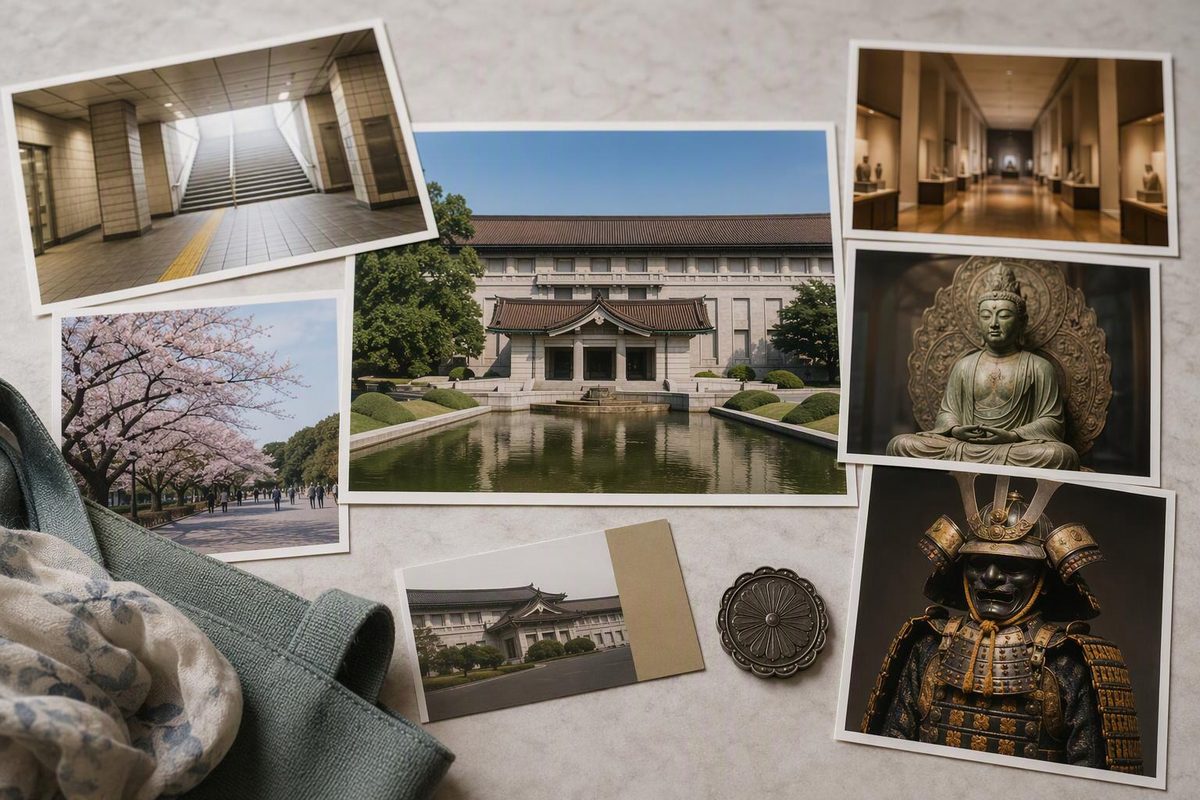
Use the right Ueno Station exit, choose a Tokyo National Museum ticket and follow a focused two- or four-hour route through the galleries.
Tokyo National Museum is a good fit when you want a broad introduction to Japanese art in one place. The main difficulty is scale: this is a campus with several gallery buildings, not a single exhibition hall. A first visit works best when you choose a route before entering.
Allow two to four hours and prioritize the Honkan, the Japanese Archaeology Gallery in the Heiseikan and, if time permits, one other building. The museum says a careful visit can take more than a day; for a short first visit, it recommends at least 30 minutes for the chronological display on the Honkan’s second floor (Tokyo National Museum FAQ).
Tokyo National Museum at a glance
| Detail | Practical answer |
|---|---|
| Address | 13-9 Ueno Park, Taito City |
| Easiest station approach | JR Ueno Station, Park Exit |
| Distance from JR Ueno | About 500 meters from the Park Exit |
| Regular hours | 9:30 a.m.–5 p.m. |
| Late opening | Until 8 p.m. Friday and Saturday, and Sunday when the following Monday is a holiday |
| Last admission | 30 minutes before closing |
| Collection admission | Adults ¥1,000; university students ¥500 |
| Closed | Usually Monday; when Monday is a holiday, the museum normally closes the following day |
| Suitcases | Not permitted inside the museum |
These hours and prices were checked on September 24, 2026. Special exhibitions can have different hours, and the museum publishes holiday exceptions and temporary gallery closures. Check its dated admission and opening information shortly before going.
Use JR Ueno Station’s Park Exit
From the Park Exit, enter Ueno Park and continue north through the museum district. Tokyo National Museum stands beyond the large fountain at the far end of the main approach.
The museum places its entrance about 500 meters from the Park Exit. It estimates 800–1,200 meters from Tokyo Metro Ueno, Keisei Ueno and Nezu stations, with inclines or stairs on some approaches. JR Uguisudani Station is about 600 meters away, but its route can involve narrow paths and steep slopes (official accessibility guide).
That makes JR Ueno the simplest default even when another Ueno station looks close on a rail map. If you arrive on Tokyo Metro or Keisei, use the Ueno Station exit guide to plan the walk or transfer.
Budget roughly 10 minutes for the walk from JR Ueno and extra time at the gate. Security screening includes metal detectors and baggage checks, and the museum warns that ticket-counter waits can exceed 30 minutes during busy periods. It recommends buying online. Do not arrive with a suitcase; lockers are available in the exhibition buildings for smaller belongings (official visitor information).
Which ticket should you buy?
The TNM Collection Exhibitions ticket is the standard choice for the regular collection galleries. It costs ¥1,000 for adults and ¥500 for university students. High school students and younger visitors, people under 18 or over 70, and visitors with disabilities plus one attendant receive free collection admission with the required proof.
Special exhibitions are priced separately. A special-exhibition ticket includes same-day admission to the collection galleries, so check its coverage before buying another ticket.
The museum rotates light-sensitive paintings, calligraphy, textiles and lacquerware every four to eight weeks. The route through each building remains broadly consistent, but individual works do not stay on permanent display (museum FAQ). Check the current exhibition listings if you are going for a particular object.
A focused two-hour route
1. Start upstairs in the Honkan
Go directly to the second-floor Highlights of Japanese Art circuit. It traces Japanese art from prehistory through the 19th century, with sections on Buddhism, court culture, ink painting, tea, samurai arms and armor, decorative arts, performing arts and ukiyo-e. The museum describes it as the essential route for first-time visitors (Honkan floor guide).
Allow about 60–75 minutes rather than trying to study every case.
2. Choose one subject downstairs
The Honkan’s first floor is organized mainly by genre. Pick one area—such as sculpture, swords, ceramics, lacquerware, Ainu and Ryukyu material, or modern art—and spend another 20–30 minutes there.
This is more coherent than rushing between every building: you get the chronological overview first, then look closely at one medium.
Extend the route to three or four hours
After the Honkan, add the following stops.
3. Heiseikan: Japanese Archaeology
The first-floor Japanese Archaeology Gallery is the place for prehistoric and ancient material, including dogu clay figures and haniwa tomb sculptures. The Heiseikan’s second floor contains special-exhibition galleries, so it is not part of the regular route unless your ticket covers the exhibition (official museum map). Allow 40–60 minutes downstairs.
4. Choose Toyokan or the Gallery of Horyuji Treasures
Do not assume you need both.
- Toyokan provides the wider Asian context. Its spiraling galleries cover China, Korea, India and Gandhara, Central and Southeast Asia, and Egypt (Toyokan floor guide). Allow at least 45 minutes.
- The Gallery of Horyuji Treasures is a more concentrated choice for early Buddhist sculpture, metalwork and related objects. The collection comprises more than 300 works, mainly from the seventh and eighth centuries, donated by Horyuji Temple to the Imperial Household in 1878 (official gallery listing). Some rooms or object groups are shown only on specified days, so check the current listing.
Photography, accessibility and luggage
Photography is generally permitted for personal use in the collection galleries unless an object has a no-photography sign. Flash, tripods, monopods and selfie sticks are prohibited, and photography is not allowed in special-exhibition galleries (museum FAQ).
Elevators and ramps provide access to the exhibition buildings and floors, apart from the garden teahouses. The Honkan has a steep entrance ramp and small interior level changes. Wheelchairs and canes can be borrowed at gallery information counters, and accessible restrooms are available in every exhibition building except Hyokeikan (official accessibility guide).
For an efficient Ueno day, visit the museum first, ideally from the 9:30 a.m. opening. Afterward, walk back through Ueno Park and continue toward Ameyoko rather than committing to another large museum. One clear route through the Honkan plus one complementary gallery is enough for a satisfying first visit.