
The Right Ueno Station Exit for the Park or Ameyoko
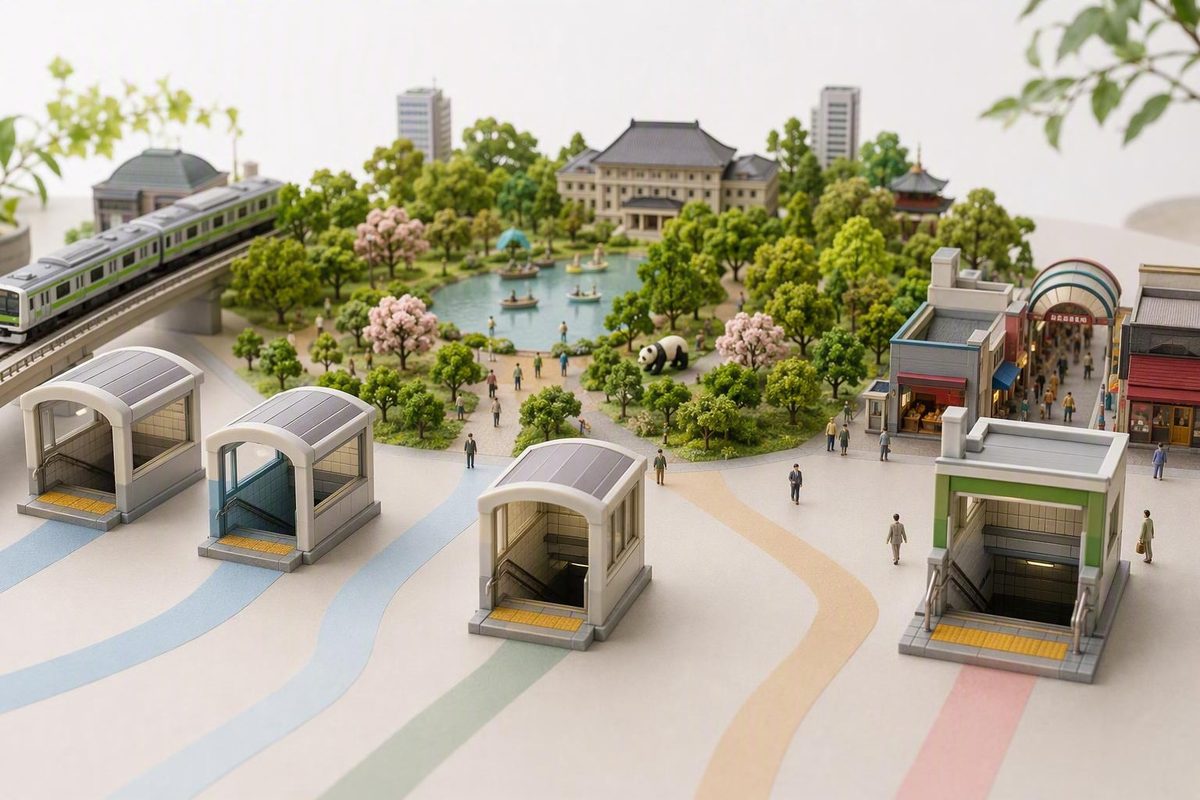
Tokyo Metro Exits 7–9 reach Ueno Park and Exit 5b reaches Ameyoko; JR's Park Gate and Shinobazu/Hirokoji exits are third-party guidance to verify on site.
Coming in on the Ginza or Hibiya line, take Tokyo Metro Exit 7, 8, or 9 for Ueno Park and Exit 5b for Ameyoko; both are listed on Tokyo Metro’s Ueno station page. Coming in on JR, the best available guidance is an undated third-party Ueno Station guide that points to the Park Gate and then the third-floor Park Exit for the park, and the Shinobazu or Hirokoji exits for Ameyoko. Those JR directions have not been confirmed against readable labels on JR East’s current maps, so treat them as a plan and confirm on the signs inside the station. Keisei Ueno is a separate station with its own exits; none of the numbers or names above apply inside it.
Pick your arrival operator and destination; the exit and its evidence basis update below.
Ueno Station Exit Finder
JR: Park Gate, then Park Exit on 3F
Basis: third-party Ueno Station guide (japan-bullettrain.com), not confirmed against readable labels on JR East's current maps.
Two stages: pass the Park Gate ticket gate first, then follow signs to the Park Exit on the third floor. Confirm the park-facing direction on the signs before leaving.
Step-free: no source here confirms a step-free path to this destination. JR East's Ueno maps (1F–M2, 2F, 3F, B4–B1) mark elevators and accessible slopes; Tokyo Metro's Feb 2023 exit table does not establish street-level elevator access at Exits 7, 8 or 9. Check the current operator map and ask staff.
All operator and destination pairs
| Operator | Destination | Exit | Basis |
|---|---|---|---|
| JR | Ueno Park, zoo, museums | Park Gate → Park Exit (3F) | Third-party guide; verify on JR signs |
| JR | Ameyoko | Shinobazu Exit or Hirokoji Exit | Third-party guide; neither confirmed best |
| Tokyo Metro | Ueno Park, zoo, museums | Exit 7, 8 or 9 | Tokyo Metro (rev. Feb 2023) |
| Tokyo Metro | Ameyoko | Exit 5b | Tokyo Metro (rev. Feb 2023) |
| Keisei | Either | — | Keisei map or staff |
Sources: Tokyo Metro Ueno station information (exit table revised Feb 2023); japan-bullettrain.com Ueno Station guide (undated, third-party); JR East Ueno Station guide maps. — means no exit is named in the sources.
Which Ueno Station You Are Standing In
“Ueno Station” covers facilities run by JR East and Tokyo Metro, and Keisei Ueno sits nearby as a third station. Their gates, maps, and exit labels are not interchangeable, so the operator you arrived with decides which instruction applies.
| Facility | Rail services | Exit system |
|---|---|---|
| JR Ueno Station | JR conventional lines and Shinkansen | Named gates and exits |
| Tokyo Metro Ueno Station | Ginza Line G16, Hibiya Line H18 | Numbered exits |
| Keisei Ueno Station | Keisei Main Line and Skyliner | Keisei signs and exits |
If you arrived on the Yamanote Line, another JR conventional service, or a Shinkansen, stay inside JR’s signage. If you arrived on the Ginza or Hibiya line, follow Tokyo Metro’s numbered exits; Tokyo Metro identifies Ueno as G16 and H18. If you arrived on Keisei, use the Keisei map and its street exits, and do not search there for JR’s Park Gate or Tokyo Metro Exit 5b.
JR uses named gates and exits; Tokyo Metro uses numbered exits. Keep the operator name attached to every instruction you write down. For JR passengers, a gate and a street exit can be two different stages. The Park Gate and the Park Exit are not two names for one door. For Tokyo Metro passengers, the exit number is the street-facing instruction.
JR Ueno to Ueno Park: Park Gate, Then the 3F Park Exit
The third-party guide describes the JR park route as two consecutive stages: follow JR signs to the Park Gate, pass through the ticket gate, then continue to the Park Exit on 3F and confirm the park-facing direction on the station signs before leaving.
The floor matters. Do not assume the park-facing exit must be at ground level because the park is outdoors; in this guidance JR Ueno’s park side is reached from the third floor.
JR East publishes an official Ueno Station map set covering 1F–M2, 2F, 3F, and B4–B1. The route above has not been checked against readable labels on those maps, so it is planning guidance, not a substitute for the current JR signs.
After you leave on the park side, check where your actual venue sits. Ueno Park covers a broad cultural area rather than one compact entrance. Museums, galleries, shrines, Ueno Zoo, and the cherry-blossom areas are spread across it, so the final walking direction depends on the destination, not on the exit. The GO TOKYO guide to Ueno covers both the park and market sides.
Tokyo Metro to Ueno Park: Exits 7, 8, and 9
Tokyo Metro’s station information lists Exits 7, 8, and 9 for Ueno Park, Ueno Zoo, and the major museums. It also orients each one against the JR station:
| Tokyo Metro exit | Faces |
|---|---|
| Exit 7 | JR Ueno’s Shinobazu Exit |
| Exit 8 | JR Main Exit and Central Gate |
| Exit 9 | JR Asakusa Exit and Main Exit area |
These are not three identical doors to one attraction. The zoo, museums, and shrines sit at different points around the park, so check your venue’s position before choosing among 7, 8, and 9.
Tokyo Metro’s exit table carries a February 2023 revision date. That supports the destination relationships above; it does not prove that every exit, elevator, or temporary route is unchanged on your travel day. The live station signs remain the final authority.
Tokyo Metro to Ameyoko: Exit 5b
Use Exit 5b. It is the exit Tokyo Metro’s Ueno exit information associates with the market.
At street level, the elevated JR tracks are the orientation point. Ameyoko runs from the Ueno side toward Okachimachi beneath and alongside those tracks. Rather than looking for one market entrance, work out whether your shop or restaurant is closer to the Ueno end or the Okachimachi end.
JR Ueno to Ameyoko: Shinobazu or Hirokoji Exit
The same third-party guide names both the JR Shinobazu Exit and the JR Hirokoji Exit as useful for Ameyoko. It does not establish either as the best exit for the whole market, and other commercial guidance differs about which JR route to prefer.
Use either as a working choice and confirm on the current JR map or signs. Do not assign one exit to a particular part of the market without knowing where your shop, restaurant, or meeting point is.
The Shinobazu side also orients you toward Shinobazu Pond and the general direction of Keisei Ueno. Once outside, find the elevated tracks and the market streets running toward Okachimachi.
Ameyoko is a dense shopping and eating area with food stalls, restaurants, seafood and grocery sellers, souvenir shops, clothing stores, and other retailers. It stretches between the Ueno and Okachimachi sides rather than starting at one precise doorway. If your destination is near the far end, compare arriving at Okachimachi Station instead of walking the length of the market from Ueno. The better arrival point depends on the address, not on one Ueno exit being best for the entire market.
Keisei Ueno Uses Its Own Exits
Keisei Ueno is a separate terminus for the Keisei Main Line and Skyliner. On arrival, orient with the current Keisei station map, exit signs, or staff guidance. The sources used here name no specific Keisei exit for either the park or the market, so this article does not assign one.
Shinkansen Arrivals, Luggage, and Step-Free Routes
JR Ueno’s Shinkansen platforms are underground. After a bullet-train arrival, ascend through JR Ueno and follow signs toward the side of the station you need. Do not start looking for a Tokyo Metro exit number while still inside the JR Shinkansen area.
No fixed platform-to-exit time is given here, and none should be relied on. The effort varies with the arrival platform, crowds, luggage, and which lifts or escalators are running. Leave enough room to correct a wrong turn.
JR East’s Ueno maps mark gates, elevators, escalators, stairs, accessible slopes, restrooms, information points, and coin lockers across 1F–M2, 2F, 3F, and B4–B1. They are the right starting point for checking the relevant levels, but the readable text does not establish a complete step-free path to either Ueno Park or Ameyoko. On the Tokyo Metro side, the supplied information does not establish street-level elevator access at Exits 7, 8, or 9, and the February 2023 revision date means a current check is worth making before travel.
If you use a wheelchair, have a stroller, or are carrying heavy luggage, check the current JR East or Tokyo Metro station map before departure, review live service information for elevator or exit disruptions, and ask station staff for the available route if a lift or corridor is closed. The shortest-looking path is not necessarily step-free.