
Find a Tokyo Capsule Stay That Fits Your Route
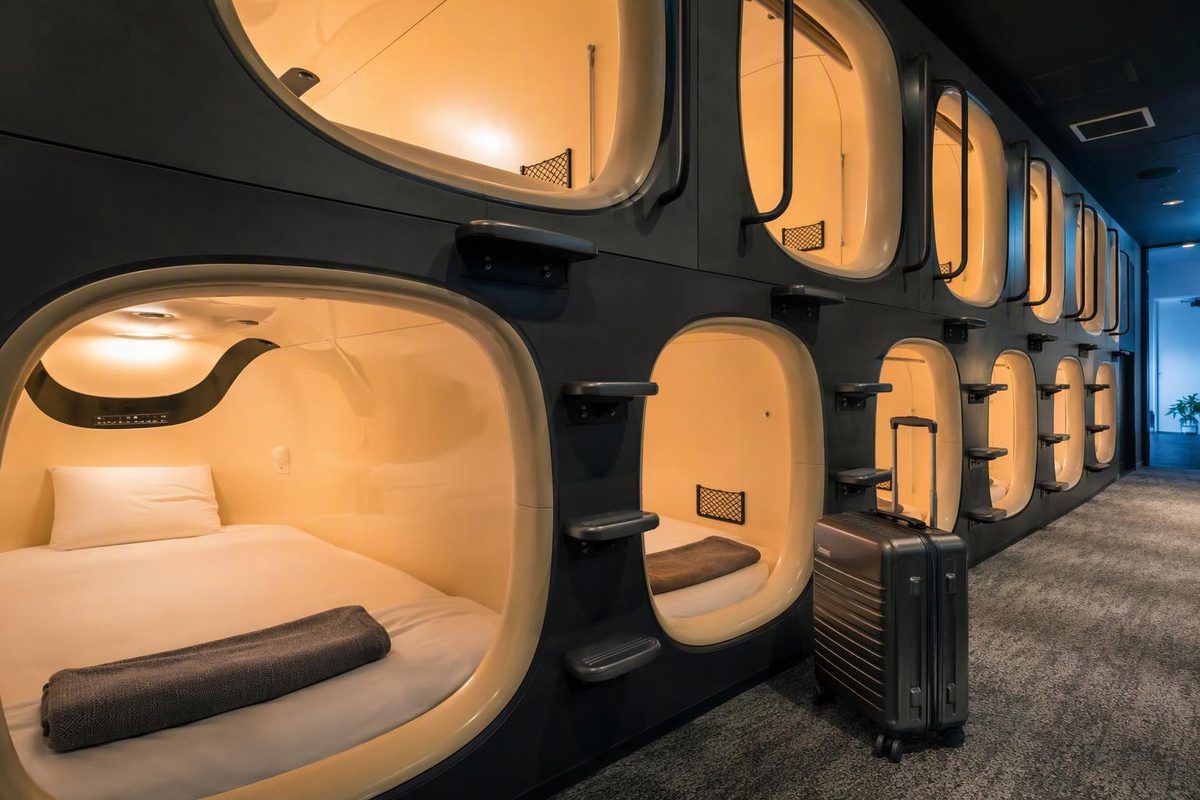
Compare Tokyo capsule hotels by neighborhood, pod layout, luggage storage, gender rules and airport access before booking a solo overnight stay.
A Tokyo capsule hotel is a good fit for a solo traveler who values location over a private bathroom. It works particularly well for one night near an early flight, after a late arrival or between longer hotel stays. Choose a business hotel instead if you need a lockable room, a private bathroom, reliable quiet or comfortable two-person occupancy.
The useful distinction is not simply capsule hotel versus normal hotel. Tokyo has conventional stacked pods, taller cabin-style units and hostel-like cabins with shared lounges. Choose the format and neighborhood first, then compare the final price with a nearby business hotel.
Choose your route, party size and privacy requirement; the tool will suggest the most suitable starting point.
Capsule Stay Picker
Check the exact station, luggage dimensions, gender arrangement and total price before booking.
Source basis: property details from First Cabin Haneda Terminal 1, The Millennials Shibuya and Resol Poshtel Tokyo Asakusa; indicative capsule pricing from GO TOKYO.
Match the Capsule Format to the Trip
| Your Priority | Start With | Main Trade-Off |
|---|---|---|
| Early Haneda flight | First Cabin Haneda Terminal 1 | It may not match your departure terminal |
| Shibuya nightlife and standing room | The Millennials Shibuya | Premium features may reduce the saving |
| Asakusa sightseeing or a small group | Resol Poshtel Tokyo Asakusa | Its nearest Asakusa station is on Tsukuba Express |
| Classic capsule experience | A stacked-pod property near your final stop | Less room and more exposure to noise |
| Privacy, quiet or two-person occupancy | A business hotel | Less novel, but operationally simpler |
Do not choose by the word “Tokyo” in a listing name. Plot the property’s actual station and entrance, then check the walk from the railway line you expect to use. A pod beside your final stop can be more useful than a cheaper one requiring another late-night transfer.
A Capsule Is a Bed-Sized Space, Not a Private Room
Tokyo’s official tourism guide describes the standard arrangement as rows of bed-sized pods with shared toilets and bathing facilities. Belongings are usually stored in a locker. It gives ¥2,000–¥5,000 as an indicative nightly range but warns that peak-season prices can be higher (GO TOKYO). Treat that range as orientation, not a quote: search your exact date and compare the tax-inclusive total.
The entrance to the sleeping space typically closes with a curtain or screen rather than a lock. First Cabin says its standard cabins cannot be locked, although each has a lockable safety box. Bathrooms and toilets are shared, sound can carry through the curtain, and its standard cabins accommodate one person (First Cabin).
Check the exact property page before paying. Capsule brands can operate different layouts and policies at different branches.
- Gender arrangement: Confirm whether the property is male-only, female-only, divided into separate floors or mixed.
- Pod access: Check for an upper or lower berth if climbing is a concern. A full-height cabin avoids the stacked layout but is still not necessarily a lockable room.
- Luggage: Look for locker dimensions, separate suitcase storage and the permitted storage hours before check-in and after checkout.
- Bathing: Establish whether the property has private shower stalls, a communal bath or both.
- Consecutive nights: Some properties require guests to vacate the sleeping area or move belongings during daytime cleaning.
- Noise and airflow: Check quiet hours, the type of pod closure and whether ventilation can be adjusted.
A safe inside the pod is not the same as suitcase storage. If dimensions are not published, ask the property before arriving with checked luggage.
First Cabin Haneda Terminal 1 Simplifies One Airport Night
First Cabin is on the first-floor arrivals level inside Haneda Terminal 1. Check-in is listed from 2 p.m. and checkout at 10 a.m., although the booked plan may differ. Business Class cabins measure 1.2 by 2.1 metres and are 2.1 metres high. First Class cabins provide 4.4 square metres of floor area. Both are single-occupancy cabins with shared facilities (First Cabin Haneda Terminal 1).
Check your airline and departure terminal before booking. Haneda provides a free inter-terminal shuttle, but an overnight stay in Terminal 1 is not the same as sleeping beside a Terminal 2 or Terminal 3 departure. Current shuttle stops and operating times are published by Haneda Airport.
The hotel says Terminal 1 closes from 12:30 a.m. to 4:45 a.m. Guests use a dedicated night entrance near bus stop 8 during that period. This branch also cannot store luggage after checkout because of airport regulations.
Those constraints make First Cabin Haneda Terminal 1 an airport-night solution rather than a general sightseeing base. It is strongest when the location removes an awkward early journey and the lack of post-checkout storage does not affect the rest of your day.
The Millennials Shibuya Provides Room to Stand and Open Luggage
The Millennials uses a full-height, 3-square-metre SmartPod rather than a stacked capsule. The operator specifies a 120-centimetre-wide reclining bed, enough floor height to stand when the bed is in sofa mode, and an under-bed drawer intended to hold a large open suitcase (The Millennials Shibuya).
That design addresses three common capsule-hotel problems: nowhere to change, nowhere to open a case and nowhere comfortable to sit. It suits a solo traveler whose evening ends in Shibuya but who does not want a low stacked pod.
The trade-off is price. No current rate is supplied here because it depends on the stay date. Compare the live tax-inclusive total with a basic private room in Shibuya rather than assuming every pod is the budget option.
Save the walking route before arrival so you emerge on the correct side of the station. The Shibuya station and one-day route explains the area’s main exits and landmarks.
Resol Poshtel Works for Asakusa and Groups of Five to 12
Resol’s cabins are 2.7 square metres, with beds listed at 90–130 centimetres wide. Guests can choose men-only, women-only or shared floors. Groups of five to 12 can reserve an entire cabin block (Resol Poshtel guest rooms). Coin laundry, a microwave, vending machines and an ice maker are listed among the facilities (Resol Poshtel facilities).
The navigation catch is the station name. The hotel is two minutes on foot from Tsukuba Express Asakusa Station, about five minutes from Tawaramachi on the Ginza Line and about nine minutes from the Ginza/Asakusa Line Asakusa Station, according to its official access page. These are separate stations, not interchangeable entrances to one complex.
For a Sensoji-focused stay, the location can still be practical. Match the hotel to the line you will actually use rather than relying on the shared “Asakusa” name. The Sensoji route and station guide connects the arrival options to the area’s main walking route.
A Business Hotel Usually Works Better for Two Travelers
Choose a capsule hotel for an efficient solo overnight when shared washrooms and a non-locking sleeping compartment are acceptable. Choose a hostel if a particular property offers the social space, kitchen or dorm arrangement you want. Choose a business hotel when you need a lockable private room, your own bathroom, two-person occupancy or somewhere to take calls.
For two travelers, compare the total rather than the per-person headline. Two pods can approach the cost of one compact double or twin room. Some properties may also place guests on separate gender floors, making the capsule format less convenient for a couple or pair traveling together.
Families must check the age rule of the exact property. First Cabin, for example, does not accept children under 12 and requires a parental consent form when a guest aged 13–18 stays without an adult (First Cabin). That policy should not be assumed to apply to every capsule operator.
For a longer trip, consider using a capsule only for an airport night or late finish, then moving to a private room in the neighborhood that fits the itinerary. The Tokyo neighborhood comparison weighs airport access, station complexity and trip style.
Check the Exact Branch Before Paying
Compare the refundable, tax-inclusive price for your dates with nearby business hotels. The indicative ¥2,000–¥5,000 range does not establish the rate for a particular property or date.
Confirm the branch’s gender and age rules, along with upper- and lower-berth availability. Read the luggage policy closely if you need to leave a suitcase before check-in or after checkout. First Cabin Haneda Terminal 1, for example, says it cannot provide post-checkout storage because of airport regulations.
Check whether private shower stalls are available if you do not want to use a communal bath. Travelers with tattoos who plan to use a communal bath should ask the property for its current bath policy rather than assuming access.
Keep valuables in the supplied safe or locker because a curtain or screen is not security. Sound can pass between sleeping spaces, so earplugs and a vibrating alarm are more practical than relying on the pod to block noise.
Finally, verify the railway line as well as the station name and save the route from the correct exit. The right Tokyo capsule hotel is the one that removes a difficult transfer, accommodates your luggage and supplies enough privacy for the night—not necessarily the newest pod or the lowest headline rate.